



How Mission Aagaman, Skyroot Aerospace, and Vikram-1 Could Transform India’s Economy, Security, and Technological Future
“The greatest revolutions don’t begin with an explosion. They begin with an ignition.”
Once upon a time, the oceans separated civilizations. Whoever mastered the seas controlled trade, wealth, and history. Then came the age of aviation, where the skies became the highways of globalization. Today, humanity is standing at the threshold of yet another epoch. One where the ultimate marketplace lies not on Earth, but in orbit.
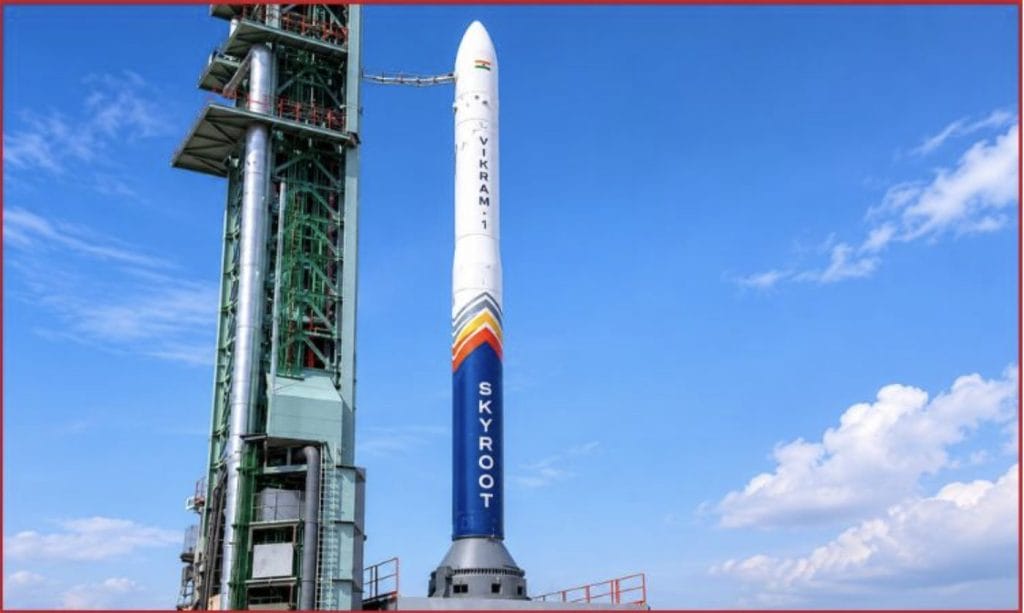
On 3 July 2026, as Skyroot Aerospace’s Vikram-1 prepared for its much-awaited Mission Aagaman, millions saw another rocket on a launch pad. Engineers, economists, military strategists, and investors, however, saw something far more profound. The emergence of a new economic frontier where private enterprise and cutting-edge engineering converge to redefine India’s place in the world.
More than a simple story about a rocket, this is the story of India’s transformation from being a respected spacefaring nation into a contender in the trillion-dollar commercial space economy.
The next frontier is now open for business.
Mission Aagaman: More Than a Launch
The Sanskrit word “Aagaman” means arrival. And, the choice couldn’t have been more symbolic. For nearly six decades, India’s space aspirations were driven almost exclusively by ISRO, whose remarkable achievements, from launching satellites at record-low costs to Chandrayaan and Aditya-L1, earned worldwide admiration. Yet every mature ecosystem eventually reaches a point where government institutions alone cannot sustain exponential growth.
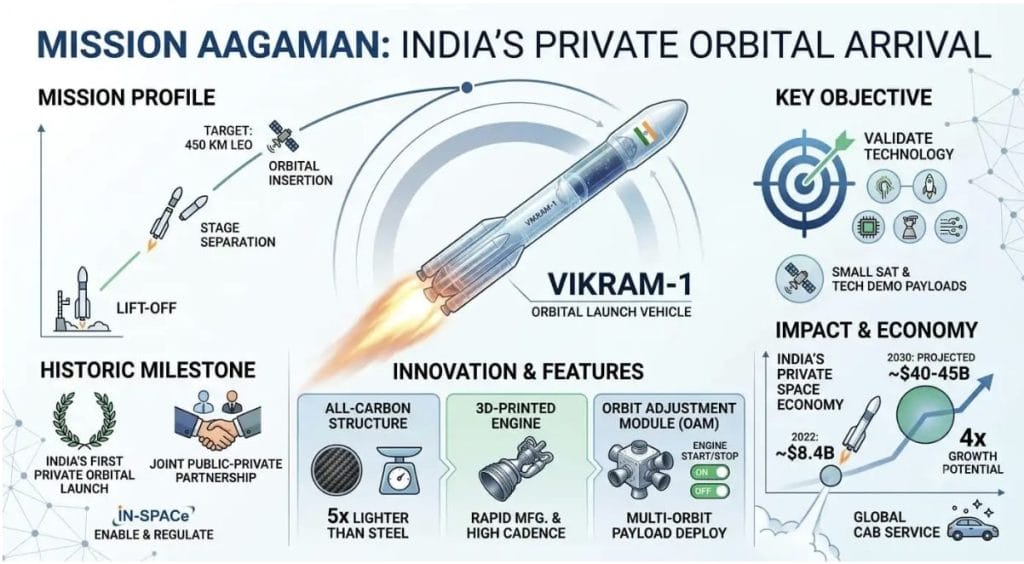
Innovation needs competition > competition attracts investment > investment accelerates innovation. That virtuous cycle is exactly what Mission Aagaman represents. It signals the arrival of India’s commercial space age.
Instead of governments doing everything themselves, private companies will increasingly design rockets, build satellites, manufacture engines, develop reusable launch systems, analyze space data, and even offer services in orbit. If ISRO built India’s highway to space, startups like Skyroot are beginning to fill that highway with commercial traffic.
Vikram-1: A Rocket Built for the New Space Age
Unlike the colossal launch vehicles that dominate headlines, Vikram-1 is designed with a different philosophy. Think of traditional heavy-lift rockets as massive cargo ships carrying hundreds of containers across oceans. Vikram-1 is more like an agile express courier. It is smaller, faster, flexible, and optimized for delivering satellites exactly where customers want them. Capable of placing hundreds of kilograms into Low Earth Orbit (LEO), Vikram-1 targets one of the fastest-growing segments of the global launch market: small satellites.
Why small satellites?
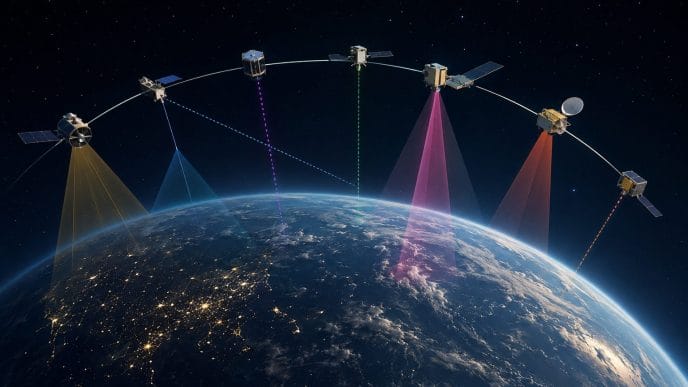
Because the modern digital economy thrives on constellations rather than single giants. Instead of relying on one enormous satellite costing hundreds of millions of dollars, companies now deploy hundreds, or even thousands, of miniature satellites working together like a swarm of intelligent bees. These constellations power satellite internet, precision agriculture, weather forecasting, disaster management, environmental monitoring, global logistics, autonomous vehicles, and military surveillance
As demand for these services grows exponentially, so does the need for affordable, reliable launch vehicles. That is precisely the market Vikram-1 aims to serve.
India’s Biggest Advantage Isn’t Money
When discussing technological superpowers, people often assume success depends primarily on massive budgets. Not always. India’s greatest competitive advantage has never been unlimited capital. It has been engineering efficiency.
For decades, Indian scientists and engineers have perfected the art of achieving extraordinary outcomes with limited resources. The Mars Orbiter Mission’s global fame is attributed to its ability to reach Mars within a budget lower than many Hollywood movies. That philosophy now extends to private industry.
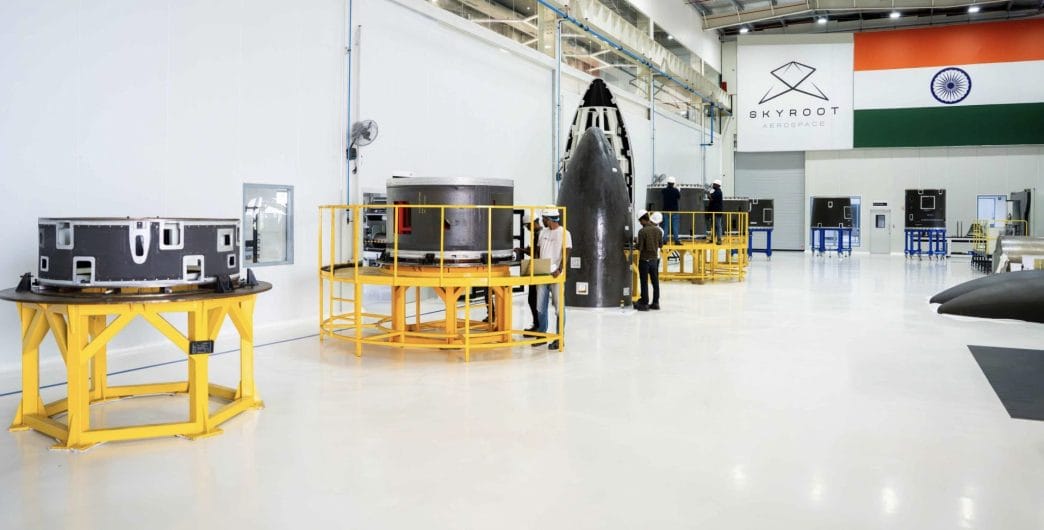
Companies like Skyroot leverage advanced composite materials, additive manufacturing (3D printing), digital simulation, AI-assisted engineering, lean manufacturing, and modular rocket architecture towards an impressive result. Reduced production costs, shorter development cycles, faster launches, and greater commercial competitiveness.
From Government Monopoly to Innovation Ecosystem
Until recently, India’s space sector resembled a magnificent cathedral. It was beautiful, powerful, highly respected, but difficult for outsiders to enter. The reforms initiated over the past few years have changed that equation dramatically. Organizations like IN-SPACe and NewSpace India Limited (NSIL) have opened the doors for startups, universities, and private industries. Instead of competing against ISRO, these companies collaborate with it. ISRO provides decades of accumulated knowledge. Private firms contribute speed, specialization, risk-taking, and entrepreneurial energy.
The outcome is an ecosystem rather than a monopoly.
Today, India boasts hundreds of space startups working to build this ecosystem. They are designing launch vehicles, propulsion systems, Earth observation, satellite manufacturing, robotics, AI-driven analytics, communications, and space applications. All this demonstrating that innovation, much like a forest, flourishes best when many different species grow together.
The Rules of the Space Race Have Changed
The twentieth-century space race was largely political. It was America versus the Soviet Union. The objective was prestige. Plant the flag, win the ideological battle, demonstrate technological superiority. The twenty-first century operates under entirely different rules.
Today’s competitors include governments and private enterprises. NASA collaborates extensively with SpaceX, and Europe encourages commercial launch providers. Meanwhile, China aggressively nurtures private aerospace firms alongside its state-led program, and Japan and South Korea are expanding commercial capabilities. And, now, India has now joined this new chapter.
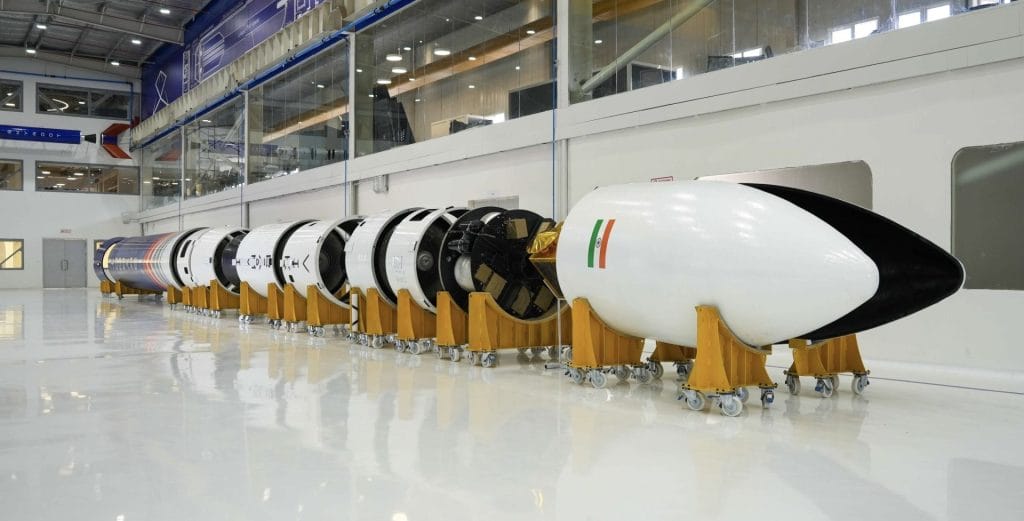
Launch cadence is becoming as important as launch capability. The competition has become about who reaches orbit more frequently, more affordably, and more reliably. The future belongs not to those who launch spectacularly once a year, but to those who can launch routinely every week. As aerospace analysts often say: “Every rocket is a supply chain wrapped in fire.”
Building one successful rocket is difficult. Building hundreds reliably is industrial excellence.
Space: The New Economic Infrastructure
Many still imagine space as astronauts floating gracefully inside orbiting laboratories. That image, while inspiring, tells only a fraction of today’s reality. Modern economies increasingly depend on space infrastructure. Every time you use GPS, order food through a delivery app, withdraw money from an ATM, watch satellite television, track a cyclone, monitor crops, or make an international phone call, chances are satellites are quietly working in the background.
Space has become invisible infrastructure. Just as roads carry vehicles, satellites carry information. And information has become the world’s most valuable commodity. Experts estimate the global space economy could surpass one trillion dollars within the next decade. This expansion is largely driven by satellite services, communications, Earth observation, manufacturing, defense, and emerging industries like in-space servicing.
India doesn’t need to dominate every segment. Even capturing a modest share could generate billions of dollars in exports, create high-value jobs, stimulate advanced manufacturing, and strengthen national technological sovereignty. In other words, rockets have crossed the stratosphere, where they were just scientific achievements, and are now evolving into economic engines.