



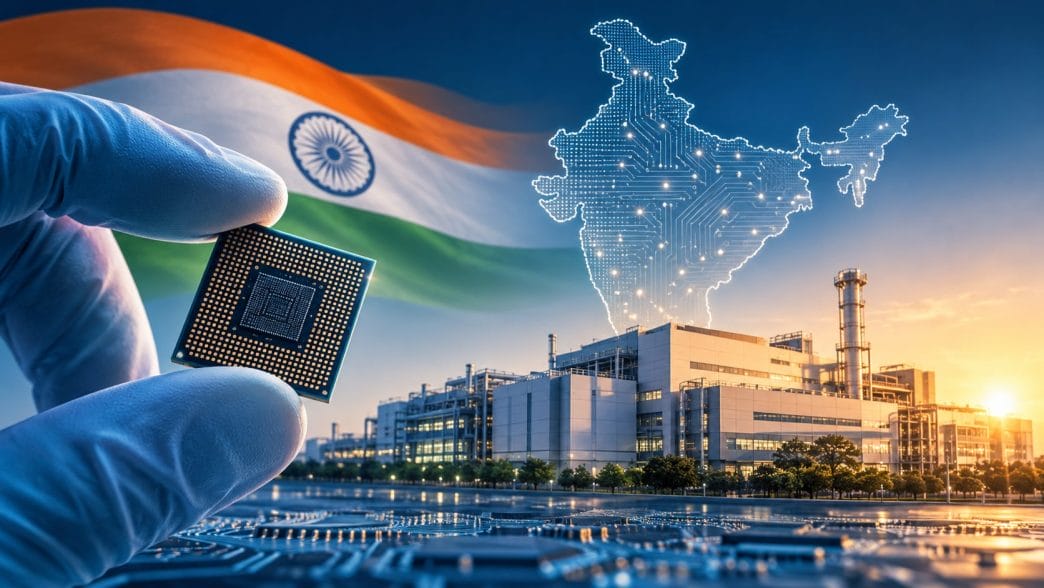
Semiconductors are the invisible engines of the modern world. They power smartphones, computers, EVs, telecom networks, satellites, defense systems, and AI infrastructure. For decades, India was one of the world’s largest consumers of chips but played only a limited role in making them. That is now changing. India is attempting one of the most ambitious industrial transformations in its history: to evolve from a design and consumption base into a semiconductor manufacturing hub with a full ecosystem spanning fabrication, packaging, testing, materials, equipment, and chip design.
This shift is not happening overnight. Semiconductor manufacturing is one of the most complex industries on earth, requiring massive capital, world-class infrastructure, highly specialized talent, and a deeply integrated supply chain. But India has begun building the right foundations. With strong domestic demand, a large engineering talent pool, and growing government support, the country is positioning itself for a long-term role in the global chip race.
The Starting Point
India’s semiconductor journey did not begin from zero. For years, the country has been a global powerhouse in chip design, embedded engineering, and software-driven electronics development. Many multinational companies already rely on Indian engineers for designing and verifying chips, even if the physical manufacturing happens elsewhere. This gave India a strong intellectual base, but not the industrial base needed for fabrication.
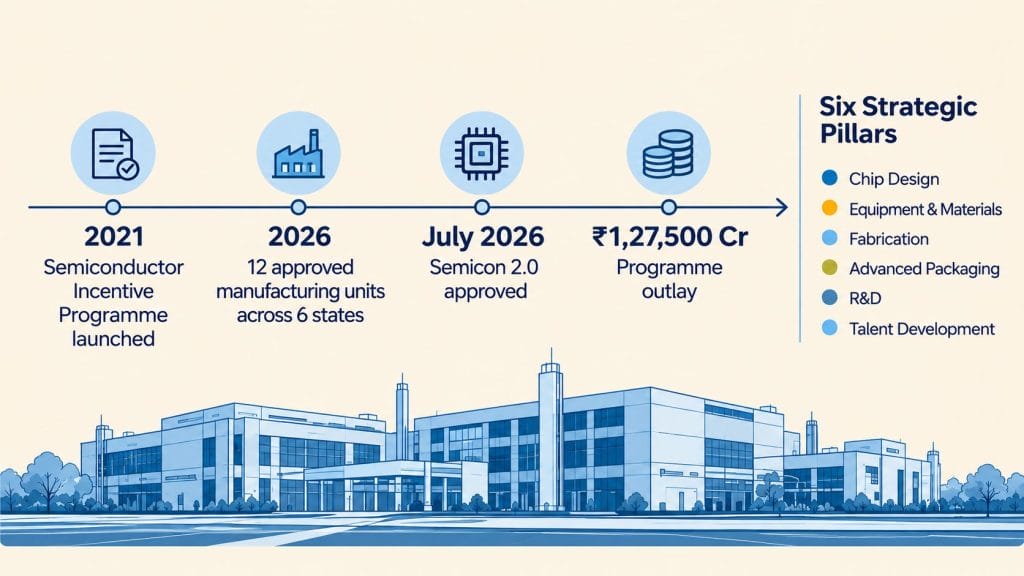
The gap was evident. India imported most of its chips and relied heavily on foreign supply chains for critical electronic components. That made the country vulnerable to global disruptions, geopolitical tensions, logistics shocks, and shortages, especially during periods like the pandemic and the recent global chip crunch. The policy response began with the semiconductor incentive push in 2021 and later expanded into a more comprehensive industrial strategy.
The Turning Point
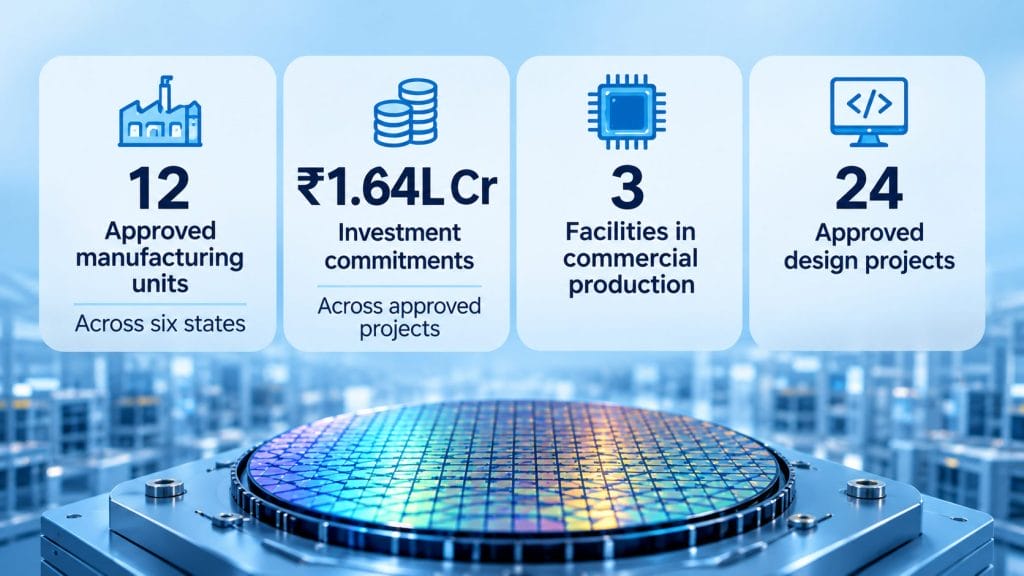
The real turning point came with the government’s semiconductor mission, which sought to create an environment where fabs, assembly plants, packaging units, and design companies could set up operations in India. The first phase laid the groundwork by offering fiscal support and attracting early projects. By 2026, India had approved 12 semiconductor manufacturing units across six states, with investment commitments exceeding ₹1.64 lakh crore.
The launch of Semicon 2.0 marked a bigger and more mature step. Approved in July 2026, the programme has an outlay of ₹1,27,500 crore and focuses on six pillars: chip design, semiconductor equipment and materials, fabrication facilities, advanced packaging, research and development, and talent development.
This is important because India is no longer trying to build only isolated factories. It is trying to create an entire ecosystem that can support semiconductor manufacturing over the long term.
What Has Been Achieved
The progress so far is real, even if the industry is still in its early stages. According to government statements, three semiconductor facilities have already started commercial production, marking the transition from policy to output. In addition, 24 semiconductor design projects have been approved, and 105 start-ups and MSMEs have been given access to EDA tools, which lowers the barrier for innovation in chip design.
India’s push is also visible in the packaging and testing segment, which is often the fastest way to build semiconductor manufacturing capability. ATMP and OSAT facilities are crucial because they are less capital-intensive than leading-edge fabs and can be commercialized faster. They also help build experience in high-precision manufacturing, quality control, and supply-chain coordination. In other words, India is not trying to leap straight to the most advanced node; it is climbing the semiconductor ladder step by step.
Why India Matters
India matters in the semiconductor world for three reasons. First, it has a very large domestic market for electronics, automobiles, telecom equipment, consumer devices, and industrial systems.
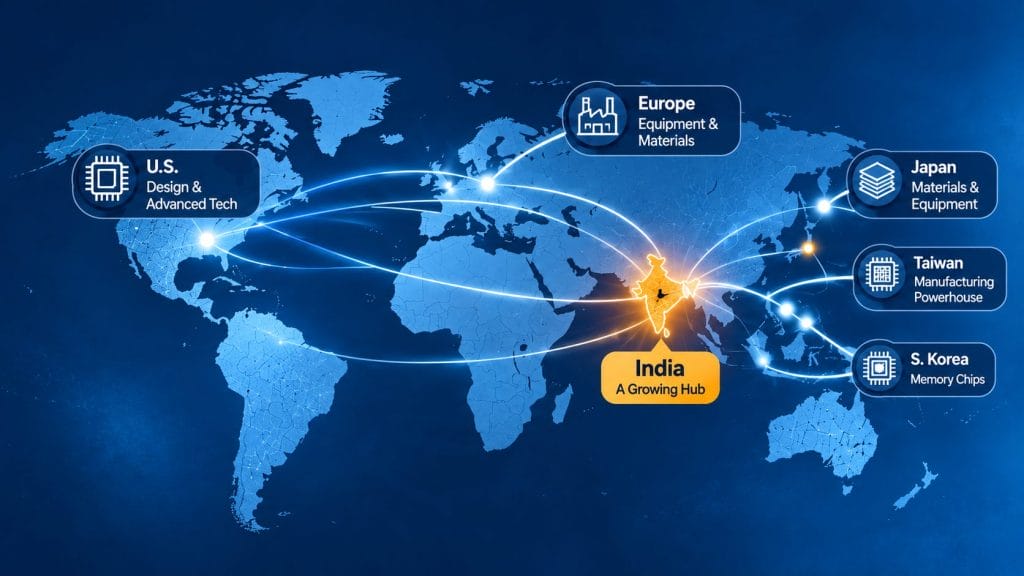
Second, it has one of the world’s strongest engineering talent pools in design, software, and systems integration. Third, it offers a strategic alternative for companies that want to diversify their manufacturing away from overconcentrated regions.
The government estimates that India’s semiconductor market could grow from about $38 billion in 2023 to $100–110 billion by 2030. That scale matters because manufacturing follows demand. If India can absorb more chips at home while also building export capability, it can become both a production base and a market hub. That combination is what gives the country strategic relevance in the global supply chain.
Global Challenges
The semiconductor industry has a unique set of global bottlenecks. It is highly concentrated, with only a few countries and companies dominating critical stages such as lithography, wafer fabrication, materials, and equipment. This concentration creates geopolitical risk, especially when trade tensions, export restrictions, or regional disruptions affect supply.
Another challenge is the enormous cost of entry. A modern fab requires billions of dollars in investment, strict process control, uninterrupted utilities, and years of learning before it becomes truly efficient. Even then, technology moves quickly, so a country has to keep reinvesting just to stay relevant. That is why semiconductor manufacturing is often described as a marathon run at sprint speed.
Supply chain dependence is another major issue. More than 90 percent of critical semiconductor equipment is still imported, and India also relies heavily on foreign sources for specialty chemicals, gases, wafers, and advanced tools. This means that even when a plant is physically located in India, many of its essential inputs still come from outside the country.
India’s Domestic Bottlenecks
India’s biggest domestic challenge is execution. The country has strong policy support, but building a semiconductor ecosystem is much harder than announcing one. The industry needs highly trained process engineers, cleanroom operators, materials experts, equipment technicians, and quality-control specialists. Reports have flagged a shortage of specialized semiconductor manufacturing talent, which is one of the biggest obstacles to scaling up.
Infrastructure is another bottleneck. Fabs require stable power, ultra-pure water, advanced waste management, and precision logistics. Any weakness in these areas can affect yield and product reliability. Additionally, India still has to strengthen domestic capacity in semiconductor-grade materials and equipment supply, which means the ecosystem is not yet fully self-reliant.
How India Is Overcoming It
India is responding with a layered strategy. The first layer is financial support. Semicon 2.0 and related incentives provide large-scale public backing to reduce the risk for investors and accelerate ecosystem creation. The second layer is cluster development, where multiple states are competing to attract fabs, packaging plants, and design centers, creating distributed industrial capability rather than relying on a single location.
The third layer is capability building. India is investing in R&D, design ecosystems, workforce training, and industry-led research centers to prepare a talent pipeline for the future. This is essential because semiconductor manufacturing is not just a factory problem; it is a science, engineering, and systems problem. The government is also encouraging global partnerships to bring in know-how from established semiconductor countries and equipment makers.
What Lies Ahead
The future of India’s semiconductor story will depend on whether the current momentum turns into deep industrial competence. The short-term goal is to strengthen packaging, testing, assembly, and mature-node manufacturing. These segments are commercially practical and can create immediate jobs, learning, and export potential.
The medium-term challenge is to localize more of the supply chain, especially materials, equipment sub-systems, and specialty chemicals. If India can reduce import dependence in these areas, the entire ecosystem becomes more resilient. In the long run, the biggest prize is the ability to design and manufacture chips for a wide range of domestic applications, from smartphones and appliances to automotive electronics and AI systems.
India is still a late entrant in a field dominated by decades-old ecosystems, especially in Taiwan, South Korea, Japan, the United States, and parts of Europe. But late entry is not the same as failure. With the right policy continuity, infrastructure investment, talent development, and global partnerships, India can still become a major semiconductor hub. The next few years will decide whether it becomes merely a strong player in packaging and design, or a full-spectrum chip manufacturing nation.