






Hundreds of kilometres over our heads, a war without sound is already underway — one where the first shot fired may not be a missile, but a blackout.
Somewhere above the troposphere, past the point where sound stops travelling and silence becomes total, a different kind of war has quietly begun. It has no front line, no smoke, no soldiers wading through mud. Its battlefield is a black vacuum ringed by machines the size of a refrigerator, moving at nearly eight kilometres a second. And its opening move, when it comes, will not look like an explosion. It will look like nothing at all. A phone that stops finding signal, a warship that loses its bearings, a radar screen that quietly goes blank.
That is the premise now driving one of the fastest reorganisations in Indian defence planning: the recognition that a modern military is only as strong as the satellites it depends on, and that those satellites are, for the first time, genuinely hunted.
The Blinding Problem
Every modern army fights through space before it fights on land. Navigation, troop movement, missile guidance, secure communication, early warning, all of it is quietly routed through a constellation of satellites that most citizens never think about. Take that constellation away, even for a few seconds, and a technologically superior force can be reduced to compasses and guesswork.
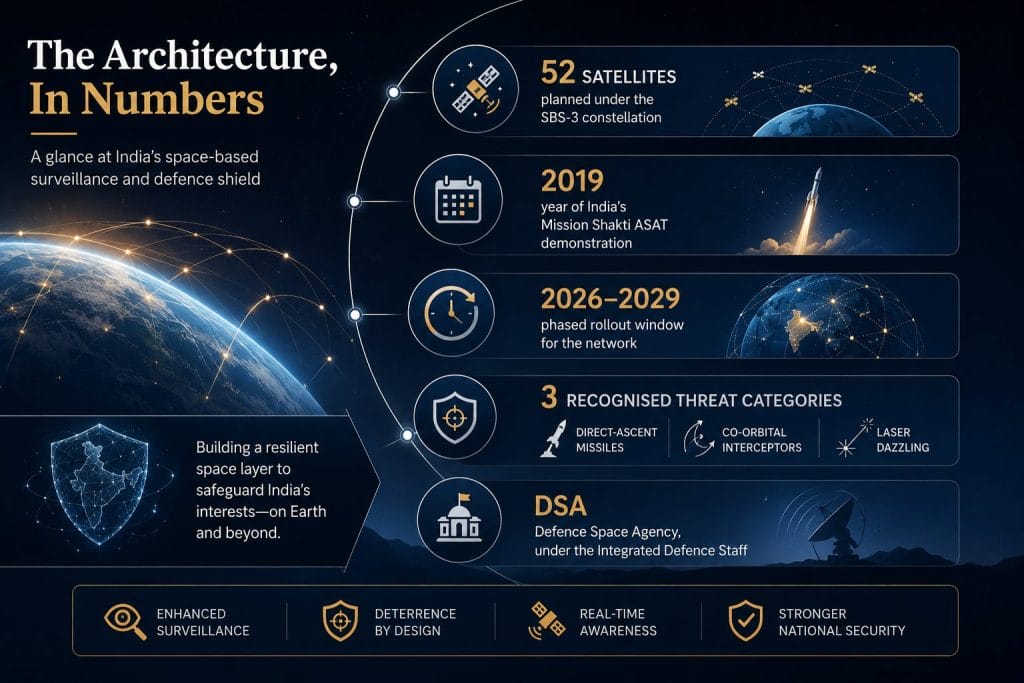
This is no longer theoretical. Military planners now speak openly of an era of kinetic and non-kinetic counter-space capabilities, in which direct-ascent anti-satellite missiles, co-orbital interceptors, and high-energy laser dazzling make any single, centralised satellite architecture inherently vulnerable. A handful of well-aimed strikes, or even a temporary jamming pulse, could blind an adversary’s eyes and ears in orbit before a single conventional shot is fired.
“India risks fighting blind if it fails to secure its interests in space.”
– General Anil Chauhan, Chief of Defence Staff (DefSpace Symposium, 2026)
India’s Answer: Don’t Put All Your Eyes In One Orbit
India’s response has been unusually candid for a country that has historically kept its space-defence posture understated. Since the 2019 Mission Shakti anti-satellite test first announced Indian capability in this domain, the conversation has shifted from demonstrating a single deterrent to building an architecture that simply cannot be blinded in one strike.
The centrepiece is the Space-Based Surveillance-3 programme, run under the Defence Space Agency operating under the Integrated Defence Staff of the Ministry of Defence. Under this programme, India is building toward a 52-satellite surveillance constellation approved by the Cabinet Committee on Security. The logic is deliberately unglamorous: instead of a few exquisite, expensive satellites that make tempting targets, spread the capability across dozens of smaller ones in a Proliferated Low Earth Orbit web. This was, the loss of a single node does not result in a strategic blackout.
It is the orbital equivalent of not keeping your entire war chest in one bank vault. Knock out one satellite, and the network simply routes around the hole. Operating the same way as the internet was originally designed to survive a nuclear strike on any one node.
The Doctrine Nobody Wants To Admit They Need
What makes this moment genuinely new is not the hardware. It is the doctrine catching up to it. For decades India treated space as ISRO’s department: rockets, weather satellites, disaster mapping, a source of quiet national pride rather than a battlefield. That framing is now openly obsolete.
As officials have started to acknowledge at forums like the DefSpace Symposium, the geopolitical climate now demands a “Space-First” defence posture. This mandates that that we treat orbital assets the way earlier generations treated tanks and aircraft carriers: as things that must be defended, camouflaged, and replaced faster than an adversary can destroy them.
This is also where the transcript’s central, unsettling question earns its weight:
if a country’s communications, navigation, and radar could all go dark within a single second, would its military still be able to take a step forward?
The honest answer, for most conventional forces today, is no — not without rehearsed fallbacks. Which is precisely why the current build-out is happening in public view rather than in a classified annexe. Deterrence, in this domain, works partly by being seen.
The Stakes Beyond The Hardware
None of this is unique to India. It is a part of a broader pattern across the Indo-Pacific region. Heightened geopolitical competition between major powers has driven the development and deployment of counter-space and electronic warfare capabilities. Due to this, even regional blocs are exploring joint frameworks to keep the domain from tipping into open conflict.
What is unique is the speed at which India has moved from spectator to builder, from a country that once treated space purely as a civilian achievement to one now writing an explicit military doctrine for it.
The silence above us, in other words, is not empty. It is being filled – quietly, deliberately, and on a timeline measured in single years rather than decades – with the infrastructure of a war that everyone hopes never has to be fought, but that no serious power can now afford to lose by default.
Reporting drawn from Ministry of Defence briefings, DefSpace Symposium 2026 proceedings, and open-source defence analysis. This piece discusses publicly disclosed strategic doctrine only; no operational or technical specifications are described.