



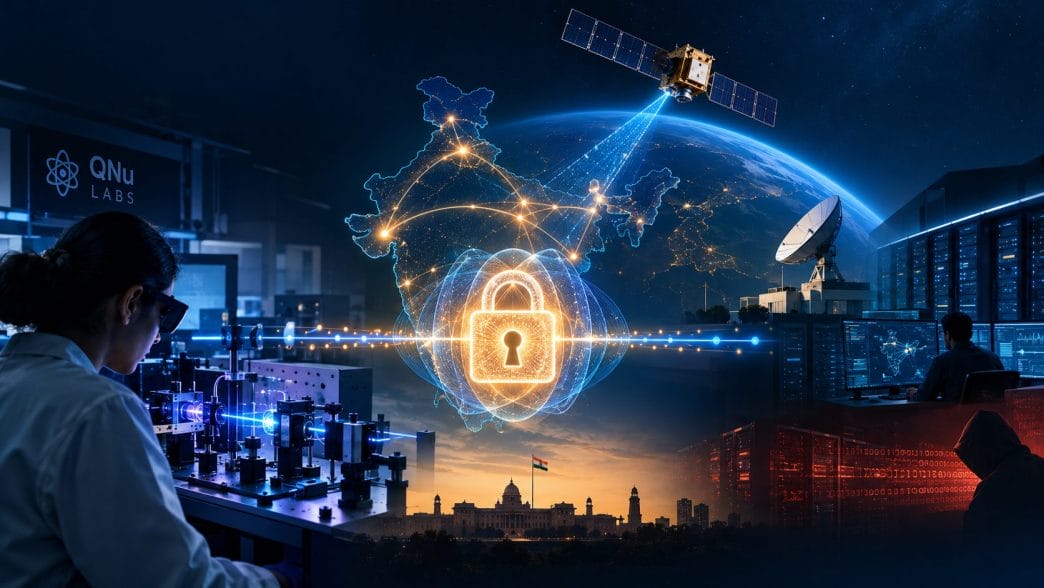
Somewhere between a lab in Bengaluru and a satellite yet to launch, India is building a lock that physics itself guards, because the encryption protecting your bank, your army and your government is already living on borrowed time.
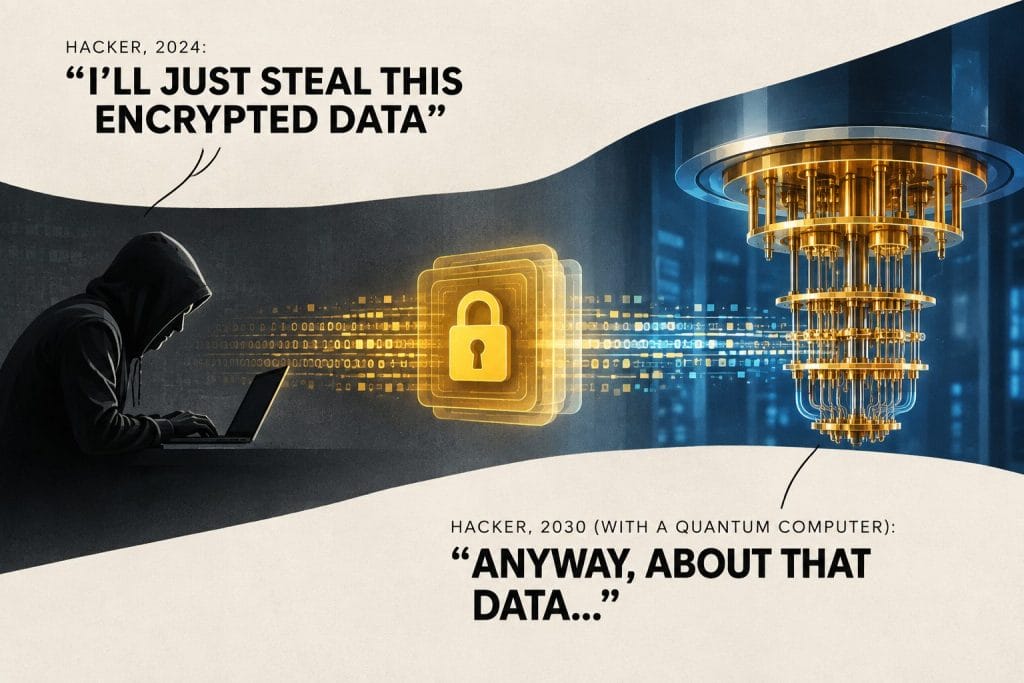
There is a clock running right now that almost nobody can see, and almost everyone should worry about. Security researchers call it “Q-Day”: the day a sufficiently powerful quantum computer switches on and every lock built on today’s public-key encryption quietly stops working. Nobody knows the exact date. But intelligence agencies aren’t waiting to find out. They are already hoovering up encrypted traffic today, storing it in cold servers, betting that tomorrow’s quantum machine will crack it open. The strategy has a name: harvest now, decrypt later. And it is the single biggest reason a quiet, unglamorous field called Quantum Key Distribution has turned into one of the most contested technologies in the world.
Locks Guarded by Physics, Not Math
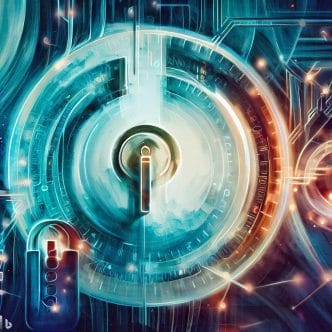
Every encryption system in use today – the padlock icon on your browser, the OTP on your banking app, the classified cable between two ministries – rests on a mathematical bet. Factoring huge numbers is hard for classical computers, so the keys built on that hardness feel safe. A powerful enough quantum computer running Shor’s algorithm changes the bet entirely, tearing through that math in a fraction of the time. QKD sidesteps the wager altogether. Instead of hiding a key behind hard math, it encodes the key itself onto single photons in a quantum state. The laws of quantum mechanics guarantee that any attempt to intercept or measure that photon disturbs it, leaving a fingerprint. Eavesdrop on the key, and the two ends of the conversation instantly know. It isn’t a stronger lock, but one that tells you the moment someone touches it.
China Had a Ten-Year Head Start
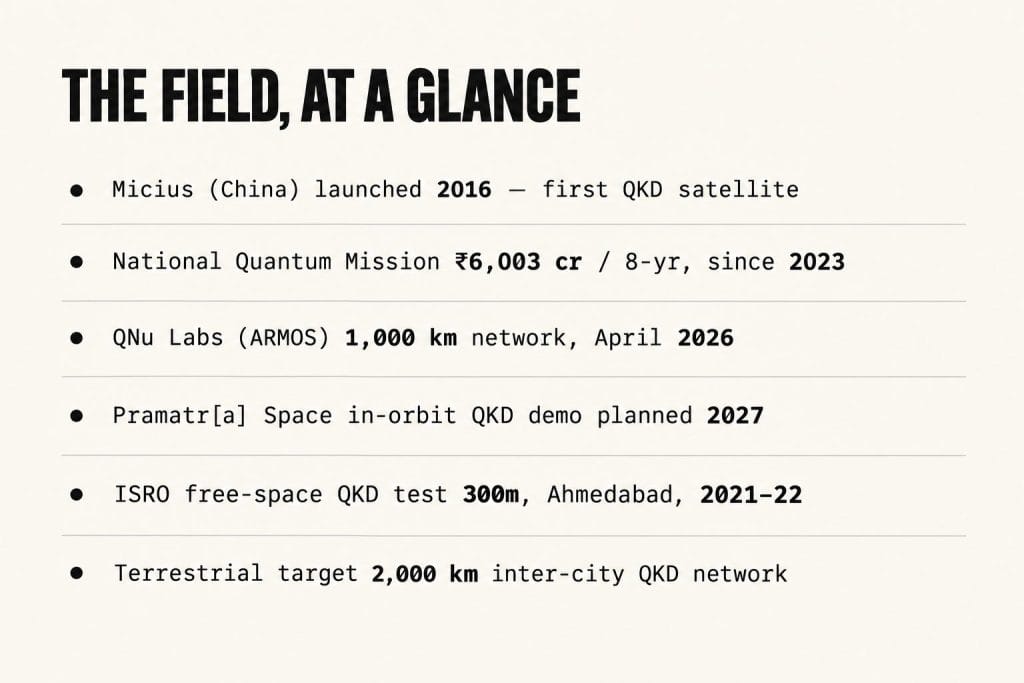
This race isn’t theoretical, and India isn’t starting from zero. Back in 2016, China launched Micius, the world’s first quantum-communications satellite. It has spent the decade since building out a satellite-to-ground QKD backbone and a 2,000-kilometre terrestrial quantum network linking Beijing and Shanghai. It was a statement as much as a scientific milestone: whoever secures their communications against the quantum era first gains a strategic buffer, while everyone else’s harvested data sits exposed on a timer. India’s answer arrived through the National Quantum Mission, a ₹6,003-crore, eight-year government push launched in 2023 to build home-grown quantum computing, sensing, and communication capability. This initiative states satellite-based secure links between ground stations up to 2,000 km apart as an explicit deliverable.
Ahead of Schedule, On Home Soil
What’s changed the tone of the conversation is how fast India’s early targets have been hit. In April 2026, the Department of Science and Technology confirmed that QNu Labs, a Bengaluru-based startup working under the National Quantum Mission, had demonstrated a 1,000-kilometre secure quantum communication network using its indigenous ARMOS platform. This was achieved in under two years, against an original roadmap that stretched to 2030-31. The system was independently validated with VIAVI Solutions’ test equipment, confirming secure key generation over 200-km fibre stretches without needing signal amplification before those links were chained together to span the full thousand kilometres. It is, by some counts, among the longest QKD deployments demonstrated anywhere in the world and it was built without importing the core technology.
“The clock is ticking, and the nation must prepare for the quantum era.” — Richa Hukumchand, Founder & CEO, Pramatra Space
That urgency is now pulling in private capital too. Pramatra Space, another Bengaluru venture, recently raised a pre-seed round to push quantum-secure satellite and terrestrial communication technology toward flight readiness. The company has already validated its photonics chip for entanglement-based QKD at IIT Madras, with an in-orbit demonstration booked for 2027. Layer that alongside ISRO’s own free-space QKD groundwork, a 2021 demonstration over 300 metres at the Space Applications Centre in Ahmedabad followed by an entanglement-based version in 2022, and a picture emerges of India assembling the pieces for a sovereign quantum satellite, even before a launch date has been announced.
Why the Boardroom Should Care as Much as the Bunker
It’s tempting to file this under defence-nerd trivia, but the National Quantum Mission explicitly frames QKD as infrastructure for defence, financial systems, and critical national infrastructure alike. Every bank transaction, every power-grid control signal, every diplomatic cable currently protected by RSA or elliptic-curve cryptography is a candidate for the harvest-now-decrypt-later playbook. Financial regulators globally have begun quietly asking institutions to inventory where “quantum-vulnerable” encryption still lives in their systems. For India, a domestic QKD stack isn’t just a scientific flex. It is the difference between negotiating from a position of cryptographic sovereignty and depending on someone else’s lock for the country’s most sensitive traffic.
The Uncomfortable Caveats
QKD is not a silver bullet, and we would be doing readers a disservice by pretending otherwise. It only secures the key exchange, not the entire pipeline: the endpoints, the software, the operators, remain as hackable as ever. Fibre-based QKD also loses signal over distance, which is exactly why the 200-km segment chaining in QNu Labs’ test matters so much, and why satellite relays remain the only realistic way to go trans-continental. And the hardware remains expensive and difficult to miniaturize, meaning QKD will likely secure the most critical links ( defence, banking cores, government backbones) long before it reaches ordinary consumer devices.
The race, in other words, isn’t to make quantum-safe communication universal. It’s to make sure it exists at all, for the systems that matter, before the machines that break the old locks arrive.
Q-Day may still be a moving target on the calendar. But the data being harvested against that future date is being copied right now, in real time, somewhere on a server that isn’t yours. India’s bet – expensive, indigenous, and running slightly ahead of its own schedule – is that when that day eventually arrives, at least some of its most important secrets will already be sitting behind a lock that quantum mechanics itself stands guard over.