






How a Bengaluru startup is attempting to rewrite the rules of electric mobility without permanent magnets.
Imagine trying to build an aircraft without aluminium, a smartphone without silicon, or a modern hospital without electricity. It sounds absurd because each depends on a material so fundamental that its absence seems unimaginable.
Now consider this question: Can an electric vehicle motor be built without permanent magnets?
For decades, engineers have treated powerful rare-earth magnets as indispensable ingredients in high-performance electric motors. These magnets, made primarily from neodymium and dysprosium, deliver high torque, excellent efficiency and compact designs – qualities that have powered the global electric vehicle revolution.
Yet a small Bengaluru startup, Vimag Labs, believes that assumption deserves to be challenged.
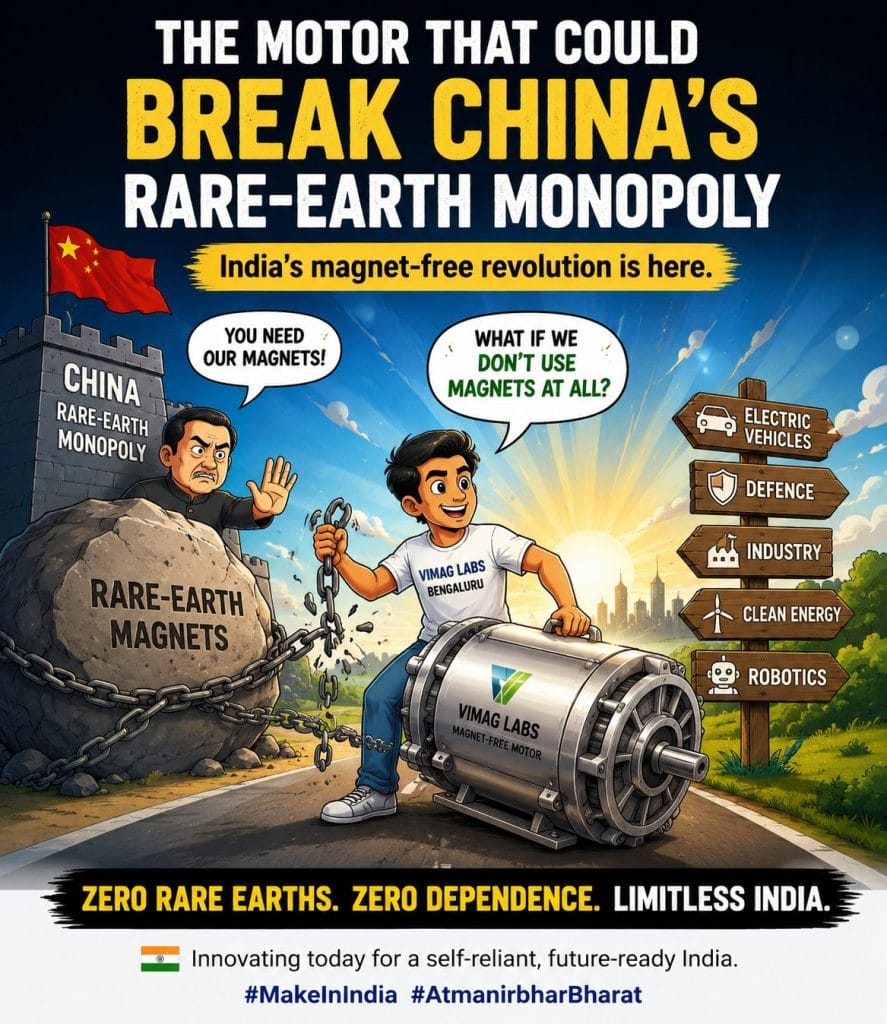
If its patented “c” achieves commercial success, it may not merely represent another engineering innovation. It could become part of a larger geopolitical shift, reducing dependence on one of the world’s most strategically concentrated supply chains.
Innovation, after all, does not always announce itself with fireworks. Sometimes it begins with the quiet hum of an electric motor.
The Invisible Metal Behind the EV Revolution
Most people admire the sleek design of an electric car. Few think about the invisible materials spinning inside its motor.
Rare-earth elements, despite what the name might suggest, are relatively abundant. What makes them rare is the fact that they are difficult and environmentally intensive to refine. These minerals are essential for manufacturing the strongest permanent magnets available today. These magnets allow motors to deliver high power while remaining compact and energy-efficient.
China has spent decades building dominance across mining, refining and magnet manufacturing. Today it occupies a commanding position in much of the global rare-earth supply chain.
This concentration has transformed what was once an engineering material into a strategic asset.
Just as oil shaped the geopolitics of the twentieth century, rare earths may shape the geopolitics of the twenty-first.
Why Magnets Matter
An electric motor converts electrical energy into mechanical motion. Inside most premium EV motors, permanent magnets create a constant magnetic field. Surrounding coils generate another magnetic field, and the interaction between the two produces rotation.
Imagine two expert dancers moving perfectly in rhythm across a ballroom floor. One leads, the other follows. Their synchronisation creates graceful motion with minimal wasted effort. That elegant coordination is precisely why permanent-magnet synchronous motors have become the preferred choice for many electric vehicles.
The engineering challenge has always been obvious. Remove the magnets, and you risk losing the very performance that made electric vehicles practical.
A Radical Question
Instead of asking how to build better magnets, Vimag Labs appears to have asked a far more provocative question:
What if the magnets disappeared altogether?
The company says its patented Virtual Magnet Synchronous Motor creates the desired magnetic behaviour through electromagnetic control rather than relying on permanent rare-earth magnets. In simple terms, instead of carrying permanent magnetic “workers” inside the machine, the motor generates the required magnetic effects dynamically as conditions change.
Think of it as replacing permanent employees with highly skilled specialists who appear precisely when needed and disappear once the task is complete.
The goal is the same. The method is entirely different.
Why This Matters Beyond Engineering
This is not simply another motor design. It touches economics, manufacturing, national security, industrial policy, and supply-chain resilience. Electric motors power far more than passenger vehicles. Factories, industrial robots, military systems, drones, wind turbines – all depend on them. Even household appliances rely on electric motors.
Reducing dependence on strategically sensitive materials could therefore ripple across multiple industries. A successful magnet-free motor would not merely save material. It could reshape strategic choices.
The Patent Race
Engineering breakthroughs become commercially valuable only when they are difficult to copy. According to company announcements, Vimag Labs has built a portfolio of foundational patents around its motor architecture.
Patents do not automatically guarantee commercial success. However, they create intellectual property barriers that can make replication significantly more difficult. History repeatedly demonstrates that successful companies often win not simply because they invent something remarkable, but because they protect it effectively.
Opportunity Meets Reality
Every revolutionary claim deserves equal measures of excitement and scrutiny. Several important questions remain. Can the motor match the efficiency of today’s best permanent-magnet motors? Can it deliver similar torque under demanding operating conditions? How will manufacturing costs compare at large production volumes? Will long-term reliability match conventional designs? Can it be integrated easily into existing vehicle platforms?
These are questions that only extensive testing, independent validation and commercial deployment can answer. Engineering rewards evidence, not enthusiasm alone.
Why India Should Watch Closely
India imports substantial quantities of components and materials used across advanced manufacturing. Developing indigenous alternatives strengthens technological resilience, reduces exposure to supply disruptions and creates opportunities for domestic manufacturing.
If companies like Vimag Labs succeed, India could become not merely a consumer of advanced electric mobility technologies but also an exporter of core intellectual property. That distinction matters. Manufacturing creates products. Innovation creates industries.
Beyond Electric Cars
The greatest inventions rarely remain confined to their original application. The transistor escaped the laboratory to transform computing. GPS moved from military systems into smartphones. Artificial intelligence evolved from academic research into everyday software.
If magnet-free motor technology matures, its influence could extend well beyond electric vehicles to robotics, aerospace, industrial automation, renewable energy and defence. Its true impact may lie not in replacing one component, but in changing how engineers think about electric machines themselves.
The TechQuest Verdict
History often whispers before it roars. A small laboratory can outthink a giant corporation. A handful of engineers can challenge assumptions accepted for generations.
Whether Vimag Labs ultimately reshapes the electric motor industry remains to be seen. Commercial success depends on rigorous testing, competitive costs, manufacturing scale and sustained reliability. Yet the question it poses is already significant:
What happens when the world no longer needs one of its most strategically important materials to build the machines of the future?
If that question finds a convincing engineering answer, the story will not simply be about a new motor. It will be about a new chapter in technological independence. One where innovation, rather than raw materials alone, determines competitive advantage. And perhaps, years from now, historians may look back at a modest Bengaluru startup and recognise that the quiet hum of its motor marked the beginning of a much louder revolution.
Takeaway
“Great inventions don’t merely solve engineering problems. They redraw economic maps, reshape geopolitical equations, and remind us that the most powerful force in technology is not the material we possess – but the ideas we dare to pursue.
Vimag Labs’ magnet-free motor is about more than a new way to power electric vehicles. It reflects how challenging long-held engineering assumptions can reduce dependence on critical materials, strengthen technological resilience, and create new opportunities for innovation. Whether or not it becomes the industry standard, it underscores an important idea: in tomorrow’s economy, competitive advantage will come not just from the resources a nation controls, but from the technologies it creates.