



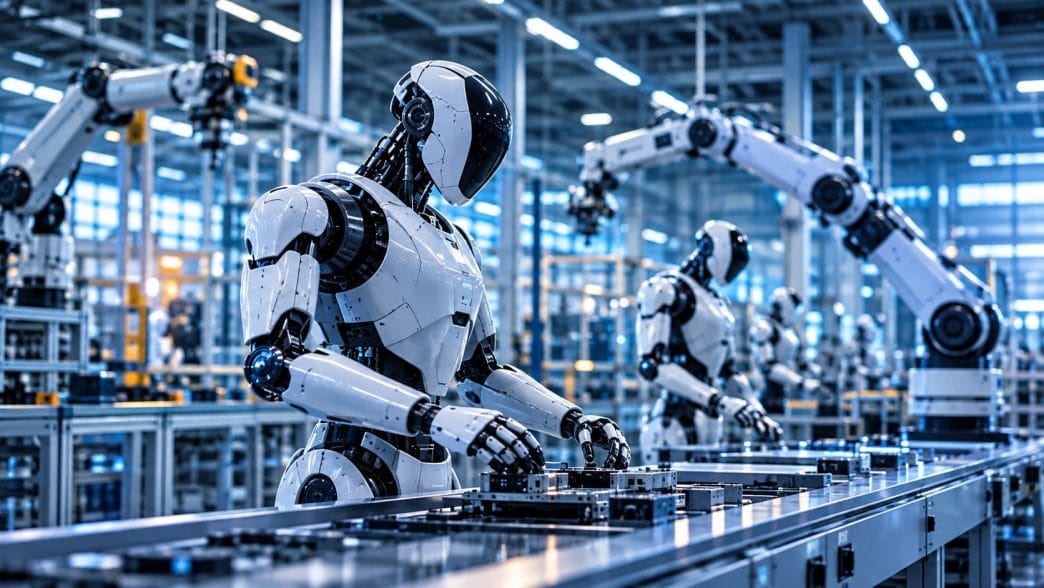
When artificial intelligence moves from screens into machines, the factory itself could become the next major computing platform.
For decades, artificial intelligence lived largely inside computers. It could recognise images, generate language, write software and analyse enormous quantities of information. But it had one fundamental limitation: it had no hands. That boundary is now beginning to disappear.
Chinese robotics company UBTECH has commissioned a new humanoid-robot manufacturing facility in Liuzhou, Guangxi, designed for an annual production capacity of more than 10,000 robots. The headline phrase “robots building robots” sounds almost like science fiction. The reality is far more interesting.
This is not yet a factory in which robots independently design, manufacture and reproduce themselves. Humans remain deeply involved, and the 10,000-unit figure represents planned production capacity rather than proven continuous output. But something important has changed.
The humanoid robot is moving from being primarily a research project or demonstration machine towards becoming an industrial product manufactured at scale. And that could eventually change the economics of automation itself.
From Robot Demonstration To Robot Production
For years, the humanoid-robot story was dominated by spectacular demonstrations: robots walking, running, climbing stairs, manipulating objects or performing carefully rehearsed tasks.
But a robot performing one impressive task is very different from a robot being produced reliably by the thousands. Manufacturing thousands of complex humanoids needs thousands of components, like cameras, actuators, sensors, and software-controlled systems, to work together with consistent quality. That makes the factory almost as important as the robot.
UBTECH’s Liuzhou facility has been designed around highly automated production, material handling and manufacturing systems. Its target capacity of more than 10,000 robots a year is significant because it moves the discussion from laboratory experimentation towards industrial scale. The significance is that robotics is beginning to acquire its own manufacturing infrastructure.
That is a much bigger story.
The Digital Factory Comes First
One of the less glamorous, but more important parts of this development is the use of digital manufacturing. UBTECH has partnered with Siemens on digitalisation of humanoid-robot production, including simulation, production planning, manufacturing execution and quality control. In simple terms, engineers can increasingly build and test a factory virtually before changing the physical factory. This is the idea behind the digital twin.
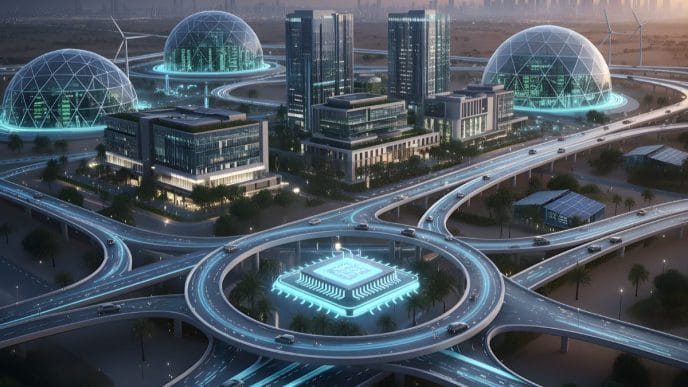
Imagine the entire factory existing first as software. Machines, production stations, material flows, robot movements, bottlenecks and production schedules can be simulated before the physical system is fully operational.
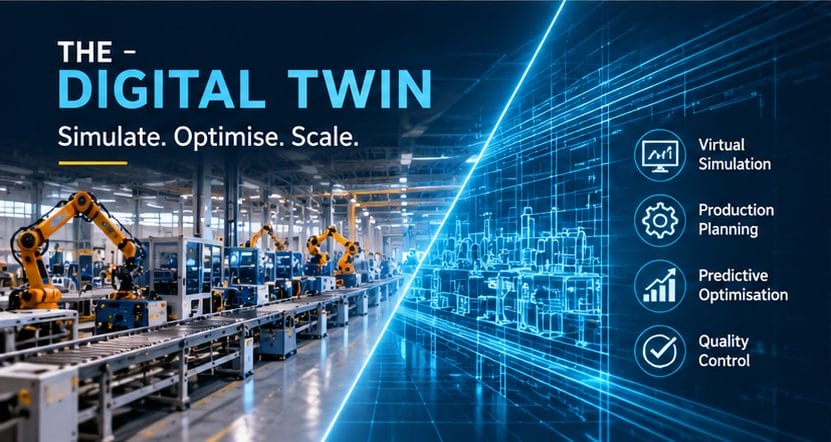
The result is a powerful combination. AI provides intelligence, digital twins provide simulation, robots provide physical action, and factories provide scale. This is where the story becomes much larger than humanoid robots. The same architecture can eventually apply to automobiles, electronics, warehouses, semiconductor equipment, batteries and other complex manufacturing systems.
The Real Breakthrough: The Feedback Loop
Here is the development worth watching. A conventional automation system generally performs a predefined task. A more advanced AI-enabled system can observe its environment, make decisions and adapt. Now imagine thousands of physical robots working every day and generating enormous amounts of operational data. That data can improve the AI, which in turn makes the robots more capable. More capable robots can take on more tasks, produce more goods and generate more data, continuously strengthening the cycle.
And the cycle begins again.
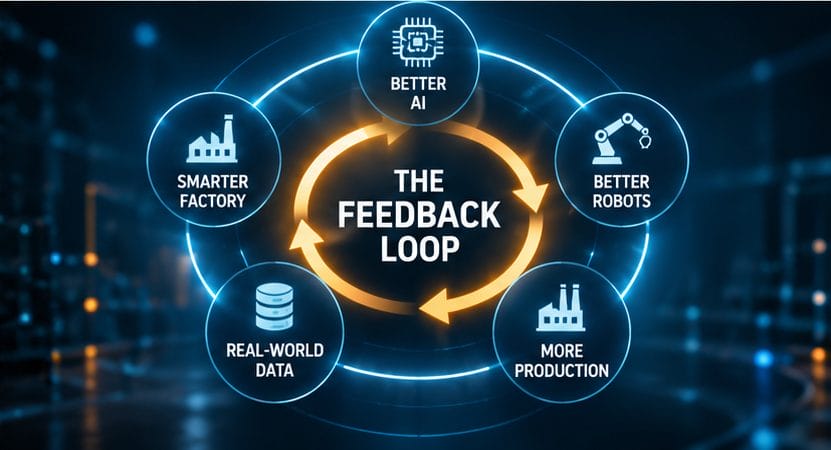
This is potentially a self-reinforcing industrial feedback loop. It is the physical-world equivalent of what happened in computing, where better processors enabled better software, which created demand for more powerful processors. The focus here shifts from the intelligence of the robot to how quickly that intelligence can be converted into reliable physical output. This shift may become one of the defining technology explorations of the 2030s.
Why China Matters
China’s advantage is not necessarily that one Chinese company has invented a magical humanoid robot. Its advantage lies in the ecosystem. It lies in the strength of its industrial ecosystem. China has vast manufacturing capacity, established supplier networks and deep expertise in electronics, batteries and precision engineering. The country has also been rapidly expanding its robotics industry and developing a broad ecosystem of humanoid-robot companies. This creates an important strategic distinction.
The United States has enormous strengths in AI models, software, computing and robotics research. China has enormous strengths in manufacturing scale and physical supply chains. The next phase of competition may become the assimilation of AI intelligence with computing, robotics and manufacturing capacity. The country that integrates all four most effectively could gain a significant industrial advantage.
India’s Opportunity
For India, this should not be viewed merely as another chapter in the China-versus-America technology race.
It should be viewed as a strategic signal. India’s opportunity is to build the entire stack:
SEMICONDUCTORS → SENSORS → MOTORS → BATTERIES → ELECTRONICS → AI → ROBOTICS → FACTORIES → APPLICATIONS
India does not need to copy every Chinese humanoid design. It needs to develop competitive capabilities across the underlying technologies and, crucially, deploy them in Indian manufacturing.
Embodied AI could eventually find applications far beyond factory floors, extending into warehouses, hospitals, construction sites and even farms. But the opportunity may extend well beyond the robots themselves. The technologies that enable them, from precision movement and sensing to machine vision and intelligent control, could become major industries in their own right.
The Hype Versus The Reality
This is where we should resist the hype. A factory designed to produce 10,000 robots is not the same as a factory actually producing 10,000 economically useful robots every year. The production-capacity figure should therefore be understood as an industrial target, not proof that 10,000 robots are already being manufactured every year. So, making the robot genuinely useful may prove to become a harder problem than simply manufacturing the robot.
Humanoid robots still face challenges involving dexterity, reliability, unpredictable environments, battery endurance and the ability to generalise from one task to another. A robot that can perform a choreographed demonstration is impressive. A robot that can work for hours every day, safely handle unexpected situations, require little supervision and save a factory more money than it costs is transformative.
We are much closer to the first than the second and that distinction matters.
The 2035 Question
By 2035, the important question may no longer be whether humanoid robots can walk.
We may take that for granted even. The more consequential question will be:
HOW MUCH OF A FACTORY CAN OPERATE WITHOUT CONTINUOUS HUMAN INTERVENTION?
The answer will probably not be “everything”. Factories will still need engineers, designers, managers, technicians and human judgement. But the balance could shift. Humans may increasingly design the production system while AI manages optimisation and robots perform an expanding share of the physical execution. That would represent a profound transition.
The First Industrial Revolution gave machines physical strength. The Digital Revolution gave them the ability to process information. The emerging AI-robotics revolution could bring the two together, allowing machines to act on intelligence in the physical world.
The Bigger Picture
This is why the Liuzhou factory deserves attention. While the story of robots beginning to build robots is intriguing, the fact of AI acquiring hands is far more indicative of the future we’re building towards. The factory may become those hands at scale, even if an autonomous factory still remains a possibility for the distant future.
But the direction is becoming clearer. As AI gives robots the ability to think and act, digital twins allow entire production systems to be simulated and refined before factories scale up. The data generated in this process then feeds the next generation of AI, creating an increasingly connected cycle of learning and improvement. As these technologies begin to operate as one integrated system, automation moves beyond simply sustaining production to actively evolving the way it works. And that may be the real beginning of the autonomous industrial age.