


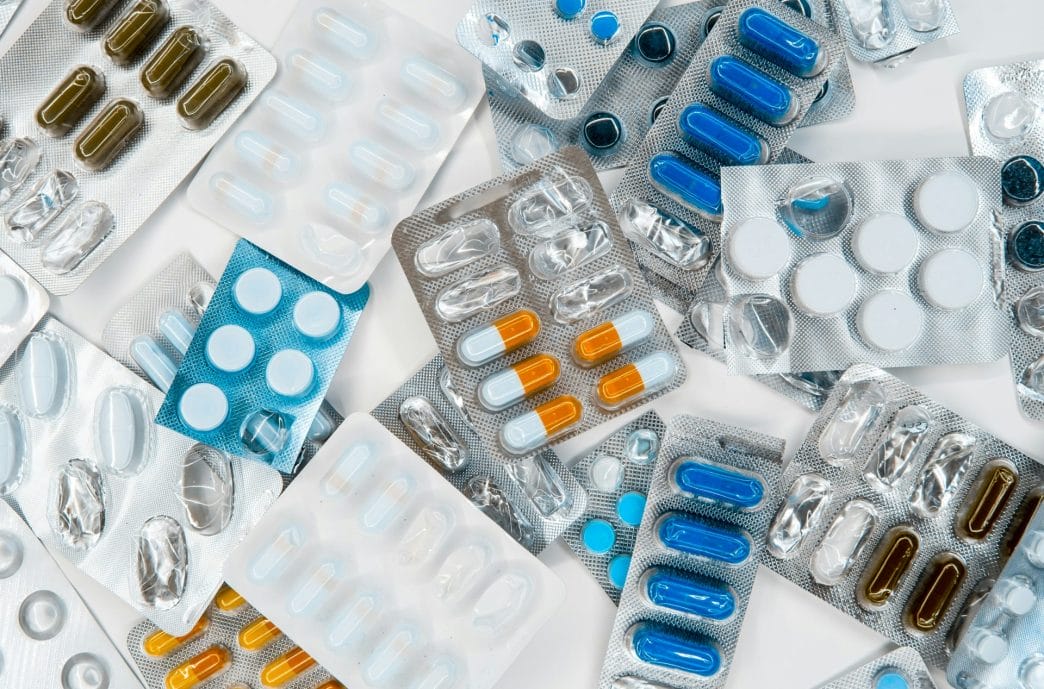
Inside the geopolitical tug-of-war over the world’s medicine cabinets — and why the self-proclaimed Pharmacy of the World still has to ask China for its raw ingredients.
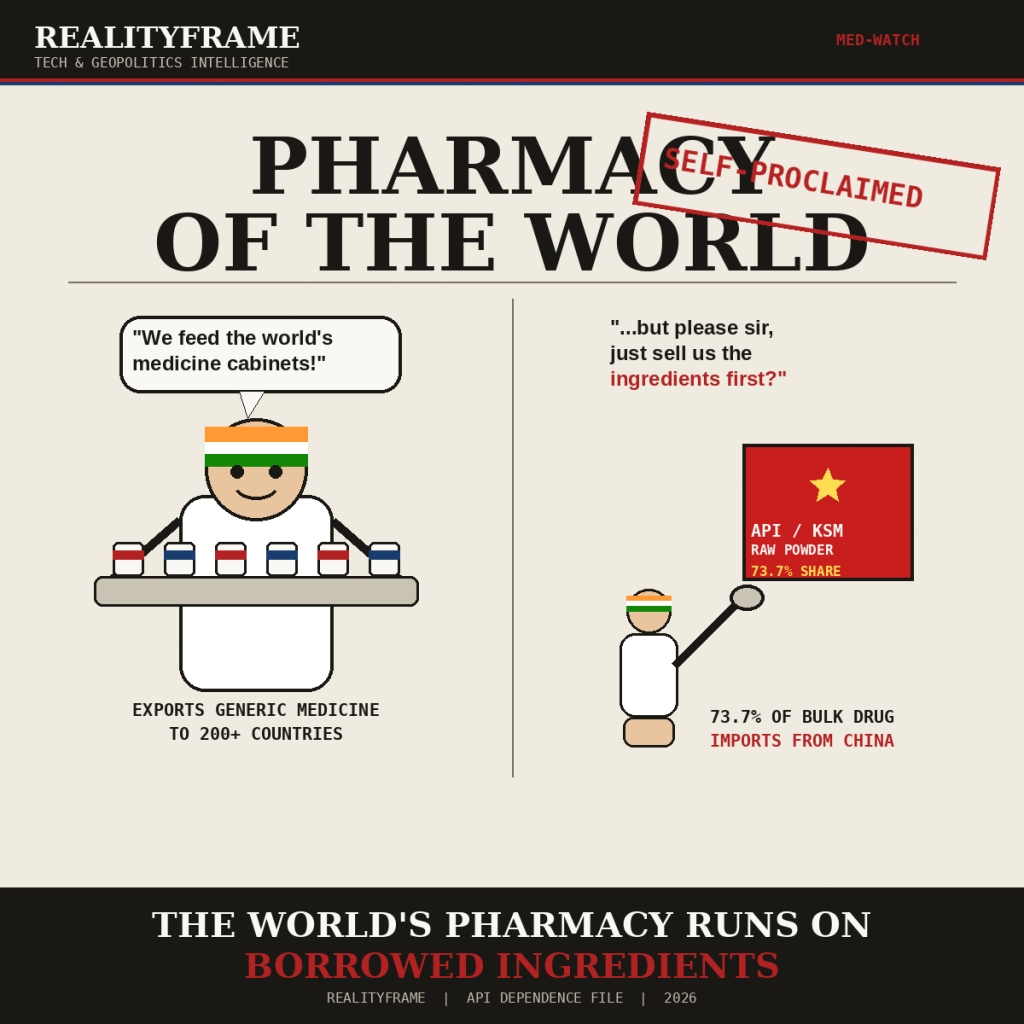
India calls itself the Pharmacy of the World, and the claim is not exaggerated. It supplies more than a fifth of all generic medicines consumed on the planet and remains the largest source of affordable vaccines for the developing world. Walk into a clinic in Lagos, Jakarta, or rural Brazil, and there is a fair chance the tablet on the counter was formulated in Gujarat or Telangana. But peel back the label, and the story gets uncomfortable. The pill itself may be Indian. The active ingredient inside it, more often than not, is not.
That is the structural fault line running underneath the world’s most celebrated generic-drug industry: India manufactures the medicine, but China still manufactures the molecule.
The Anatomy of Dependence
Active Pharmaceutical Ingredients, or APIs, are the biologically active compounds that actually do the curing. Everything else in a tablet is a delivery mechanism. For decades, Indian pharmaceutical companies quietly offshored bulk production of these compounds to Chinese manufacturers, keeping the higher-margin business of formulation, packaging, and export at home. The arrangement worked well until it didn’t. When Chinese factories slowed during recent supply shocks, the fragility of a single-source chain for life-saving medicine became impossible to ignore.
The numbers are stark. India’s bulk drug import basket spans more than two hundred categories of APIs, intermediates, and key starting materials, running into billions of dollars annually. Per the Ministry of Chemicals and Fertilizers, China accounts for roughly 73.7% of these imports, concentrated precisely where it can do the most damage.
80–90%
FERMENTATION APIs
(Penicillin, Cephalosporins)
70–80%
VITAMINS & KSMs
(Vitamin B/C, Paracetamol)
~60%
SYNTHETIC ACTIVES
(Cardiovascular, Metformin)
The sharpest exposure sits in fermentation chemistry, where microbial cultures rather than chemical synthesis produce the core building blocks. China effectively controls global supply of Penicillin-G and 7-ACA, the precursor molecules behind everyday antibiotics like amoxicillin and the cephalosporin family. When a handful of Chinese plants adjust output or pricing, antibiotic costs move worldwide – India included.
Other therapeutic categories carry the same exposure with less visibility. Data from the Press Information Bureau flags heavy import reliance across antivirals such as acyclovir, maintenance medications like atorvastatin for cardiovascular care, and corticosteroids including dexamethasone used in critical care settings. These are not niche molecules. They are the backbone of routine treatment for hundreds of millions of patients, and each one currently depends on a Chinese-controlled supply line that India does not directly influence.
How India Priced Itself Out
This was not always the arrangement. India was largely self-sufficient in bulk drug manufacturing through the 1980s and into the early 1990s. What changed was economics, not capability.
China built industrial-scale fermentation hubs, backed by discounted state-subsidised power, cheap land, and bioreactors operating at roughly ten times the scale of typical global facilities. Combined with historically lighter environmental compliance costs during their growth years, Chinese producers could routinely undercut Indian manufacturers by 15–40%.
“India didn’t lose this industry to a lack of skill. It lost it to a spreadsheet – and is now spending billions to win the spreadsheet back.”
India compounded its own disadvantage through policy. The 1995 expansion of the Drug Price Control Order capped retail prices on finished medicines to protect consumer affordability. Domestic API producers, already squeezed by rising costs, found their finished-goods customers shifting to cheaper Chinese inputs to preserve margins. One by one, domestic bulk drug units became commercially unviable and shut down. Indian pharma adapted by climbing the value chain instead, with formulations, drug delivery tech, finished generic exports to the US and Europe. It made sense at the company level. At the national level, it created a single point of failure in a sector classified as essential to public health.
New Delhi’s Counter-Offensive
The government’s response treats this as a national-security question, not merely an industrial-policy one and funds it accordingly. The Department of Pharmaceuticals rolled out a Production Linked Incentive scheme for Bulk Drugs worth nearly ₹6,940 crore, targeting 41 critical KSMs, intermediates, and APIs.
38
GREENFIELD PLANTS
NOW OPERATIONAL
56,800 MT
ANNUAL CAPACITY
ESTABLISHED
₹2,192Cr
IMPORTS
SUBSTITUTED
Perhaps the most symbolic data point: domestic production of Penicillin-G and Clavulanic Acid has resumed through new greenfield fermentation plants, ending a three-decade gap since India last manufactured these molecules at scale.
A second, larger PLI scheme worth ₹15,000 crore targets higher-value categories: biopharmaceuticals, complex generics, orphan drugs. As of late 2025, it had pulled in over ₹41,943 crore in cumulative investment and helped commercialise nearly 2,000 products, including 191 APIs manufactured in India for the very first time.
Alongside the incentive schemes, the government is building three dedicated Bulk Drug Parks, in Nakkapalli (Andhra Pradesh), Jambusar (Gujarat), and Haroli (Himachal Pradesh), backed by a ₹3,000 crore federal grant. The logic mirrors China’s industrial-park model: shared effluent treatment, common steam generation, solvent recovery, and testing infrastructure, so individual manufacturers don’t absorb the full capital and compliance burden alone.
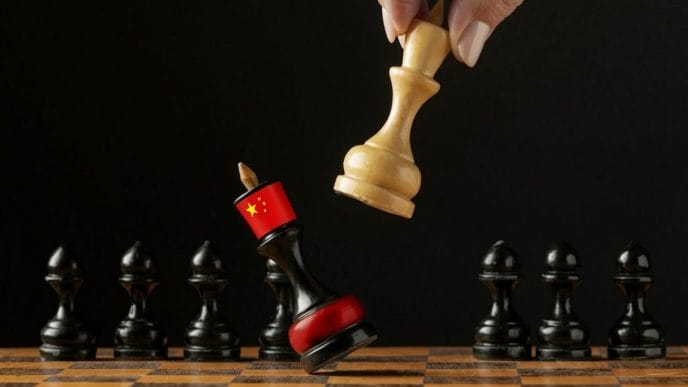
The Global Chessboard
India’s domestic push is riding a larger geopolitical current. Western governments are independently de-risking their pharmaceutical supply chains away from China, and India is positioning itself as the natural beneficiary.
In the United States, the Biosecure Act and rising Section 301 tariffs are tightening reliance on Chinese biotech and manufacturing entities. The European Union’s Critical Medicines Act pursues similar diversification goals. Both are pushing global pharma buyers toward a “China Plus One” model, away from pure cost optimisation, and toward risk-adjusted diversification. India already has FDA-compliant formulation infrastructure and deep contract-manufacturing relationships with Western firms looking for a second sourcing option outside China.
But the limits are real, and worth being honest about. Matching China’s cost structure in bulk fermentation chemistry, at the scale China operates, remains a genuinely hard problem, and not a matter of a few years of subsidy. Domestic manufacturers are already lobbying for anti-dumping protections to shield new greenfield investments from predatory pricing, which suggests the new capacity is still commercially fragile rather than fully competitive.
There is also a sequencing risk worth watching. If Western buyers diversify away from China faster than India can scale fermentation capacity, the gap may simply be filled by other emerging manufacturing hubs in Southeast Asia or Eastern Europe, rather than by India by default. Geography and goodwill are not the same as commissioned capacity – and capacity is the one variable still catching up.
The Takeaway
The deeper lesson here isn’t really about pharmaceuticals. It is about what happens to any country that builds a celebrated downstream industry on top of an upstream supply chain it does not control. India spent three decades optimising for margin and ended up exposed at the molecular level, vulnerable to decisions made in Chinese industrial parks it has no influence over.
The PLI schemes, the Bulk Drug Parks, the returning fermentation plants, which are not yet a victory lap. They are the opening moves in a long, capital-intensive effort to re-shore chemistry that took China three decades and enormous state backing to dominate in the first place. Whether India can close that gap before the next supply shock arrives is the real test of whether “Pharmacy of the World” is a fact or a slogan.