


India, the multipolar order, and the long road to economic leadership: a civilisation that has outlasted empires now reckons with a world that has no single centre.
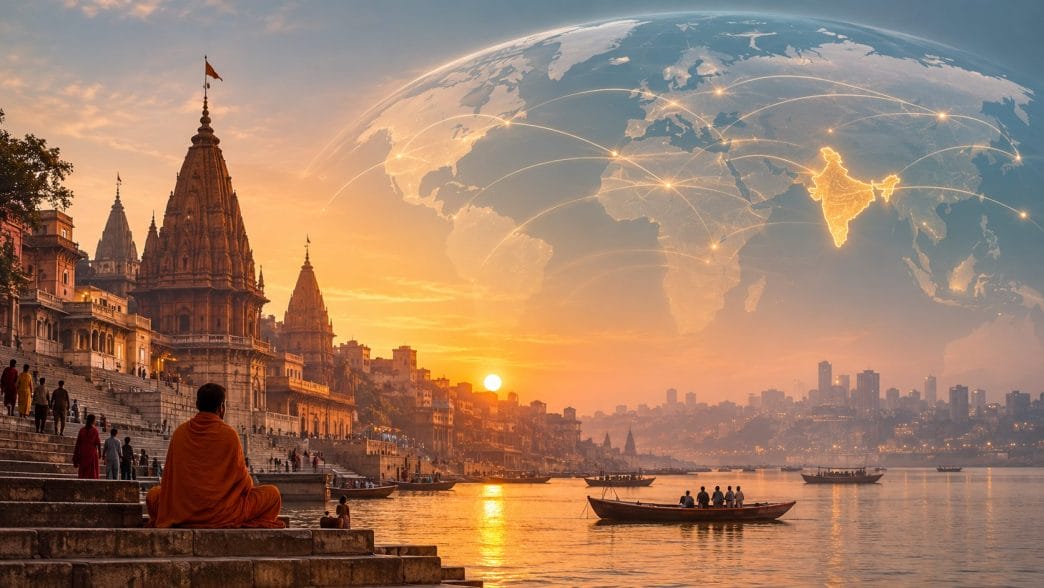
Stand on the ghats of Varanasi and watch the Ganga move against an ancient skyline, and you witness a continuity few places on Earth can claim. Kashi, the city of light, has for millennia been a crucible of philosophy, argument and spiritual resilience. It is a fitting emblem for our moment. As Varanasi reconciles timeless wisdom with the demands of each new epoch, the global system is leaving behind the post-Cold War unipolar settlement and entering something more decentralised, more contested, and far more complex.
At the heart of that reconfiguration sits India’s ascent: sturdy macroeconomic fundamentals, world-class digital public infrastructure, and a foreign policy built on strategic autonomy. It is an ascent that fuses an old idea, Vasudhaiva Kutumbakam, the world as one family, with twenty-first-century scale.
The Architecture Is Shifting
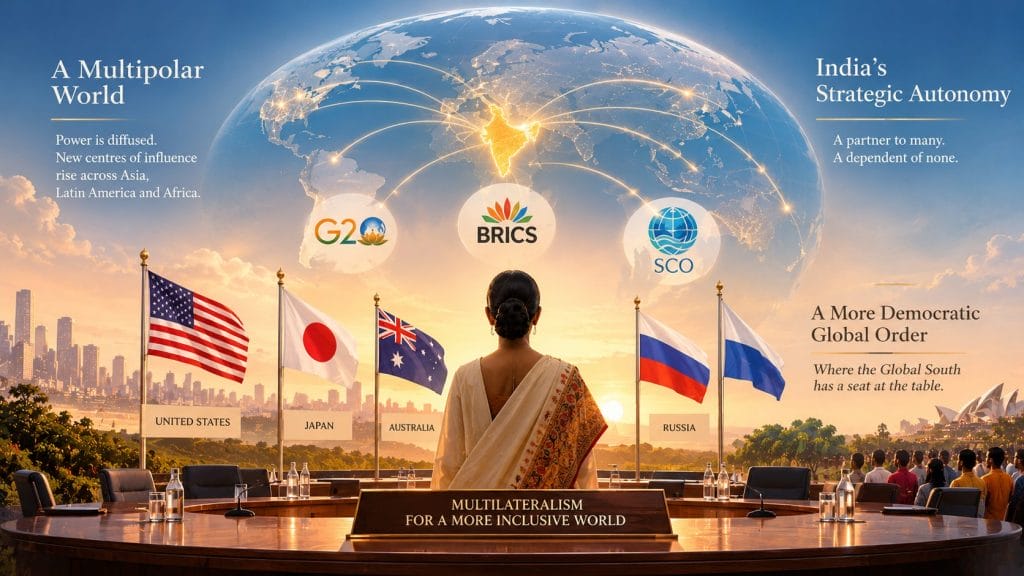
For three decades after the Soviet collapse, international order meant Western gravity: its financial institutions, its security alliances, its narratives. That centre has not vanished, but it no longer holds alone. Power has diffused across continents, and new centres of weight have appeared in Asia, Latin America and Africa.
In this architecture, middle powers and rising giants refuse to be sorted into binary blocs. India has become a quintessential anchor of that refusal. Through the G20, BRICS and the Shanghai Cooperation Organisation, New Delhi argues for a reformed multilateralism that mirrors today’s economic realities, not the power balance of the mid-twentieth century.
Not a camp, not a bloc, not a hegemon: a partner to many, a dependent of none.
Strategic autonomy means keeping independent partnerships with the United States, Japan, Australia and Russia at once, and absorbing the friction that follows without surrendering the national interest. The aim is not primacy. It is a more democratic model of global governance in which the voices of the Global South are heard by design, not by courtesy.
The Engine Beneath The Diplomacy
Geopolitical weight needs an economic engine, and India’s is running hot. By the IMF’s October 2026 estimates, India’s nominal GDP stands at about $4.06 trillion this year, and is projected to reach $4.52 trillion in 2027, which would lift it past Japan and into fourth place. The Fund has also raised its growth forecast for India to roughly 7 per cent for 2026-27, keeping it the fastest-growing major economy.
A fair reading requires one caveat. In dollar terms India currently ranks sixth, behind Japan and Britain. Rupee depreciation and a revision of the national accounts base have held the headline figure down even as rupee growth stays strong. The ascent is real; it is a matter of when, not whether.
The Demographic Dividend
The world’s largest population, with a median age below thirty, is entering its most productive years, in stark contrast to ageing Western and East Asian economies. Digital public infrastructure Aadhaar for identity, UPI for payments, account aggregators for data are a stack of important technological advancements. One that has pulled vast segments of the economy into the formal system and driven transaction costs down. Manufacturing and supply-chain diversification, production-linked incentives, ports, railways and dedicated freight corridors are positioning India as a trusted alternative node in global manufacturing and technology chains.
A Full-Stack Technology Power
India’s rise no longer rests on services and outsourcing alone. It is increasingly described as a full-stack player in frontier technology: artificial intelligence, the renewable-energy transition and space. Sovereignty, in this telling, is not an abstraction; it is owning the layers on which a modern economy runs.
Then there is a quieter instrument, digital diplomacy. By offering its public-infrastructure models to partners across Africa, Latin America and Southeast Asia, India lets other nations build sovereign identity and payment rails of their own: open, interoperable, and not dependent on any single power’s platform.
Old Wisdom, Modern Crises
As economic power drifts east and south, the character of global risk changes with it: climate degradation, inequality, the weaponisation of supply chains, and a quiet epidemic of burnout. Here the ethos of places like Varanasi offers more than nostalgia.
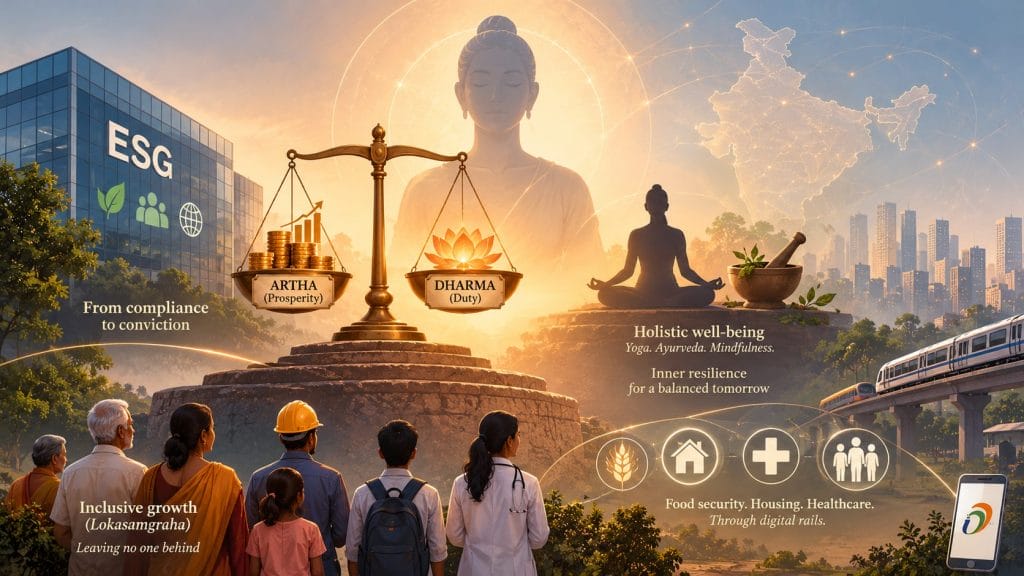
Enterprise and Dharma Indian thought holds wealth creation (Artha) to be legitimate when governed by duty (Dharma). In modern terms, ESG becomes a corporate conviction rather than a compliance burden. Holistic well-being Yoga, Ayurveda and mindfulness have gone global, and offer practical tools against corporate burnout. Inner resilience matters as much as material infrastructure. Inclusive growth (Lokasamgraha) The Gita speaks of upholding the welfare of the world. India’s welfare architecture, which delivers food security, housing and healthcare to hundreds of millions through digital rails, echoes that ideal of leaving no one behind.
Shaping The Next Era
As Varanasi has bridged millennia of unbroken inquiry, India now stands at a comparable crossroads. The move to a multipolar order is not merely a reshuffling of GDP tables or military balances; it is a cultural and philosophical rebalancing.
India is doing more than building a top-tier economy. It is drafting a blueprint for leadership that is inclusive, sustainable, and plural.