



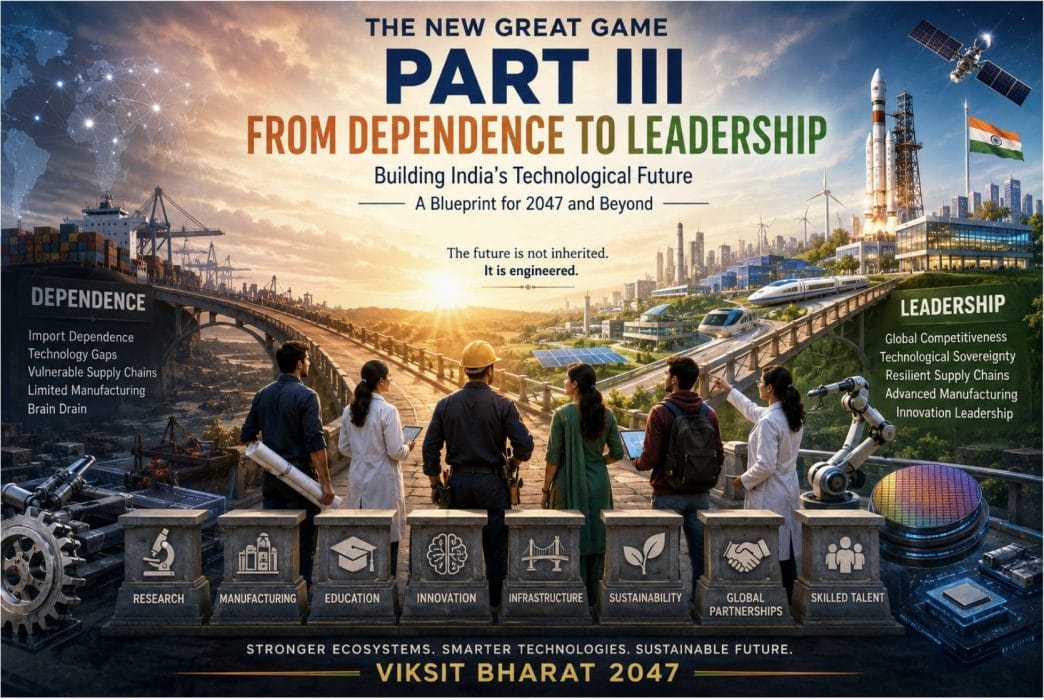
Building India’s Technological Future: A Blueprint for 2047 and Beyond
Standfirst
Every generation inherits a defining challenge. Some rebuild nations after wars. Others build railways, power grids, universities or digital networks. Our generation stands before a different frontier: transforming India from a large market into a globally trusted creator of technology, manufacturing and innovation. The road to 2047 will be forged through laboratories, factories, classrooms, startups, shipyards, semiconductor fabs, clean-energy plants and millions of skilled hands. This is not merely a roadmap for India, but a manifesto for every nation aspiring to shape its own technological destiny.
“The future is not inherited. It is engineered.”
The Year Is 2047
Imagine India in the centenary year of Independence. Not merely richer or larger, but wiser. A country that has built the capabilities to shape its own future and contribute to the world. Its universities drive research, its industries build advanced technologies, and its startups grow into global companies. From semiconductors and robotics to clean energy and advanced manufacturing, India is no longer just a participant in global supply chains, but a country that helps shape them.
Children visit science museums where today’s ambitions have become yesterday’s milestones. But that future will not happen by itself. It will be shaped by the choices India makes consistently and patiently, over decades.
The First Principle: Build Ecosystems, Not Islands
Great nations do not succeed because one company becomes world-class. They succeed because thousands of organizations strengthen one another. A startup develops a sensor, a university offers improved curriculums, a supplier manufactures precision bearings, a logistics network delivers reliably, and banks finance expansion. All while the government provides stable policies and investors fund innovation. Step by step, the ecosystem becomes stronger than any individual participant. Industrial leadership becomes the triumph of an interconnected ecosystem rather than of a lone genius.
The Citizen’s Role
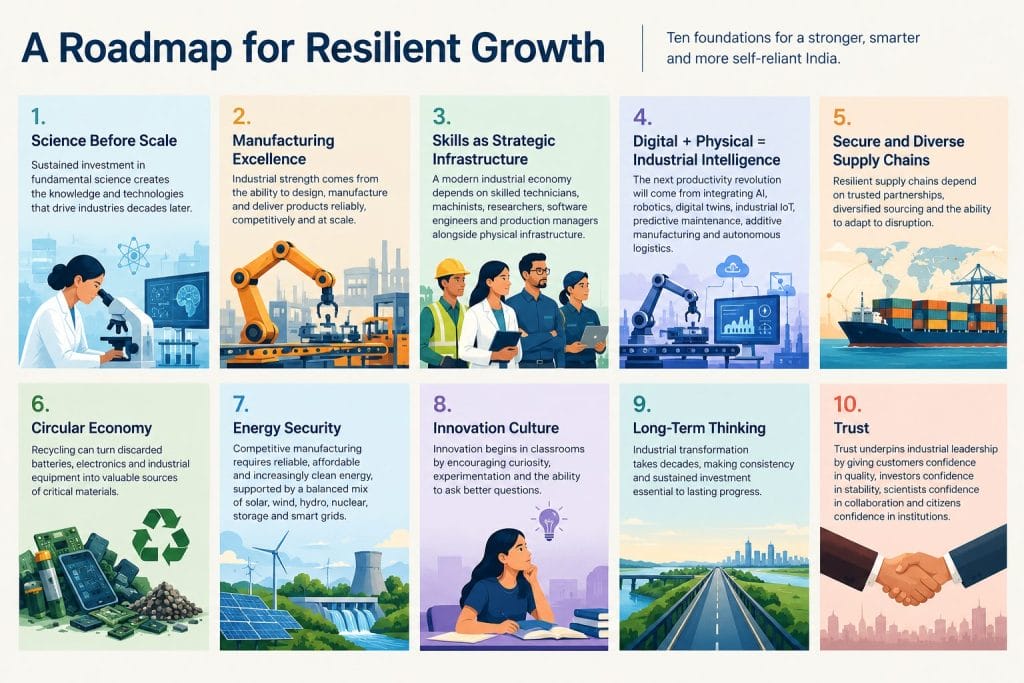
The responsibility of national transformation doesn’t fall solely on the governments, but requires contributions from the citizens as well. Teachers inspire curiosity, engineers improve processes, entrepreneurs solve practical problems, farmers adopt better technologies, and students become the researchers of tomorrow. Consumers reward quality, while retirees pass knowledge to the next generation. A technologically confident nation is ultimately a society where learning, improving and contributing continue throughout life.
The greatest natural resource of any nation is not buried beneath its soil. It walks into schools & offices every morning.
A Letter to the Next Generation
Each of us dreams of a different professional future for ourselves. And our difference is where we find our greatest strength as a community. It is important that we don’t underestimate our contributions to the nations, regardless of our profession – be it a teacher, a coder, a welder, a technician or a nurse. Each and every skilled professional contributes differently to the growth of the nation and the future is assembled one careful decision at a time.
Conclusion: The Age of Builders
Every civilization leaves behind a signature. The Egyptians left being the pyramids, the Romans built roads, and France gave us Renaissance art. Every invention, ranging from the steam engine, the transistor, the internet or even artificial intelligence are all mementos of human civilization.
And each generation writes history using the tools it creates. Our generation has been entrusted with a profound responsibility: to build technologies that expand human possibility while preserving human dignity. Our aim is to strengthen resilience without abandoning cooperation. We must compete without forgetting collaboration and innovate without neglecting sustainability.
The question before India, and indeed every nation, is no longer whether it can participate in the technological century. The question is how it chooses to shape it. Factories,universities, ideas, character all remain essential but how we use them becomes far more important than ever before. Because in the final analysis, civilizations are remembered not by what they consumed…
…but by what they built.
A bridge is not built on the day the last span is laid. It begins with the first survey, the first drawing, the first stone, and the first act of faith that the opposite shore can indeed be reached. Nations are built in the same way.
BONUS EPILOGUE
The Age Of Builders: Dedicated to Those Who Will Shape Tomorrow
The Last Factory
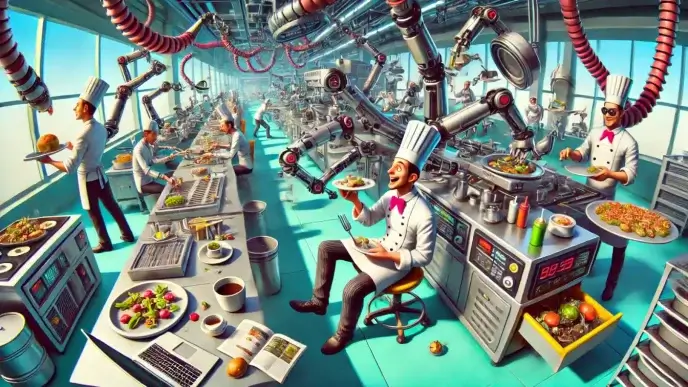
Imagine walking through the world’s last factory. The cause for its end would not be because industries have vanished, but because every factory has become intelligent. Machines can speak, robots collaborate, artificial intelligence can predict failures before they occur, and materials repair themselves.
In a world where energy flows intelligently across continents and waste becomes raw material, factories would no longer merely manufacture products, but they’d be manufacturing possibilities.
Yet something inside this futuristic factory remains unchanged: human curiosity. Across human history, that spark has led to innovations that turned us from nomads to a global technological community in the 21st Century. From the first fire, the first wheel, the first blade, to the first satellite, and now artificial intelligence – as technology kept changing, curiosity endured.
The Builders
History often celebrates conquerors, yet civilizations survive because of builders. There were people who designed the bridge, refined steel, discovered alloys, and programmed the software. Meanwhile others inspected the weld, maintained the turbine, repaired the machine, and taught the engineer. Most of these people never appear in history books, and yet history quietly rests upon their shoulders.
When we speak about nations becoming powerful, we often imagine presidents, prime ministers, CEOs and famous scientists. Reality is far less glamorous. The future is usually built by anonymous people: a teacher, a machinist, a laboratory technician, a truck driver or a researcher, each patient building progress every single day.
Civilizations rise because ordinary people perform extraordinary work with extraordinary consistency.
The Real Meaning of Self-Reliance
Self-reliance does not mean isolation. In a world as interconnected as ours, true self-reliance means possessing enough scientific knowledge, industrial capability, skilled capability, and trusted partnerships. Such a foundation means that no single disruption can stop your journey.
So we build towards resilience, not isolation; confidence, not arrogance; and partnership, not dependence.
The Technology We Must Never Lose
Technology will continue to evolve. Artificial Intelligence will become more intelligent, robots more capable, and quantum computers more powerful. Yet virtues such as human character, integrity, curiosity, humility, courage and patience remain irreplaceable. Every civilization that forgot these eventually declined, and those that nurtured them continued to innovate.
And, perhaps, somewhere today, a child dismantles an old radio, a girl writes her first computer program, or a boy wonders why aircraft fly. Someone plants a seed. Someone asks: “Why?”
Every great industrial revolution began exactly there. With curiosity.
A Note To Every Reader
Whether you are a student, a teacher, an engineer, a scientist, a farmer, a doctor, a policymaker, or simply someone who loves learning – you already belong to this story. Technology is not merely about machines, but about people improving life. And every improvement, however small, becomes part of civilization.
The Final Reflection
When future generations look back upon our era, they may not remember which smartphone we carried, or which company briefly became the world’s largest. They may remember something far more important: whether we built societies capable of learning, factories capable of adapting, universities capable of questioning, and technologies guided by wisdom. Because ultimately, the greatest supply chain is not made of ships, or ports, or semiconductors. It is the uninterrupted chain of human knowledge, passed carefully from one generation to the next.
Break that chain and civilizations stumble. Strengthen it and civilizations flourish.
A nation’s greatest monument is not the tallest skyscraper, the fastest train, or the most powerful rocket. Its greatest monument is a generation that leaves behind more knowledge, more opportunity, and more courage than it inherited.