



From Red Tape to Runtime — Rewiring India’s Industrial DNA
The Factory That Starts Like an App
There was a time when building a factory in India felt less like engineering and more like an endurance test. Entrepreneurs didn’t just design products; they navigated land disputes, regulatory bottlenecks, and infrastructural gaps that could stretch timelines indefinitely. In a world sprinting toward automation and scale, India’s manufacturing story often lagged, not for lack of ambition, but due to systemic friction.
Now imagine a different reality – one where setting up a factory resembles deploying an application. The groundwork is ready, approvals are streamlined, and production begins almost on cue. This shift from friction to flow is precisely what the BHAVYA initiative seeks to engineer. It is not merely a policy intervention to attempt to redefine the very starting point of manufacturing in India.
India’s Real Bottleneck: Friction, Not Potential
For decades, India has had all the right ingredients for manufacturing dominance. A vast workforce, expanding domestic demand, and a strategic global position made it an obvious contender. Yet, global manufacturers have long hesitated about execution.
The process of setting up operations often became a labyrinth of approvals, unclear timelines, and logistical inefficiencies. Time-to-production stretched unpredictably, eroding investor confidence and operational viability. In contrast, competing economies optimized for speed and certainty, turning manufacturing into a predictable, scalable process.
India’s challenge, therefore, was not to build capacity, but to eliminate friction. And this is where BHAVYA begins to matter.
BHAVYA: Infrastructure as a Service
At its core, BHAVYA introduces a powerful abstraction. Instead of expecting businesses to assemble every component of their operations, it offers a pre-configured industrial environment. Land is pre-acquired, utilities are in place, connectivity is integrated, and approvals are streamlined. This is infrastructure delivered as a service layer.
The parallel with cloud computing is hard to ignore. Just as businesses no longer worry about managing servers and storage, manufacturers within this ecosystem are freed from the complexities of setup. The focus shifts from preparation to production, from groundwork to growth.
In effect, BHAVYA compresses the timeline between intent and execution, transforming manufacturing from a slow, sequential process into a rapid, deployable system.
When Manufacturing Becomes Intelligent
What elevates this transformation is its intersection with technology. These industrial ecosystems are not designed as static spaces; they are envisioned as dynamic, data-driven environments.
Sensors embedded across facilities enable real-time monitoring, allowing predictive maintenance to replace reactive fixes. Supply chains, traditionally fragmented and opaque, become integrated networks driven by data and analytics. Production processes can be simulated digitally before being physically executed, minimizing risk and maximizing efficiency.
Even compliance, long viewed as a bureaucratic burden, begins to evolve into a streamlined, transparent system managed through digital interfaces. What was once paperwork becomes a process, and what was once a delay becomes a dashboard.
Manufacturing, in this context, starts to resemble software – modular, scalable, and increasingly autonomous.
The Global Shift: India’s Strategic Window
This transformation is unfolding at a moment of global realignment. The disruptions of recent years have exposed the vulnerabilities of concentrated supply chains, prompting companies to diversify their manufacturing bases.
The “China+1” strategy is no longer a theoretical concept; it is an operational imperative. Nations like Vietnam and Mexico have already positioned themselves as alternatives, leveraging efficiency and ease of doing business to attract global players.
India, despite its inherent advantages, has struggled to fully capitalize on this shift. The missing link has been execution speed. BHAVYA has the potential to change that narrative by offering what global manufacturers value most- predictability, efficiency, and scale.
It signals that India is not just participating in the global manufacturing race; it is recalibrating its approach to compete more effectively.
From Economy to Operating System
Look deeper, and the implications become even more profound. BHAVYA is not just about industrial parks; it is about building an economic operating system.
In this emerging model, infrastructure, governance, and technology converge into a unified framework. Processes are standardized, workflows are parallelized, and decision-making is increasingly data-driven. Industrial zones evolve into platforms, where businesses can plug in and operate with minimal friction.
This mirrors the evolution of the digital world, where platforms replaced isolated systems and ecosystems replaced silos. Manufacturing, long seen as rigid and linear, begins to adopt the flexibility and scalability of software architectures.
Factories become nodes, supply chains become networks, and data becomes the control layer orchestrating the entire system.
The Road Ahead: Autonomous and Connected
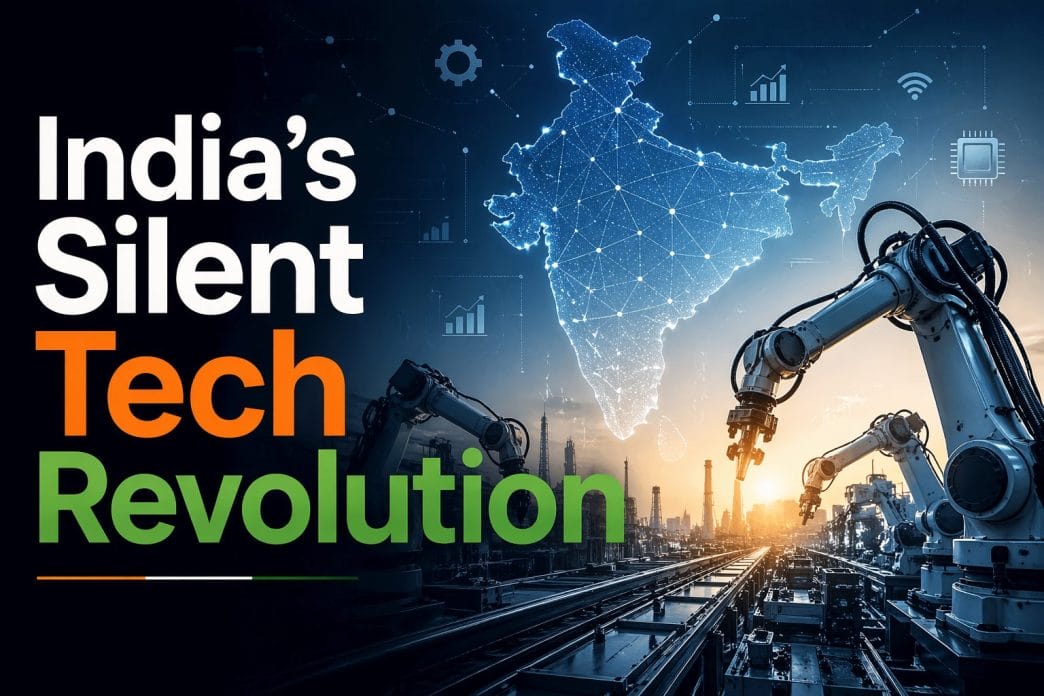
If this model matures, the future of manufacturing in India could look radically different. Factories may operate with a high degree of autonomy, driven by robotics and artificial intelligence that optimize production around the clock. Industrial clusters could become hyper-connected ecosystems, sharing data and resources to achieve collective efficiency.
Sustainability, too, could move from compliance to core design, with smart energy systems and resource optimization built into the infrastructure itself. The convergence of AI and hardware manufacturing could accelerate, creating a feedback loop where technological innovation fuels industrial capability, and vice versa.
In such a scenario, India would not just be producing goods; it would be producing them intelligently, efficiently, and at scale.
The Execution Challenge
Yet, the success of this vision hinges on a single variable- execution. India’s policy landscape has often been rich in intent but uneven in implementation. Land acquisition complexities, coordination challenges between different levels of government, and inconsistencies in infrastructure quality remain real risks.
There is also the danger of bureaucratic inertia creeping back into the system, diluting the efficiency gains that the model seeks to achieve. The challenge, therefore, is not just to design a better system, but to sustain its integrity over time. Execution, in this context, becomes the ultimate differentiator.
A Silent but Structural Revolution
Unlike the visible narratives of startups and digital platforms, this transformation operates quietly. It does not generate immediate headlines or dramatic success stories. There are no viral moments or overnight valuations to capture attention. And yet, its impact could be far more enduring.
Because the true measure of a nation’s progress lies not just in its ideas, but in its ability to execute them at scale. It lies in the factories that produce, the supply chains that deliver, and the systems that sustain growth over time.
BHAVYA, in this sense, represents a foundational shift. It is not about incremental improvement; it is about redefining how manufacturing is conceived and executed in India.
The Final Word: Where Code Meets Concrete
The future of technology will not be confined to the digital realm. It will emerge at the intersection of code and concrete, where algorithms meet assembly lines and data drives design. Those who recognize this convergence will be best positioned to navigate the next phase of global transformation.
India, through initiatives like BHAVYA, appears to be aligning itself with this reality. It is not merely coding the future and also preparing to manufacture it at scale.