





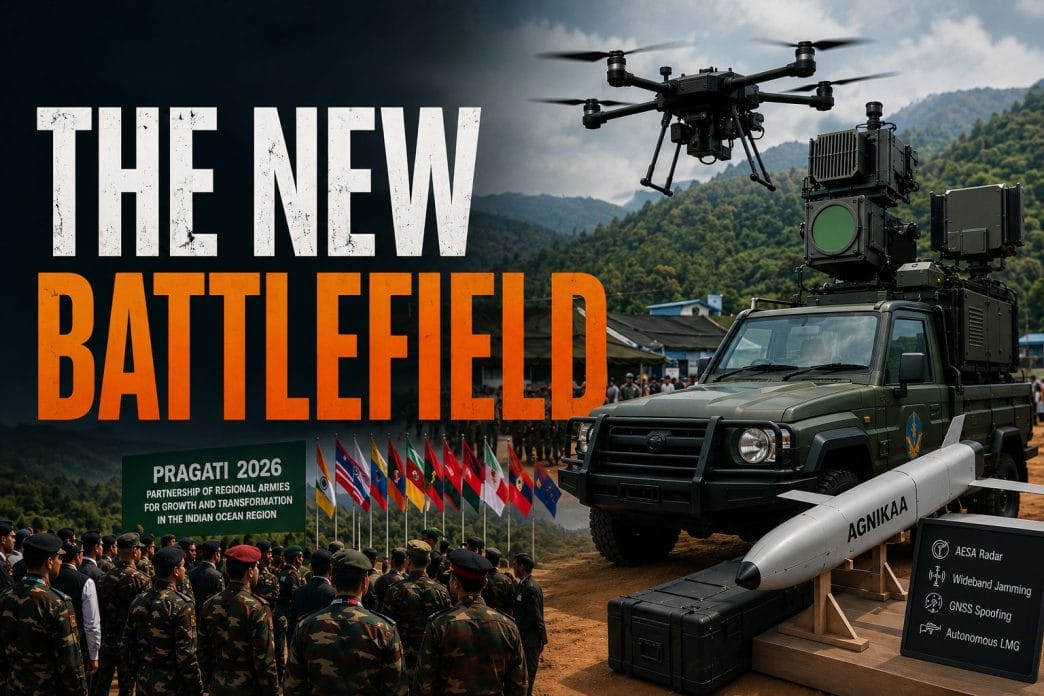
Heavy machinery, mass formations, brute force: the kings of yesterday’s battlefield are being dethroned. Technology is the new frontline. At Umroi, India showed it intends to lead it.
UMROI (SHILLONG), MEGHALAYA: Every active conflict zone on this planet has witnessed a fundamental transformation powered by the rise of electronic warfare, autonomous drones, and loitering munitions. These war technologies have become indispensable, with private sector innovation serving as the primary driver behind this radical military evolution.
The shift was impossible to miss at PRAGATI 2026, the maiden multilateral joint military exercise held at Field Training Node, Umroi, from May 18-31. Organised jointly by FICCI, the Indian Army’s HQ Eastern Command and the Army Design Bureau, the Industry Exposition brought together Indian defence firms showcasing advanced battlefield technologies before representatives from 12 friendly foreign countries from the ASEAN and regional neighbourhood.
Among the participants, Adani Defence & Aerospace emerged as one of the most prominent showcases of India’s expanding indigenous defence ecosystem, presenting a wide spectrum of battlefield technologies ranging from counter-drone systems and loitering munitions to small arms, ammunition and missile systems.
A Full Spectrum Battlefield Showcase
The Adani Defence & Aerospace counter-UAS portfolio drew significant attention amid growing concerns around drone warfare and asymmetric aerial threats. Last year, Adani Defence & Aerospace, launched India’s first public-private, vehicle-mounted Counter-Drone System (CUAS). Integrated onto a 4×4 platform, the system can autonomously detect, classify and neutralise hostile drones using high-energy lasers, radar and signal jammers.
Adani showcased a layered counter-drone architecture to strengthen India’s integrated defence strategy in line with Mission Sudarshan Chakra. Its Vehicle-Mounted Counter-Drone System combines soft-kill and hard-kill technologies on a mobile platform designed for convoy protection and forward deployments.

How Counter-Drone Systems Work
Counter-drone warfare is far more complex than simply shooting a drone out of the sky. A hostile drone must first be detected, identified, tracked and only then neutralised. Failure at any stage can render the entire defence chain ineffective.
Modern counter-drone systems rely on multiple layers of sensors working together. Radar helps detect small aerial objects with low radar signatures. Radio-frequency sensors monitor communication links between drones and their operators. Electro-optical and infrared systems provide visual confirmation and tracking. The effectiveness of the system comes from fusing these different inputs into a single operational picture.
Once a drone is detected, the challenge shifts to identification. Birds, friendly drones and hostile drones can often occupy the same airspace and display similar flight characteristics. Advanced software and artificial intelligence models help classify aerial targets in real time, reducing the risk of false alarms and misidentification.
Only after detection and identification does neutralisation begin. Soft-kill measures include jamming control links or spoofing navigation systems to disrupt the drone’s operation without physically destroying it. Hard-kill measures involve kinetic interceptors, lasers or other systems designed to eliminate the threat outright. Modern counter-drone architectures increasingly combine both approaches, allowing operators to choose the most effective response depending on the threat, environment and operational objective.
Among the standout systems was the ‘Cyber Takeover’ platform, an SUV-mounted counter-drone solution integrating AESA radar, wideband jamming, GNSS spoofing and an autonomous Light Machine Gun. Unlike conventional systems that merely jam or destroy hostile UAVs, ‘Cyber Takeover’ is designed to seize control of enemy drones.
The defence giant also showcased its loitering munitions portfolio, the ‘kamikaze drones’, highlighting the global shift toward precision-strike warfare. Designed to hover over target areas before engaging with precision, these systems are increasingly emerging as force multipliers in difficult terrains, including the semi-mountainous and jungle warfare scenarios simulated during PRAGATI 2026.
Beyond aerial systems, the company displayed indigenously manufactured small arms, ammunition and missile systems, reflecting India’s broader push toward self-reliance in advanced defence manufacturing. Recently, Adani Defence & Aerospace had also delivered its first batch of 7.62 mm-calibre Prahar Light Machine Guns (LMGs) to the Indian Army. Manufactured at the company’s small arms complex in Gwalior, this milestone was completed months ahead of schedule and will significantly boost indigenous infantry firepower.

Indigenous Defence Systems, Global Strategic Relevance
The broader significance of the exposition extended beyond individual product displays. PRAGATI 2026 is the first edition of a multilateral exercise involving India and 12 friendly foreign countries including Bhutan, Cambodia, Indonesia, Laos, Malaysia, Maldives, Myanmar, Nepal, the Philippines, Seychelles, Sri Lanka and Vietnam.
With military leaders, procurement officials and defence attachés in attendance, the event served simultaneously as an operational exercise and a structured opportunity for Indian companies to explore export potential and deepen defence cooperation within the region.
As modern battlefields become more technology-defined and less platform-defined, exercises like PRAGATI create infrastructure for something larger than procurement. They seed long-term defence relationships, doctrine alignment and interoperability. India’s private sector arrived at Umroi not merely as vendors, but as strategic partners building the nation’s evolving security architecture.