





Every minute, the internet generates more words than a human being could read in a lifetime. Videos, advertisements, articles, AI-written posts: all competing for the same finite resource. Not bandwidth, or storage. Attention. Technology has solved the supply problem of information decisively. But it has yet to solve the demand problem of meaning. That gap is where the next competitive advantage in communication is being built.
The professional who wins that contest is no longer the one who knows the most. It is the one who can take raw information, give it a shape, make it emotionally legible, and leave something behind in the reader’s memory. Put plainly: the frontier of content now sits at the intersection of narrative structure, storytelling craft and applied neuroscience, with marketing as the discipline that converts all three into action.
Information Answers. Narrative Asks.
Take a single sentence: generative AI can automate a meaningful share of knowledge work. This might be accurate. But it’s also forgettable. Now, let’s recast it: For two centuries, machines replaced human muscle; AI is the first machine to enter the territory of human cognition. The facts are nearly identical, the effect is not. Since the second version has a trajectory, a contrast, and an implied question the reader cannot help but ask: where does that leave me?
“Information answers a question. Narrative creates a question worth answering.”
That is the functional difference between broadcasting a fact and communicating an idea. A narrative is, in essence, an architecture of meaning. It tells the reader where things stood, what changed, why, and what comes next. Even the driest engineering subject bends to this structure. A digital twin explained through sensors and simulation platforms is accurate but expensive to process. A digital twin introduced as a living shadow of a machine, one that shows signs of trouble before the real machine fails, gives the reader a mental picture first. The technical detail becomes easy to absorb because it now has something to attach itself to.
Technology’s Real Protagonist Is Never the Technology
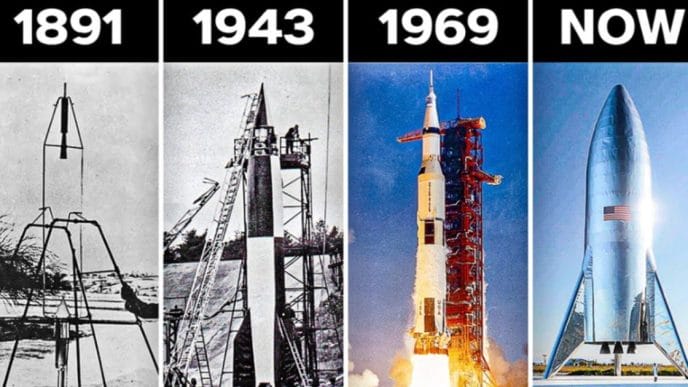
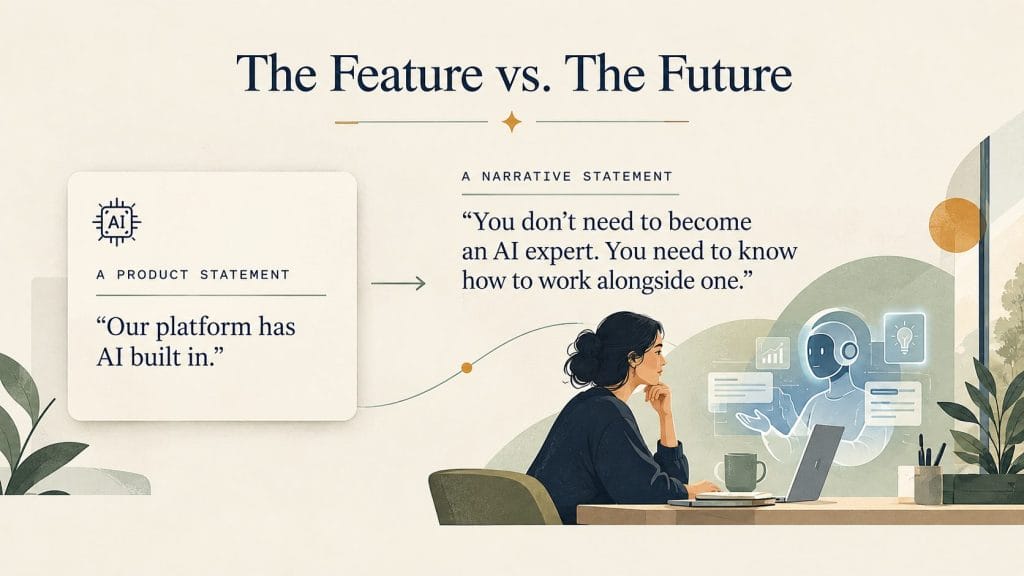
Storytelling does something narrative alone cannot: it installs a human being inside the machine. AI communication is rarely, at bottom, about model architecture. It is about a worker wondering whether her role is about to change. A rocket is not a fuel-and-thrust problem; it is humanity’s long argument with gravity. Similarly, a diagnostic model is not a classification algorithm; it is a doctor trying to make one better call for one real patient. Ask where the human is inside a piece of technology, and the technology stops being abstract.
The Brain Is Not a Neutral Reader
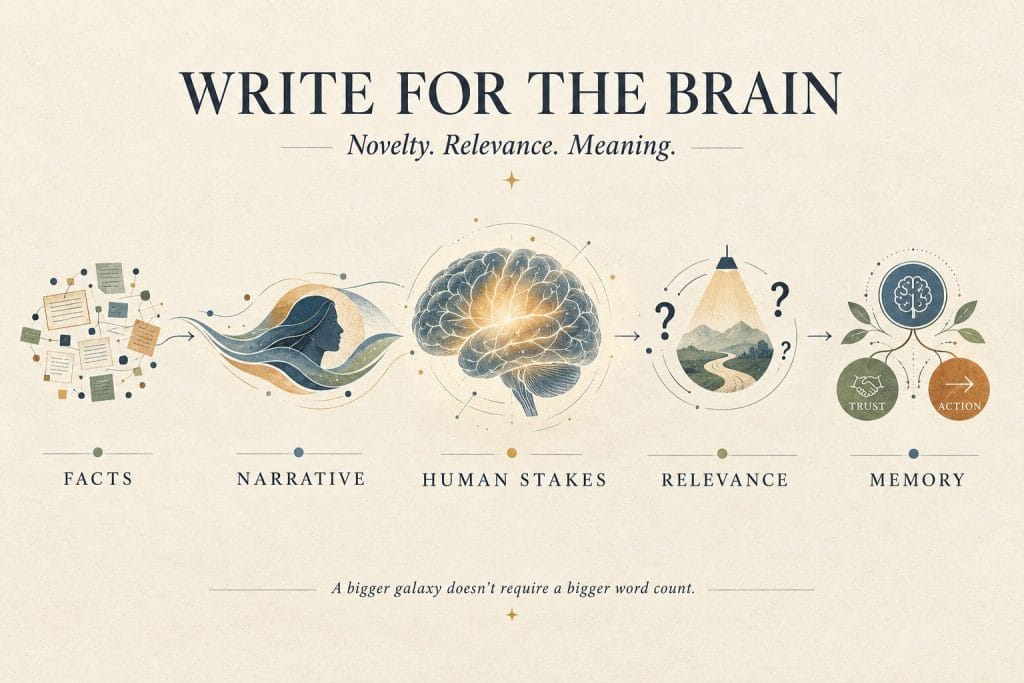
This is where neuroscience earns its place at the table. Attention is selective, not evenly distributed. Emotion regulates what gets processed and retained. Novelty draws the eye; relevance decides whether it stays. Information that connects to something the reader already knows is processed faster and remembered longer. The practical implication is uncomfortable for anyone who thinks of writing as simply arranging facts in order: the writer is not addressing a blank page. The writer is addressing a biological system that is constantly running the same background query. Is this new, is this relevant, should I care, can I understand it, what does it mean for me.
Content that performs well does not fight that query. It answers it, in sequence, before the reader has to ask.
The Architecture of Attention
Strong content typically moves a reader through a repeatable sequence: attention, curiosity, understanding, emotion, insight, memory, and only then, action. First the noise must be interrupted. Then curiosity has to be created. Not manufactured through a false promise, but through a genuine information gap that the piece is prepared to close. A headline that says “the next revolution in computing may not happen inside a computer” is not decoration. It is the doorway into cognition, and the reader’s mind will supply its own candidates (quantum, biological, edge) before the piece even answers.
“Curiosity should not become clickbait. The promise made by the headline must ultimately be honoured. Trust is the invisible currency of long-term content.”
Emotion Is Not the Enemy of Technical Credibility
Engineers want facts. Scientists want evidence. Boardrooms want numbers. All are correct to want them. But human beings do not construct meaning out of numbers alone. Emotion is simply the brain’s internal flag for “this matters.” “Global temperatures are rising” is information. “What kind of planet will our grandchildren inherit” is a question the reader cannot politely decline. The first informs, while the second implicates. That is not manipulation; it is the honest connection of an abstraction to a stake the reader already holds.
Why This Matters More, Not Less, in the Age of AI
Generative models can now summarise, translate and produce thousands of words in seconds. Information production is becoming cheap at a speed no newsroom or content team fully anticipated. This relocates the communicator’s job. The premium is moving away from “what information should I give” and toward “what should the reader think, feel, understand and remember after encountering this.” Judgment, originality, narrative intelligence and credibility do not scale the way word count does, which is exactly why they are becoming the asset worth owning.
The same logic governs the most sophisticated marketing, which no longer opens with how do I sell this but with why should this matter to this person. A product has features, a customer has a problem, and the story serves as simply the bridge between the two. And people, in the end, buy futures and identities far more readily than they buy specification sheets.
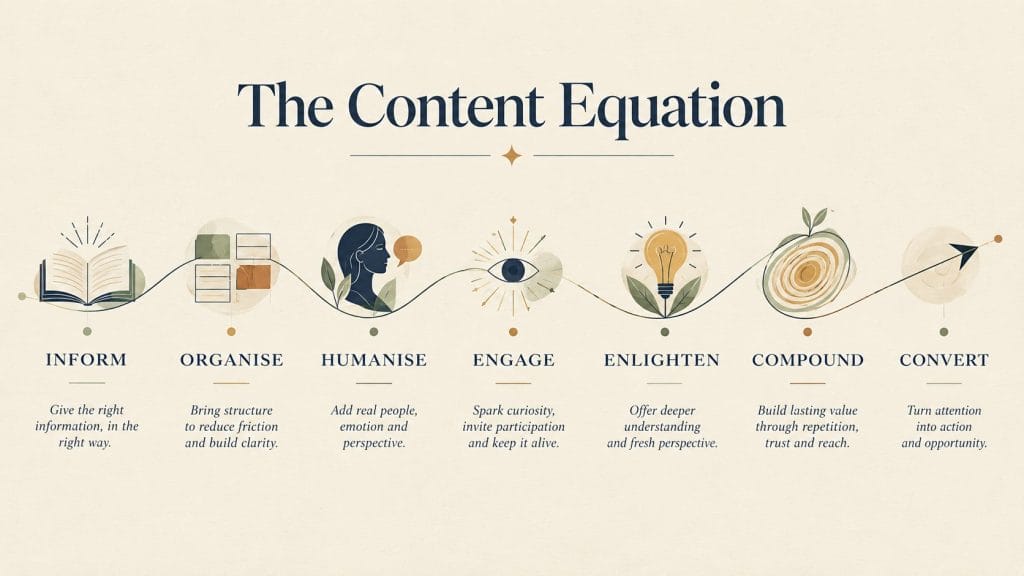
The coming contest is not human content versus AI content. It is forgettable information versus meaningful communication. And only one of those scales with a bigger model.
A content creator, redefined: not someone who produces information, but an architect who gives it narrative structure, ties it to human experience, and designs a journey through another person’s mind.