




How a spacecraft ventured where no machine had gone before, and transformed our understanding of our life-giving star.
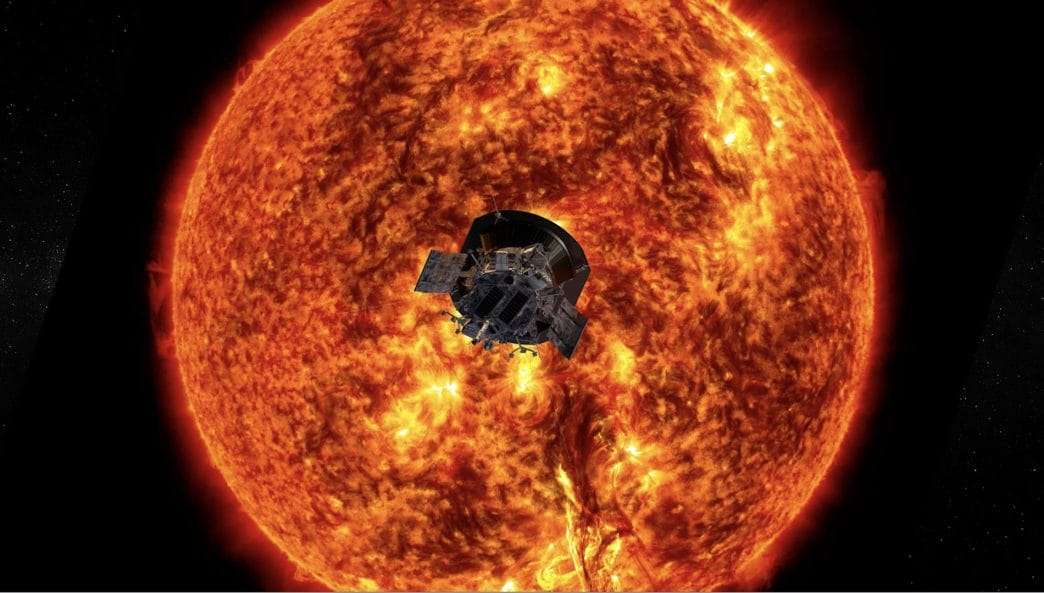
Imagine standing beside a blazing furnace so hot that steel melts like wax. Now imagine deciding not merely to approach it, but to plunge into its heart. It may sound like the opening scene of a science-fiction movie. Yet, this is precisely what humanity has accomplished with the Parker Solar Probe, a spacecraft that ventured closer to the Sun than any object ever built by human hands.
For centuries, the Sun has been revered as a deity, feared as an inferno, and studied as the engine of life itself. Every sunrise fuels our crops, drives Earth’s climate, and powers the winds and oceans. Yet, despite being our closest star, the Sun has guarded many of its deepest secrets.
One mystery has puzzled scientists for decades: why is the Sun’s outer atmosphere, called the corona, hundreds of times hotter than its visible surface? Common sense tells us that moving farther from a fire should make things cooler, not unimaginably hotter. Answering that question demanded extraordinary courage, not from astronauts, but from engineers, physicists, and dreamers.
In 2018, NASA launched the Parker Solar Probe on a mission unlike any before it. Rather than observing the Sun from afar, it would repeatedly dive into its fiery atmosphere, enduring temperatures exceeding 1,000°C on its protective shield while travelling at speeds approaching 700,000 kilometres per hour, making it the fastest human-made object in history.
How Does it Survive?
The answer is surprisingly elegant. The spacecraft is protected by a carbon-composite heat shield only a few inches thick. While the Sun-facing side glows white-hot, the scientific instruments hidden behind it remain near room temperature. Survival depends not on escaping the heat, but on constantly keeping the shield perfectly pointed toward the Sun. A tiny mistake could expose sensitive electronics to destructive temperatures.
The Parker Solar Probe is, in many ways, an autonomous explorer. Radio signals between Earth and the spacecraft take several minutes to travel one way, making real-time control impossible. Instead, the probe constantly monitors itself, detects danger, and corrects its orientation without waiting for instructions. It is an engineering masterpiece built to think, react, and survive on its own.
But reaching the Sun is far more difficult than it appears.
Ironically, falling into the Sun is harder than escaping the Solar System. Earth races around the Sun at tremendous speed. To get close to our star, a spacecraft must shed much of that sideways motion. Parker accomplishes this by repeatedly flying past Venus. Each close encounter with the planet acts like a carefully calculated gravitational brake, allowing the spacecraft to spiral ever closer to the Sun.
This celestial dance has transformed Parker into a record-breaker. With every orbit, it has travelled faster, ventured deeper into the Sun’s atmosphere, and gathered data never before available to science.
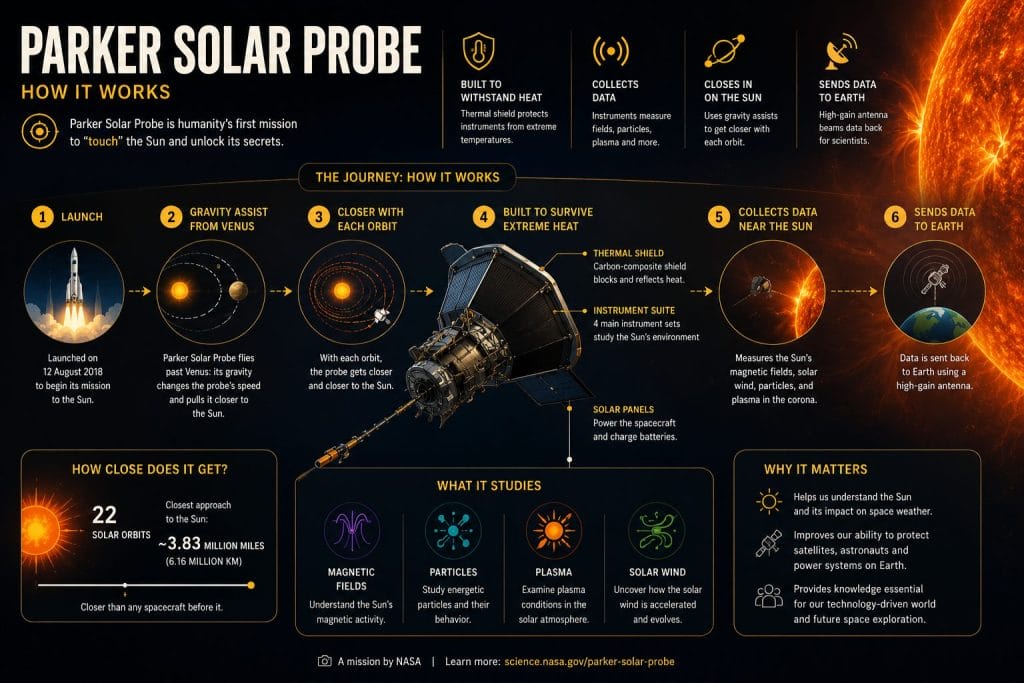
The discoveries have been astonishing. Scientists have observed bizarre magnetic structures called switchbacks, where the solar wind suddenly twists and reverses direction. They have flown through regions where the solar wind is actually born. They have measured violent magnetic fields and captured breathtaking images of structures hidden within the solar corona.
Each observation has challenged long-held theories and refined our understanding of how stars behave.
Why Should Ordinary People Care?
Because the Sun is not a gentle lamp hanging in the sky. It is an enormous nuclear reactor capable of unleashing colossal eruptions known as solar flares and coronal mass ejections. These storms hurl billions of tonnes of charged particles into space. When directed toward Earth, they can disrupt satellites, GPS navigation, radio communications, airline operations, astronauts in orbit, and even electrical power grids.
Modern civilisation increasingly depends on technologies vulnerable to space weather. Understanding the Sun, therefore, is becoming an essential requirement for protecting our technological world. The Parker Solar Probe is helping scientists forecast these solar tempests with greater accuracy, much like meteorologists predict cyclones on Earth.
Its discoveries are also guiding future missions across the world. India’s Aditya-L1 solar observatory, Europe’s Solar Orbiter, and future international missions will all build upon the knowledge Parker has gathered.
Perhaps the most inspiring aspect of the mission is its name. Unlike most spacecraft, which are named after historical figures long after their passing, the Parker Solar Probe honours physicist Dr. Eugene Parker during his lifetime.
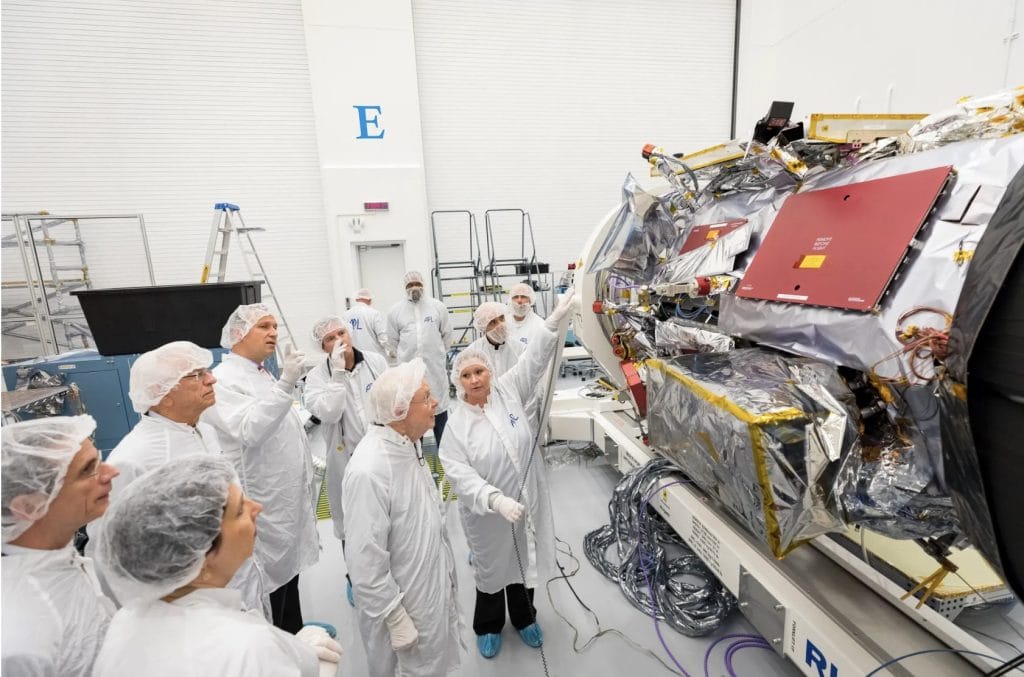
Decades earlier, Parker proposed the revolutionary idea that the Sun continuously emits a stream of charged particles, called the solar wind. Initially dismissed by many, his theory was later proven correct and fundamentally changed astrophysics. The spacecraft bearing his name now flies through the very phenomenon he predicted.
Fueled By Curiosity
Science occasionally comes full circle in the most beautiful way. The Parker Solar Probe also reminds us that great exploration is not solely about reaching distant worlds. Sometimes, the greatest adventure lies in understanding what has been shining above us every single day. Every photograph returned, every magnetic field measured, and every burst of solar wind analysed brings us closer to answering questions that have puzzled humanity for generations. More importantly, it demonstrates what becomes possible when curiosity refuses to accept impossible as an answer.
The spacecraft will eventually exhaust its mission, but its legacy will endure for decades. Its data will inspire thousands of scientific papers, shape future spacecraft, improve space-weather forecasting, and deepen humanity’s understanding of the star that makes all life on Earth possible.
The Parker Solar Probe has not conquered the Sun. It has done something far more profound. It has shown that the greatest power of human civilization is not its machines, but its curiosity, the quiet determination to ask impossible questions and then build extraordinary tools to seek the answers.
In reaching toward the Sun, humanity was never chasing fire. It was chasing understanding.