




How a quiet revolution in neural sensors is rewriting the rules of human-machine interaction
For most of recorded history, the boundary between a human mind and the machines it built was absolute. You thought. The machine waited. You acted. The machine responded. This boundary is dissolving.
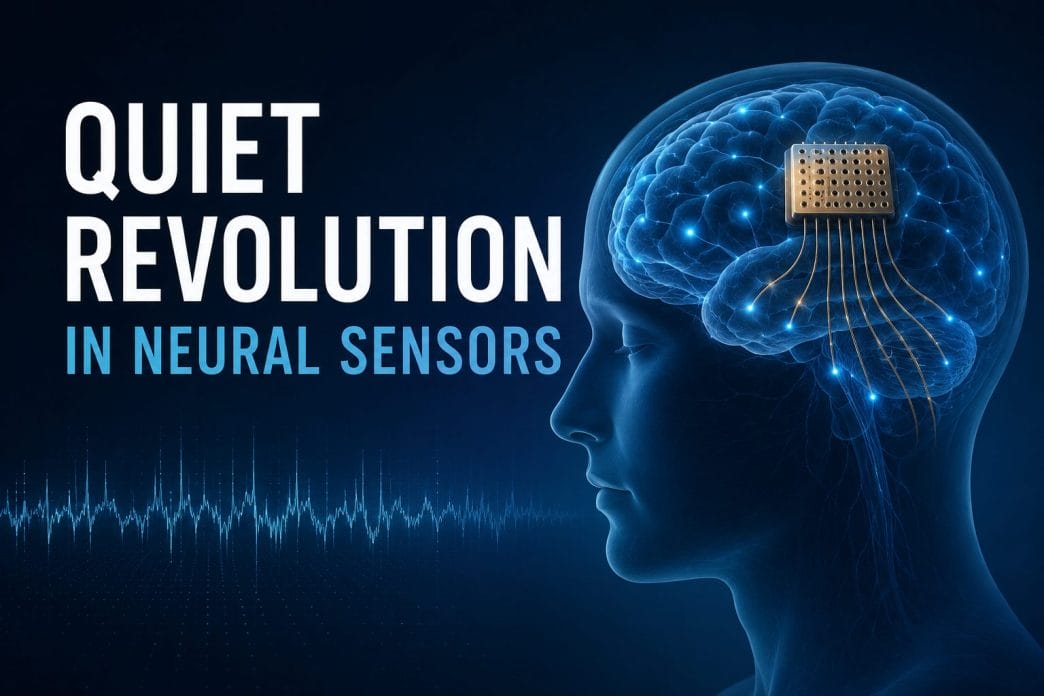
Brain-computer interfaces, devices that establish a direct communication channel between neural tissue and external hardware, have existed in research settings for decades. The concept is not new. The engineering is. A new generation of soft, flexible, 3D-printed sensors that conform to the brain’s surface is solving problems that rigid implants never could. The result is a technology category that is quietly crossing the threshold from academic curiosity to strategic priority.
Understanding what BCIs actually are, how the new sensor technology changes the calculus, and why signal quality is the variable everything else depends on is where this story begins.
What a Brain-Computer Interface Actually Does
A BCI does one thing at its core: it reads electrical signals generated by neurons and translates them into commands a machine can act on. The neuron fires. The electrode picks up the signal. The software decodes it. Something happens: a cursor moves, a prosthetic hand closes, a word appears on a screen.
The earliest clinical BCIs used rigid electrode arrays implanted directly into brain tissue. The Utah Array, developed by Blackrock Neurotech and still the backbone of most research-grade neural recording, looks like a small bed of metallic pins. It works. It has restored meaningful motor function to patients with paralysis. It has enabled thought-controlled cursor navigation and text composition. These are not theoretical results. They are published, peer-reviewed, clinically demonstrated outcomes.
But rigid implants carry a fundamental problem. The brain is soft, wet, and in constant micro-motion. A rigid electrode, pressed against living tissue over months and years, generates inflammation. Scar tissue forms around the implant. Signal quality degrades. The device that worked well in month three may be producing noise by year two.
This is the bottleneck that new sensor technology is designed to break.
Why the Sensor Breakthrough Matters
Think of the shift from rigid to soft, conforming neural sensors as less an incremental improvement and more a different order of magnitude, like the jump from standard definition to 4K. Same underlying idea. Entirely different ceiling.
Soft sensors, fabricated using advances in flexible electronics and 3D bioprinting, conform to the brain’s surface rather than pressing against it. They move with the tissue, reducing the inflammatory response that kills signal quality over time. And they can be designed to match the exact geometry of an individual patient’s cortex, making genuine personalisation of the hardware layer achievable at scale for the first time.
The downstream implications are significant. Long-term stable implantation becomes viable. AI decoding accuracy improves when the underlying signal is cleaner and more consistent. And the range of clinical applications expands, from short-term interventions to lifelong assistive devices.
Signal quality is not a technical footnote. It is the prerequisite for everything else BCIs are supposed to do.
The Four Layers That Determine Who Wins
BCIs are not a single product. They are a stack: four distinct layers of technology, each of which must work, and each of which represents a separate competitive arena.
The hardware layer is where sensors and implants live. This is the physical interface with the brain, the domain of Neuralink, Blackrock Neurotech, Synchron, and the emerging cohort of soft-sensor researchers.
Above that sits the signal processing layer, where raw neural electrical activity is decoded into intelligible commands. This is fundamentally an AI problem. The signal is noisy, high-dimensional, and deeply individual. Decoding it requires machine learning systems trained on neural datasets, which is why Google DeepMind, Meta’s AI labs, and a growing number of specialist startups have positioned themselves here.
The third layer is cognitive applications: the actual use cases that sit on top of decoded neural signals. Thought-controlled typing. Memory prosthetics. Seamless BCI device control. This is where platform companies and healthcare giants will eventually compete.
And then there is the fourth layer, which is the one that actually determines long-term power: the data layer. Neural datasets, large, longitudinal, high-resolution records of how individual brains generate and pattern signals, are the training resource that makes everything above work better. Whoever accumulates this data, at scale, across diverse populations and clinical contexts, holds an asset that cannot easily be replicated.
The actor who integrates all four layers is not simply ahead in a technology race. They hold something qualitatively different from everyone else.
Where Things Actually Stand
It is worth being precise about what exists today versus what is still on the horizon.
Blackrock’s Utah Array and Synchron’s Stentrode, a device deployed via the jugular vein without open-brain surgery, are already in human trials and clinical use. Neuralink demonstrated a human participant controlling a computer cursor through thought in 2024. Researchers at UCSF and UC Berkeley have published work on neural signal decoding for speech reconstruction in Nature. These are operational results, not roadmaps.
What is still emerging: personalised brain-conforming implantable hardware at commercial scale, and long-term stable implantation with minimal scarring. Both are in active development across academic and private labs globally, with a realistic commercialisation horizon of two to five years.
What remains on the horizon: seamless bidirectional human-AI cognitive integration, and commercial cognitive augmentation for healthy individuals. The science is not there yet, and the regulatory frameworks do not exist in any jurisdiction.
The distance between what BCIs can do today and what they are projected to do is real. But so is the distance between where the technology was five years ago and where it stands now. The trajectory is not speculative.
The Race Has Already Started
The soft sensor breakthrough is not arriving into a quiet landscape. It is arriving into a race that is already structured, already capitalised, and already producing results.
The next question is who is running it, under what national strategies, and what the geopolitical stakes of controlling the neural layer of human civilisation actually look like.
That is the subject of the next piece in this series.