




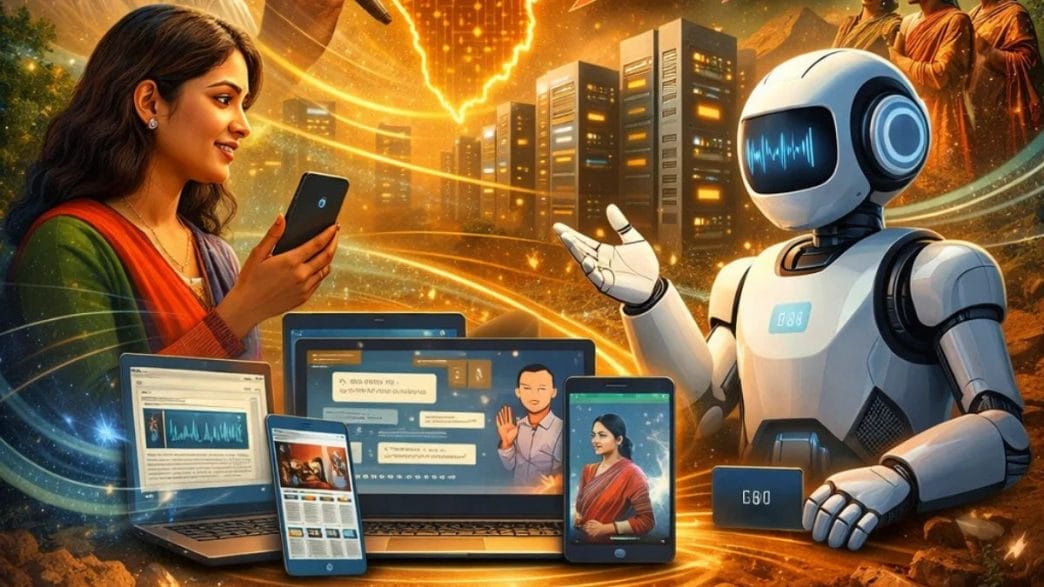
India’s digital language barrier is finally being dismantled, not by Big Tech, but by a government-led AI initiative. Bhashini, the BHASHa INterface for India under MeitY, is steadily powering a multilingual revolution, helping government apps, universities, and citizens communicate seamlessly across 36 languages, covering all scheduled Indian languages.
For instance, a senior citizen in Odisha needs to access the government pension portal. Previously, the English interface was a barrier. Now, Bhashini enables the portal in Odia. The senior citizen navigates and accesses services effortlessly using conversational AI in their regional language.
This isn’t just about convenience. It’s what happens when technology actually speaks the language of a billion people. While global tech giants build AI for English speakers, India is constructing something more ambitious: a language-neutral AI stack spanning 36 languages, including the 22 scheduled ones, plus hundreds of dialects. India’s emerging multilingual AI revolution, powered by Bhashini and platforms like BharatGen and Adi-Vaani, is building infrastructure most people haven’t heard about yet.
Bhashini: The Hub Nobody Talks About
Bhashini (BHASHa INterface for India) launched in July 2022 during Digital India Week in Gandhinagar, but it didn’t make global headlines. No flashy product announcements. No billion-dollar valuations. Just a government-backed platform steadily building the foundation for multilingual AI across India.
The platform operates under the National Language Translation Mission, implemented by the Digital India BHASHINI Division under the Ministry of Electronics and Information Technology. It currently supports 36 languages, covering all scheduled Indian languages for text translation and hosts over 1,000 AI-based language models. That’s not experimental tech. It’s infrastructure that has processed 5 billion inferences cumulatively in 2025 and serves over 1.3 million app downloads.
Over 50 stakeholders including NPCI, Reserve Bank Innovation Hub, Ministry of Rural Development, Lok Sabha, and Rajya Sabha are now collaborating with the platform.
What makes Bhashini different from Google Translate or similar tools? It’s built specifically for Indian linguistic structures. The platform provides text-to-text translation, automated speech recognition, text-to-speech synthesis, optical character recognition, video translation, document translation, language detection, and voice-based payments. All of this is offered as public digital infrastructure, free to use for developers, startups, and government agencies.
The results of this linguistic transformation are already visible across flagship government portals.
Government Apps Go Vernacular
By early 2025, multilingual rollout efforts began for the e-Shram portal. Same month, the Department of Defence Production website went multilingual on Army Day.
CPGRAMS, India’s largest grievance redressal portal, is integrating complaints in multiple regional languages, with expansion underway to full multilingual support. Over 5.6 million grievances resolved via CPGRAMS, with growing regional language support.
August 2024 saw the launch of the multilingual e-Gram Swaraj platform for rural governance, letting every citizen access digital services in their native language.
Building inclusivity also means tackling one of AI’s hardest problems: low-resource languages.
The Low-Resource Language Challenge
Building AI for Hindi is relatively straightforward. Building AI for Bhojpuri? That’s a different challenge entirely.
Bhojpuri is spoken by roughly 50 million people, yet digitized data in Bhojpuri is scarce. The JNU-BHLTR Bhojpuri corpus contains approximately 45,000 sentences. Global tokenizers perform poorly on many Indian scripts, misinterpreting characters or skipping them entirely.
AI4Bharat, an initiative from IIT Madras, built IndicBERT, supporting 12 major Indian languages. The model uses cross-lingual transfer learning, meaning knowledge from high-resource languages helps improve performance for low-resource ones.
For languages like Bhojpuri, researchers use datasets including ASR data from rural women speaking Hindi and Bhojpuri, supporting inclusive voice recognition.
From low-resource challenges to real-world deployment, the infrastructure is now powering applications at scale.
Citizen-Tuned Voice AI Powers Real Applications
Voice interfaces matter more in India than in most countries. Literacy rates vary. Screen sizes on affordable phones are small. Many users prefer speaking to typing. Bhashini enables AI-assisted real-time speech-to-speech translation in pilot and official use cases, and the results are already deployed at scale.
In December 2023, Prime Minister Narendra Modi used Bhashini to translate his real-time speech for a Tamil audience. During high-profile national addresses including the 2024 Union Budget presentation, AI-enabled multilingual translation was demonstrated. These weren’t publicity stunts. They were demonstrations that the technology works under high-pressure, high-visibility conditions.
More importantly, everyday applications are integrating Bhashini’s capabilities. ONDC launched Saarthi in September 2024, an application enabling businesses to create personalized buyer-side apps using Bhashini’s models. Federal Bank and Snapdeal and the Ministry of Information & Broadcasting signed MoUs with the BHASHINI Division to develop vernacular language solutions.
The platform offers several specialized tools. Chitraanuvaad handles video translation for Indian languages. Lekhaanuvaad manages document translation and digitization. The Bhashini Translation Plugin lets users translate webpage content across multiple Indic languages. Vaanianuvaad provides real-time speech-to-speech translation, making seamless communication possible across different languages.
GeM, the Government e-Marketplace, integrated GeMAI, an AI-powered multilingual assistant using advanced natural language processing. The system provides voice and text-based support across multiple Indian languages, helping users search, navigate, and complete transactions. This breaks language barriers in government procurement, a sector that affects millions of small businesses.
IndiaAI Mission: The ₹10,372 Crore Bet
In March 2024, the Cabinet approved the IndiaAI Mission with a budget outlay of ₹10,372 crore over five years. This isn’t research funding. It’s infrastructure investment designed to build a comprehensive AI ecosystem across seven key pillars.
- IndiaAI Compute Capacity established a high-end scalable AI computing ecosystem. Through public-private partnership, approximately 38,000 GPUs and TPUs are planned for deployment, with an additional 3,850 GPUs tendered in January 2026. Pilots and deployments are ongoing. An AI marketplace will offer AI as a service and pre-trained models to innovators, acting as a one-stop solution for resources critical to AI innovation.
- IndiaAI Innovation Centre developed indigenous Large Multimodal Models and domain-specific foundational models in critical sectors. This includes BharatGen, launched in June 2025 with its Param-1 model (2.9 billion parameters with 25% Indic data). The project has received total funding of approximately ₹2,000 crore, including an additional ₹1,058 crore allocation. BharatGen is currently piloting support for 9 to 15 languages, with plans to cover scheduled and additional languages by June 2026.
- IndiaAI Datasets Platform will streamline access to quality non-personal datasets for AI innovation. The platform will house a large collection of anonymized datasets, reducing barriers for Indian startups and researchers. By providing diverse datasets, the initiative aims to reduce biases and improve reliability of AI applications across agriculture, weather forecasting, and traffic management.
- IndiaAI Application Development Initiative promotes AI applications in critical sectors. It addresses problem statements from Central Ministries, State Departments, and other institutions. The focus is on developing, scaling, and promoting adoption of impactful AI solutions with potential for large-scale socio-economic transformation.
- IndiaAI FutureSkills will increase AI courses in undergraduate, master’s, and Ph.D. programs. Data and AI Labs will be set up in Tier 2 and Tier 3 cities across India to impart foundational level courses. The goal is building human capacity, not just funding research. India needs engineers working on language AI, not just researchers publishing papers.
- IndiaAI Startup Financing provides streamlined funding access for deep-tech AI startups. Approximately ₹2,000 crore is allocated for startup financing including the IndiaAI Startup Financing scheme at different growth stages, supporting startups from product development to commercialization.
- Safe & Trusted AI develops guidelines and frameworks for responsible AI practices, including indigenous tools for project assessment. This pillar addresses ethical concerns and ensures AI deployment aligns with Indian values and legal frameworks.
Bhashini received recognition including Express Computer’s Digital Trailblazer Award and ELETS Atma Nirbhar Award.
But the real measure isn’t awards. It’s usage. Over 100 use cases now run on Bhashini across industries and sectors. The platform hosts over 1,000 AI-based models available through Open Bhashini APIs. Developers can integrate these capabilities with a few lines of code.
India joined initiatives like the National Quantum Mission and Gaganyaan space program as statements of technological capability. The language AI stack is different. It’s not about prestige. It’s about making digital technology work for a billion people who don’t speak English. That’s a market global giants have largely ignored because building for linguistic diversity is hard and expensive.
India is proving it’s not just possible but practical. When a platform processed 5 billion inferences cumulatively by end-2025, when millions of grievances get filed in native languages, when delivery drivers see productivity gains by switching to their native language, the infrastructure is working at scale.
The language AI stack India is building gives the country a structural advantage. Global companies will struggle to replicate this because they don’t have the data, the partnerships, or the understanding of Indian linguistic complexity. India does, and it’s being offered as public infrastructure. The language barrier that kept millions offline is becoming the competitive moat that makes India’s digital economy uniquely positioned for the next decade.
India’s language-neutral AI stack is real infrastructure already deployed at scale, breaking digital barriers one translation at a time. Yet much of this transformation remains underreported outside India.