




Read through the Shenzhen side of the Shizi Yang tunnel project and the numbers look straightforward. A tunnel boring machine 15.03 metres in diameter. A working depth of 78 metres below the seabed. An intervention pressure of 0.85 MPa at the cutting face. By every surface metric, this is a large civil engineering project in a country that builds large civil engineering projects.
Three details make it something else entirely.
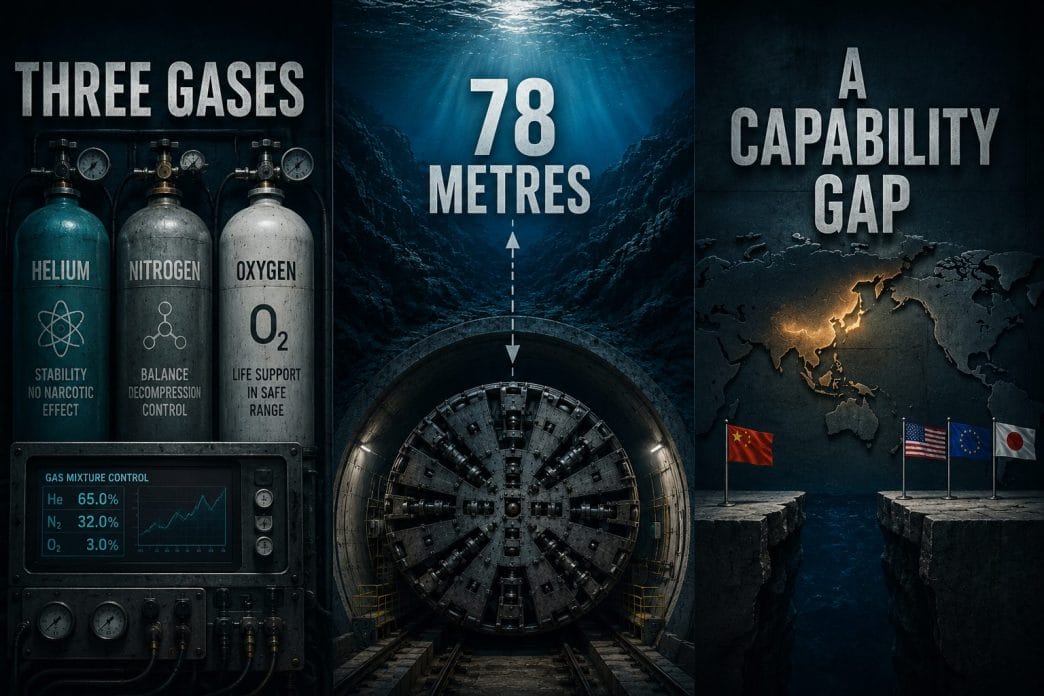
China has deployed the world’s first ternary mixed gas pressurized intervention system for undersea rail tunneling. Workers are entering a pressurized chamber at 0.85 MPa, roughly 8.5 atmospheres, breathing a purpose-blended mixture of helium, nitrogen, and oxygen to stay alive and functional while repairing a rotating cutterhead that cannot be reached any other way. No country has industrialized this procedure for tunnel construction before.
The Physics That Makes This Hard
Pressurized tunnel interventions require human workers at the cutting face for repairs too complex and unpredictable for remote systems. To keep water out, the working chamber is pressurized to match the surrounding ground pressure. At shallow depths, compressed air handles this adequately.
The problem is nitrogen. At elevated pressures, nitrogen acts as a narcotic. Cognitive function degrades, coordination fails, and judgment becomes unreliable at pressures well below what this project demands. Oxygen compounds the problem from the other direction: above a partial pressure of roughly 1.6 bar, it becomes directly toxic to the central nervous system, causing seizures and pulmonary damage. Standard compressed air, which is 78% nitrogen and 21% oxygen, cannot be safely breathed at 0.85 MPa.
The solution is to replace most of the nitrogen with helium, which has no narcotic effect at any pressure relevant to construction work. Oxygen concentration is then held within a narrow band, enough to sustain life, not enough to trigger toxicity. The third gas, residual nitrogen, is retained partly for cost reasons and partly to manage decompression.
Helium conducts heat away from the body six times faster than nitrogen. Workers in a helium atmosphere lose core temperature rapidly without active thermal management, which means heated undersuits, pre-conditioned breathing gas, and continuous physiological monitoring. Decompression from 0.85 MPa on a helium mix takes roughly 68 hours of staged pressure reduction. Workers spend days inside an onboard hyperbaric habitat while pressure is methodically reduced according to protocols calibrated to avoid decompression sickness. The full system includes automated gas blending, real-time monitoring of each worker’s physiological state, and emergency transfer capability to a surface decompression chamber.
Who Else Can Do This
Saturation diving, which uses the same helium-oxygen principles, has existed since the 1960s. Offshore oil operators in Norway, the UK, and the United States run saturation diving programmes routinely. The science is not new.
What is new is the industrialization of that science into a repeatable construction procedure, at tunnel-boring scale, on a domestic infrastructure programme. The relevant comparison is not whether other countries understand helium-oxygen physiology. They do. The comparison is whether they have the full stack to deploy it: tunnel boring machine manufacturers capable of integrating hyperbaric habitats into a 15-metre diameter machine, hyperbaric medicine infrastructure to staff and certify the programme, a regulatory framework to approve it, and a construction pipeline large enough to justify building the capability in the first place.
Germany has Herrenknecht, arguably the world’s finest tunnel boring machine manufacturer, but no domestic programme at this scale or depth. Norway leads in saturation diving operations but has no civil tunneling pipeline to put it to use. The United States has foundational research across all relevant disciplines but has not run a civil infrastructure programme that demanded integrating them.
China had the demand, the manufacturing base, the scientific capability, and a state apparatus with both the mandate and the budget to fund the integration. That combination produced the first deployment, not superior knowledge of helium chemistry.
Why Individual Projects Are the Wrong Unit of Analysis
Individual deployments generate operational data, refine protocols, reduce costs, and build embedded institutional knowledge. The first deployment is the most expensive and most uncertain. Each subsequent one is cheaper and more reliable. The country that industrializes a capability first runs down that learning curve while others are still deciding whether to start.
Two structural features of this particular capability make that compounding effect larger than usual. First, the adjacencies are wide. The gas management systems built here transfer directly to deep offshore energy maintenance. The hyperbaric life-support protocols apply to ultra-deep mining as near-surface deposits deplete. Second, the bottleneck is not knowledge but integration. The science exists in Western institutions. What does not exist, outside China right now, is a construction programme demanding that the science be integrated into working industrial procedure. Demand is what converts research into capability, and China is currently generating that demand at a scale no other country is matching in this domain.
Western policy analysis of Chinese infrastructure tends to focus on geopolitical applications: port access, rail connectivity, financing leverage over smaller economies. Those are real. The narrower concern is more technical and less discussed: the systematic accumulation of hard-environment engineering capability, domain by domain, in ways that are difficult to replicate quickly once the gap becomes structural.
The Long View
Capabilities like this are invisible in good times and consequential in bad ones. They do not appear in GDP figures. They do not move indices. They show up when a country needs to build or maintain infrastructure in conditions that defeat everyone else, and discovers it either has the engineering ecosystem to do it or it does not.
The Shizi Yang tunnel is not a headline. On the specific question of who is building the industrial capacity to operate in environments most of the world cannot reach, it is a more important development than most of what is generating headlines. That gap between significance and attention is worth closing.