



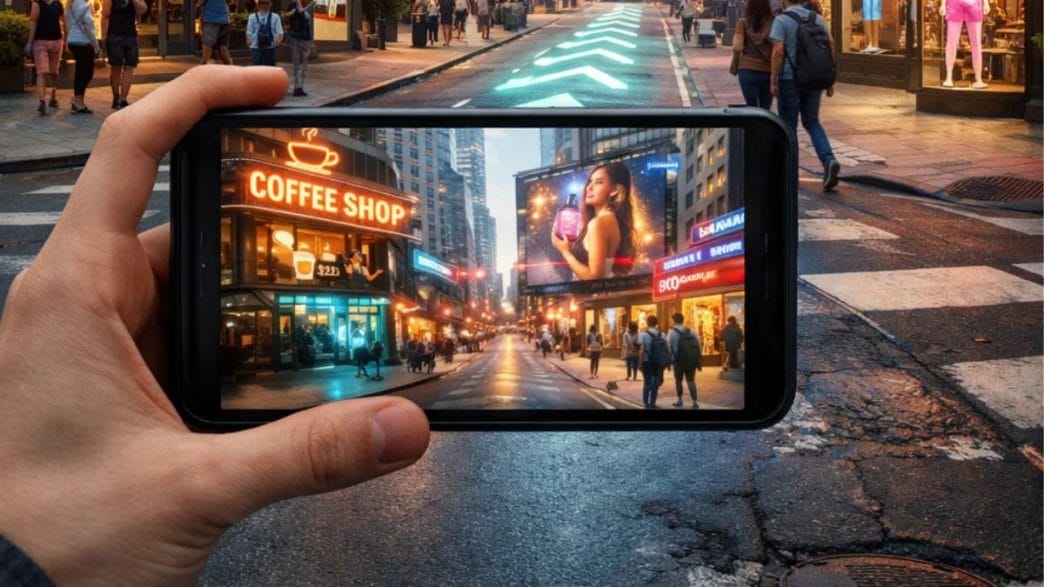
Your street corner could be worth more digitally than physically. Walk past a storefront today, and your phone might show a completely different business floating in augmented reality, one paying premium rates for that exact spot. This isn’t speculation about distant futures. AR advertising revenue continued to grow in 2025 and is emerging as a meaningful channel, and the infrastructure powering it just finished wrapping around an entire continent.
The question isn’t whether digital overlays will become permanent fixtures of urban life. It’s who controls them, who profits from them, and whether cities can regulate what doesn’t technically exist.
Bandwidth Makes Virtual Real
Meta just completed the core 2Africa submarine cable system, connecting 33 countries across Africa, Europe, and Asia. At 45,000 kilometers, it’s the world’s longest subsea cable network. The system delivers 180 terabits per second of capacity through 16 fiber pairs, double what older systems could handle.
India Connection Planned for 2026
The Pearls extension targets India, Pakistan, and the Arabian Gulf for 2026 deployment, though Red Sea security concerns have caused delays in some segments. This matters for AR because persistent digital overlays demand constant data streams. Current mobile networks struggle when hundreds of users in the same block try loading AR experiences simultaneously. Subsea cable capacity like 2Africa could help address that bottleneck, though last-mile infrastructure will determine actual performance.
Red Sea delays have pushed back some segments due to regional security concerns, but the core system now reaches populations that Meta estimates at over 3 billion people. That’s roughly 30% of global population with access to improved backbone infrastructure, though always-on augmented experiences will still depend heavily on local networks and device capabilities.
Digital Twins Turn Cities Into Platforms
Urban digital twins aren’t new, but their integration with AR is creating something different. Traditional city models helped planners simulate traffic or test building placements. AR-enabled twins let anyone overlay information onto physical spaces in real time.
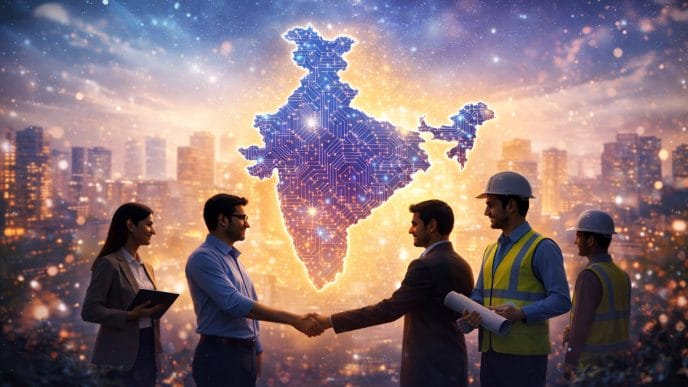
Maharashtra state’s 2025 AVGC-XR policy positions immersive technology like essential infrastructure, with provisions for 24/7 operations. The policy backs this with ₹3,268 crore in funding and targets ₹50,000 crore in private investment. It’s not treating AR as entertainment. It’s treating it as utility-grade infrastructure.
Pune has piloted digital twin use for simulating monsoon flooding in some construction planning. Real estate developers in Bengaluru and Hyderabad are deploying AR property tours that let buyers visualize unbuilt apartments overlaid on empty lots. These tools are spreading quickly in India’s fastest-growing tech hubs.
The Monetization Layer Nobody Expected
AR advertising doesn’t work like banner ads. A navigation app showing sponsored overlays for nearby stores isn’t intrusive when you’re actively looking for coffee. Location-based AR experiences are reported to increase engagement and visits to physical businesses. The Inter Miami CF partnership with XBTO and BrandXR transformed a street mural into an AR experience, delivering exclusive content to anyone pointing their phone at the wall.
That permanence matters. Traditional advertising provides momentary exposure. AR campaigns create ongoing destinations. Walk past the same corner daily, and each visit might show different promotions, events, or information based on time of day and your interests.
Revenue models are becoming clear:
- Sponsored overlays appearing in navigation and social apps
- Virtual real estate where businesses buy AR placement rights near physical locations
- Branded filters and effects that users voluntarily engage with
- Try-before-you-buy experiences driving actual purchases
In some Shopify case studies, products with AR visualization achieved 94% higher conversion rates than those without. That’s not a marginal improvement. That’s a fundamental shift in how people make buying decisions.
India’s Infrastructure Timing
Several factors align to position India as an AR infrastructure testing ground:
- Bandwidth expansion: 2Africa Pearls targeting India connectivity in 2026
- Policy support: Maharashtra’s AVGC-XR promotion plus Smart Cities Mission’s ICT initiatives
- Digital twin pilots: Projects emerging in Pune and Mumbai
- PropTech growth: Virtual tours common, with AR property visualization expanding in major markets
India’s Smart Cities Mission emphasizes ICT platforms, sensors, and data integration for urban management, with AR being explored in some pilot deployments. The National Artificial Intelligence Mission, with over ₹10,300 crore in funding, supports infrastructure, research, and development across AI applications including immersive technologies.
PropTech companies like Square Yards and PropVR are using AR and digital twins for property sales in Dubai and Riyadh, exporting Indian-developed technology to global markets. The domestic market is growing faster. Urban digital twin applications in India are expected to expand significantly as substantial infrastructure development continues through 2050.
When Streets Become Screens
The convergence is happening now. Cities build digital twin models. Telecom providers roll out high-capacity networks. Software platforms make AR creation accessible to small businesses, not just Fortune 500 brands. AR campaigns that once required substantial investment can now be launched at much lower costs using platforms like Snapchat’s Lens Web Builder or TikTok’s Branded Effects.
This democratization creates opportunities and problems. If any business can place AR content at any location, who mediates conflicts? If three coffee shops compete for the same street corner’s AR space, what determines priority? Traditional property rights don’t extend to virtual overlays, and most cities lack frameworks for regulating what exists only through screens.
From Experiment to Essential
Some cities are moving ahead of regulation. Columbus, Ohio used AR to get residents involved in transit planning, letting them visualize proposed bus rapid transit stations overlaid on actual streets. Residents scanning QR codes saw future infrastructure from multiple angles, turning abstract engineering drawings into tangible experiences.
Dublin’s docklands project created digital twins for smart planning, integrating AR visualization tools for public consultation. Rotterdam uses digital twins to model flood risks, and AR helps show those risks to residents who can visualize water levels overlaid on their neighborhoods.
These aren’t technology demonstrations. They’re governance tools becoming operational infrastructure. As cities generate more real-time data from sensors, cameras, and connected devices, the line between physical and augmented urban environments blurs until the distinction stops mattering.
The Revenue Question Cities Face
Traditional outdoor advertising generates municipal revenue through permits and fees. When AR advertising happens through private apps showing content at physical locations, who should collect fees? If a business places a virtual storefront in AR space near a physical landmark, does that require city approval?
These questions lack clear answers because the legal frameworks don’t exist yet. Some cities will move fast to establish rules. Others will wait until conflicts force action. The first-mover advantage goes to municipalities that can attract AR investment while protecting public interests.
AR monetization through advertising, branded experiences, and virtual commerce is projected by various market forecasts to influence billions in consumer spending by 2030. Cities either participate in that revenue distribution or watch it flow entirely to private platforms.
Three Years From Now
Picture walking through Connaught Place in Delhi. Your phone shows restaurant menus floating above entrances, reviews from friends overlaid on storefronts, and navigation arrows painted onto the sidewalk. A virtual art installation hovers above the central park, viewable only through your device, sponsored by a brand but created by local artists.
This works through phones today, and AR-capable glasses as they become more common. The infrastructure is being built right now. The bandwidth capacity improvements target 2026. The software platforms exist. India’s cities are generating digital twin models.
What’s missing is the regulatory structure and the business ecosystem to manage permanent AR layers responsibly. Cities that solve this first will become templates for hundreds of others facing the same questions. The technology isn’t coming. It’s here, scaling fast, and turning every street corner into potential real estate that exists in two dimensions simultaneously.