



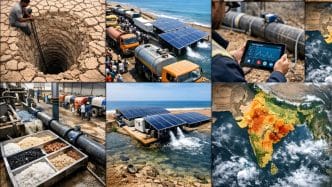
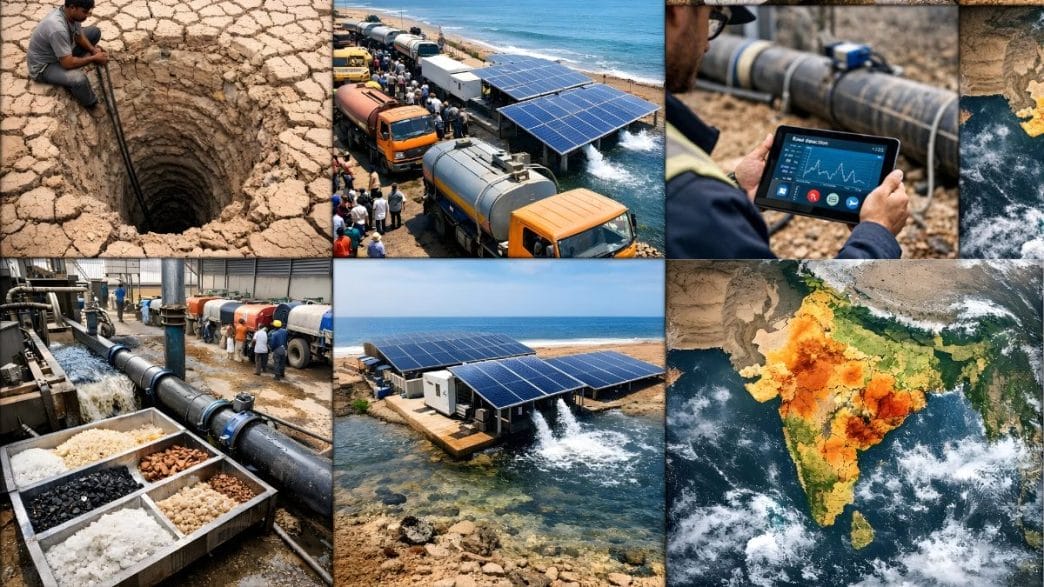
Bangalore faced a severe water crisis in 2024 as thousands of borewells ran dry across the city. The tech capital watched water tanker prices explode as families scrambled for basic water supply. Drilling 2,000 feet deep couldn’t find a drop.
This wasn’t supposed to happen. Chennai experienced a severe water crisis in 2019 when reservoirs nearly emptied and the city became heavily dependent on tankers. Bangalore watched, nodded sympathetically, and then ignored every warning sign. When thousands of borewells failed in 2024, the city teetered on collapse.
But something unexpected happened. While politicians blamed each other and residents panicked, a different kind of solution was already working quietly in the background. AI-powered systems, solar desalination plants, IoT sensors, and predictive algorithms were being deployed across India. The question now isn’t whether technology can solve water scarcity. It’s whether we’ll deploy it fast enough.
Solar Panels That Think Like Deserts
Traditional desalination plants work, but they’re expensive and dirty. They consume massive electricity and produce toxic brine that kills marine life. Coastal India needs desalination, but not at the cost of destroying oceans.
Desolenator approached the problem differently. The Dutch company built solar-powered thermal desalination systems that operate without chemicals or fossil fuels. Their technology combines photovoltaic panels with thermal collection, creating an integrated system that runs completely off-grid.
The system produces low-concentration, non-toxic brine that can be further processed through zero liquid discharge methods. Desolenator partnered with Jakson Green in December 2024 to deploy across India, focusing on regions where traditional infrastructure remains inadequate.
For cities like Chennai and Mumbai facing acute coastal water stress, this technology could mean the difference between survival and mass migration.
Wastewater That Pays for Itself
Industries worldwide produce massive amounts of wastewater annually. Most get dumped because treating it costs more than the water is worth. AquaFortus saw an opportunity where others saw a disposal problem.
Their non-thermal system doesn’t boil contaminants out. Instead, it uses a hydrophilic agent to bind water molecules while everything else crystallizes out. Simple chemistry, massive impact. The result is 98% water recovery using significantly less energy than thermal evaporation methods.
Here’s where it gets interesting for India. Those extracted salts aren’t wasted. They contain lithium, copper, magnesium, and other minerals that can be sold. The technology has been demonstrated at industrial scale, proving the concept works.
Think about what this means during droughts. Some industries in Bangalore and surrounding regions faced water shortages in 2024 when water became scarce. This technology could keep factories running while dramatically reducing freshwater withdrawal. The wastewater becomes an asset instead of a liability.
Sensors That Hear What Humans Miss
Water utilities lose billions of gallons through leaks nobody notices for weeks. A crack in a pipe underground. A joint that fails slowly. By the time anyone spots the problem, thousands of liters have vanished into soil.
IoT sensors changed that equation by listening constantly. Modern systems deploy sensors throughout infrastructure, measuring flow and pressure variations in real-time. Companies like Bluebot use ultrasonic technology to provide continuous monitoring and precise leak detection.
These systems learn normal patterns. When flow rates shift even slightly, algorithms flag anomalies before they become emergencies. Many smart water systems integrate quality monitoring as well, checking parameters like chlorine and pH levels to prevent contamination. For Indian municipalities dealing with pipes installed decades ago, IoT sensors cost a fraction of wholesale replacement. They’re essentially giving aging infrastructure digital awareness.
AI That Sees Tomorrow’s Droughts
Veolia took the concept further by making AI predict problems months before they arrive. Their systems analyze historical climate patterns, soil moisture, satellite imagery, and weather data to forecast droughts with remarkable accuracy.
The company’s digital platforms provide real-time monitoring and use AI to detect waste, optimize energy, and slash emissions. Veolia’s AI-powered water management projects have achieved significant savings through predictive analytics and operational optimization.
This represents a fundamental shift from reactive to proactive management. Instead of responding to crises, cities can prepare months ahead. Research institutions are developing even more sophisticated systems using satellite measurements to improve drought monitoring and detection capabilities.
India’s Crisis Demands More Than Hope
The numbers are brutal. 2024 was India’s hottest year since 1901, announced in January 2025. Monsoons that provide 70% of annual rainfall are becoming increasingly unpredictable. According to recent estimates, around 163 million Indians lack access to safe drinking water, and 21% of communicable diseases are linked to unsafe water.
India accounts for approximately 24% of global groundwater extraction. NITI Aayog’s 2018 Composite Water Management Index warned that 21 major cities including Delhi, Bangalore, Chennai, and Hyderabad were at risk of running out of groundwater, a projection highlighting severe water stress. Water shortages could cause a 6% GDP loss by 2050 according to projections.
Infrastructure is woefully inadequate. Sewage treatment plants in India treat approximately 28% of the sewage generated daily. River pollution affects multiple river stretches, making traditional infrastructure development insufficient to solve the crisis fast enough.
Indian Startups Building Local Solutions
While global companies deploy sophisticated technology, Indian startups are developing solutions tailored to local conditions and budgets. DigitalPaani uses IoT platforms to monitor and manage wastewater operations across industrial and municipal facilities. They catch problems before they cascade.
Uravu Labs in Bengaluru literally extracts drinking water from air. Using thermo-sensitive hygroscopic materials and renewable energy, they absorb atmospheric moisture and convert it to clean water. For remote locations where pipes will never reach, this offers real hope.
Boon combines AI and IoT for water access solutions. WEGoT Utility Solutions deploys smart meters detecting leaks and abnormal usage in real-time. These companies prove solutions don’t need foreign tech or massive budgets. Local entrepreneurs understand regional challenges better than anyone.
The Race Against Evaporation
Water intelligence powered by AI represents a fundamental shift. Desolenator produce clean water using only sunlight. AquaFortus recovers most industrial wastewater while extracting valuable minerals. IoT sensors detect leaks instantly. Machine learning forecasts droughts months ahead.
These aren’t experimental concepts. They’re working technologies deployed today. For India facing perhaps the world’s most acute water crisis, this combination of global innovation and homegrown startups offers genuine hope.
But technology alone won’t prevent water wars. It requires governance reform, equitable resource allocation, ecosystem protection, and recognition that water access is fundamental. The algorithms work. The hardware exists. The question is whether deployment happens faster than climate change accelerates scarcity.
Bangalore nearly ran out. Chennai survived a severe crisis through luck and emergency measures. The next crisis might not resolve so easily. India’s choice is stark: deploy these technologies at scale now, or watch cities struggle as water becomes scarcer. Intelligence exists. The urgency couldn’t be more real. What happens next depends entirely on decisions made today.