





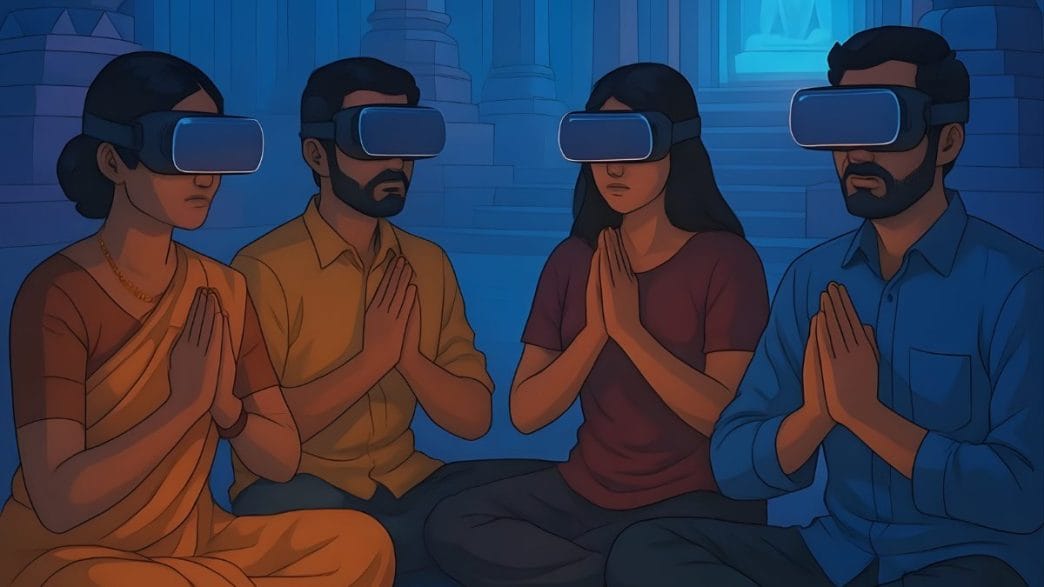
India is quietly becoming one of the world’s most ambitious labs for digital faith. In a country where belief shapes daily routine, worship is no longer limited to stone idols and crowded mandirs, but flows through apps, livestreams, headsets and chat windows that promise darshan on demand and guidance at scale. As the line between code and cosmos blurs, the real question is whether these virtual temples and AI guides open new doors to transcendence or simply wrap old comforts in smoother interfaces.
India’s Faith Tech Moment
Analysts now describe an organised, fast growing “faith economy” where the Indian religious and spiritual market is estimated at about 58 to 60 billion dollars, with projections of high single digit annual growth over the next decade. You can see this in breakdowns of India’s faith tech sector that track temple tourism, digital rituals, online astrology and spiritual content under one umbrella.
Commentary on the faith tech market in India points out that almost the entire population identifies as religious, and a large share of monthly household spending goes to rituals, donations and spiritual services. This deep cultural base, combined with cheap data and smartphone penetration, makes religion one of the most natural spaces for rapid digital adoption.
In that context, faith tech platforms have positioned themselves as one stop ecosystems for rituals, content and community. Startups such as VAMA are building apps that bundle e darshan, live streamed pujas, digital donations and prasad delivery so that a user can perform an entire worship journey without leaving their phone. Investor notes even describe religion tech as a 60,000 crore opportunity in India, underscoring how central this space has become to the broader tech story.
From E Darshan To Metaverse Temples
The pandemic acted as an accelerant rather than a starting point. Work on digital Hinduism in post Covid India documents how temple closures pushed priests and devotees onto livestreams, WhatsApp groups and Zoom satsangs almost overnight.
Ethnographic research on mobile phones and temple worship in India during Covid shows how major shrines like Tirupati, Jagannath and Vaishno Devi leaned on online darshan and app based access to keep rituals going when physical gatherings were banned.
Journalistic accounts on online darshan during the Covid 19 pandemic describe how devotional apps began streaming aartis, enabling remote donations and guiding pilgrims through temple lists, routes and bhajans on a single interface. That infrastructure did not disappear when restrictions eased. Instead, it normalised the idea that a meaningful part of religious life could happen through a screen, especially for elderly devotees, migrants and people living far from major shrines.
The Next Step: Immersive Devotion
The next wave is moving from flat screens to immersive environments.
Pieces on India’s digital spirituality and faith tech trends talk about virtual temple visits, 3D replicas and mixed reality pilgrimages as emerging formats. As the metaverse narrative matures, the idea of metaverse temples no longer feels like science fiction, but a logical extension of what live darshan apps already do.
In this model, the same engines that power gaming worlds could host avatar based yatra experiences where a group of devotees joins an aarti in sync, guided by priests who “serve” both physical and virtual congregations.
Experiments with VR for religious tourism aim to let people explore temple architecture, learn rituals or rehearse a pilgrimage route before they travel, particularly appealing to younger users who treat immersive media as a default way to experience culture.
AI Gurus And Digital Guides
Alongside virtual spaces, AI has started to act as a spiritual companion. Tools like
Gita GPT, often described as a chatbot trained on the Bhagavad Gita, invite users to ask questions and receive answers framed in scriptural language. Other products such as
Gita AI promises “divine conversations” with Krishna through text and voice, powered by large language models fine tuned on religious texts.
A growing body of reporting explores how people are using AI to talk to God, seek moral advice or work through anxiety via bots that mimic the style of pastors, gurus or sacred texts. Indian faith tech founders speak openly about using AI for personalised recommendations, meditation prompts and ritual suggestions, positioning it as a way to scale one to one style guidance without needing a human teacher on call.
Algorithms, Authority And Trust
This shift raises uncomfortable questions.
Scholars studying the emergence of digital Hinduism argue that online spaces flatten traditional religious authority, giving voice to people who were previously excluded, but also amplifying unverified interpretations. When a chatbot presents itself as a channel for the Gita, the average user cannot see how it chooses verses, which commentaries it treats as central, or how it handles sensitive issues like caste and gender.
At the same time, many spiritual tech startups monetise through subscriptions, paid pujas, astrology consults and virtual events. Coverage of the spiritual app and faith tech boom notes that these products sit inside the same engagement driven, investor funded logic as other consumer apps. That raises a tough design question: are AI suggestions nudging people toward deeper practice, or simply keeping them inside a profitable product loop.
Transcendence Or Well Coded Comfort
Research on worship practices in Hindu India during and after the pandemic suggests that most devotees are not abandoning physical temples, but layering digital habits on top of embodied practice. Phones have become sacred tools as much as communication devices, used for bhajans, live aartis, donations and festival coordination through family and community groups.
Whether this infrastructure delivers transcendence or just well coded comfort depends on how it is framed and governed. Used as a bridge, virtual darshan can make sacred spaces more accessible to those who are distant, disabled or marginalised. Used as a replacement for commitment, community and ethical work, it risks turning spirituality into a frictionless subscription that soothes without transforming.
For India’s faith tech ecosystem, that tension is the real design brief. The most meaningful virtual temples and AI guides will be the ones that protect depth in an attention hungry economy, nudging people back into real relationships, responsibilities and inner work, even while they travel through the metaverse in search of the divine.