



How India and Japan Are Plotting to Break China’s Strategic Grip
If oil powered the geopolitics of the 20th century, critical minerals are shaping the silent strategic contest of the 21st. Lithium, cobalt, nickel, gallium, germanium and a family of obscure but indispensable rare-earth elements have suddenly become the lifeblood of modern industry. Electric vehicles, semiconductors, renewable energy systems, advanced defence electronics and even artificial intelligence hardware depend on them. Yet the uncomfortable truth is that the world’s supply chain for these minerals has for decades been dominated by one country: China.
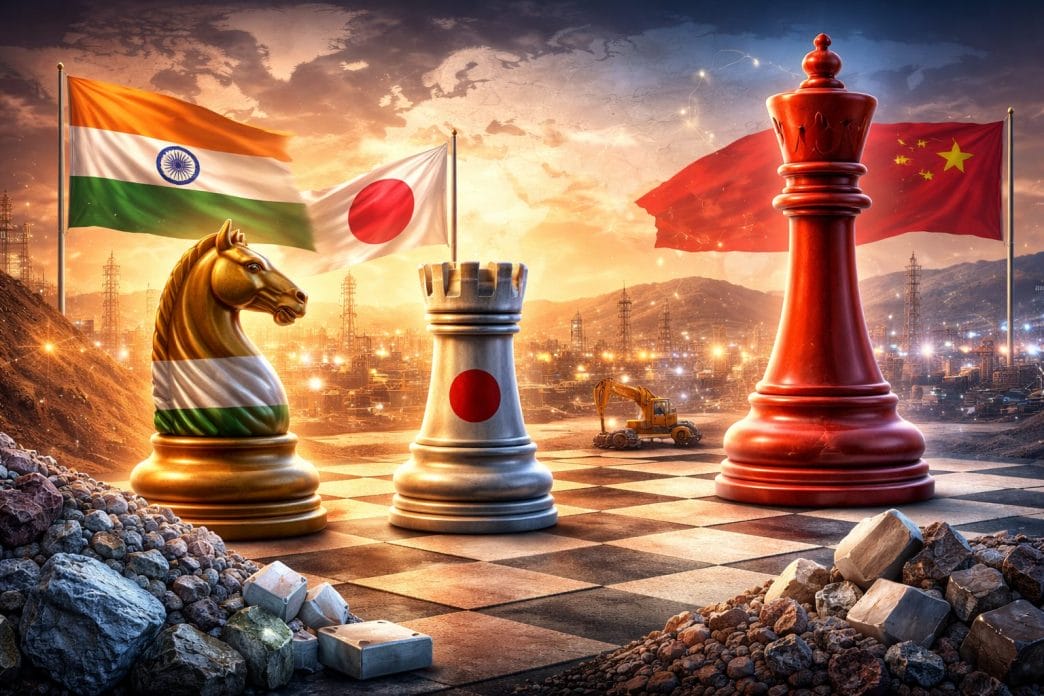
Against this backdrop, the recent move by India and Japan to collaborate in exploring and developing critical mineral resources represents far more than a routine industrial agreement. It is, in fact, a calculated geopolitical manoeuvre aimed at loosening China’s strategic hold on the raw materials that power the technologies of the future.
China’s Processing Advantage
To understand the significance of this partnership, one must first grasp the scale of China’s dominance. Over the past three decades, Beijing quietly built an overwhelming advantage in the mining, processing and refining of rare earth elements and other strategic minerals. Today, China controls roughly 60-70 percent of global rare-earth mining and close to 90 percent of their processing and refining capacity. Even minerals mined in Africa, Australia or South America frequently end up being shipped to China for chemical separation and purification before entering global supply chains.
The reason is simple. Extracting rare earths from ore is only the first step. The real challenge lies in separating and refining them through complex chemical processes that are expensive, technically demanding and environmentally hazardous. Many Western countries, concerned about environmental costs, abandoned these industries decades ago. China stepped into the vacuum, absorbing the pollution and building an industrial ecosystem that now dominates global supply chains.
This dominance has translated into geopolitical leverage. The most dramatic example came in 2010 when China briefly halted rare-earth exports to Japan during a diplomatic dispute. For Japanese manufacturers, who rely heavily on rare-earth magnets for electronics and automotive components, the move was a rude awakening. Tokyo quickly realised that its advanced industries were dangerously dependent on a single supplier.
Japan’s Strategic Wake-Up Call
Since then, Japan has been actively diversifying its sources of critical minerals. Partnerships with Australia, Vietnam and other countries followed. The emerging collaboration with India is therefore part of a long-term Japanese strategy to build alternative supply chains that are resilient, diversified and geopolitically safer.
India’s Resource Opportunity
For India, the opportunity is equally significant. Geological surveys suggest that India possesses considerable reserves of rare earths and other strategic minerals, particularly in regions such as Rajasthan, Gujarat and in coastal mineral sands along the eastern seaboard. However, despite these natural resources, India has historically lacked the advanced processing technologies and industrial scale required to fully exploit them.
This is where Japan enters the picture. With decades of expertise in precision metallurgy, mineral processing and high-tech manufacturing, Japan brings exactly the technological capabilities that India needs. In essence, the partnership is a classic case of strategic complementarity: India provides resource potential, while Japan contributes technological sophistication and investment capital.
If the collaboration progresses as planned, it could lead to joint exploration projects, development of mining infrastructure and, most crucially, the establishment of refining and processing facilities within India. Such facilities would allow India to move up the value chain rather than exporting raw ores for processing elsewhere.
Why Critical Minerals Matter for India’s Industries
The implications for India’s industrial future are substantial. Consider the rapidly expanding electric vehicle market. EV motors rely heavily on rare-earth permanent magnets such as neodymium-iron-boron magnets, which are essential for efficient power delivery. Similarly, a wide range of strategic technologies depend on these materials, including:
- Electric vehicles and hybrid vehicles
- Wind turbines and other renewable energy systems
- Robotics and industrial automation
- Defence electronics and advanced sensors
- Semiconductors, AI hardware and high-performance computing systems
By developing a domestic ecosystem for critical minerals, India could secure the raw material backbone for its ambitious plans in electric mobility, semiconductor manufacturing, AI hardware and defence modernisation. It would also strengthen the country’s position in global supply chains at a time when multinational companies are actively seeking alternatives to China.
The Environmental Trade-Off
However, the path to genuine mineral security is not straightforward. Building a complete critical-minerals supply chain takes years, sometimes decades: mining operations must be established, environmental clearances obtained, processing plants constructed and specialised chemical expertise developed. At the same time, rare-earth extraction generates significant chemical waste and, in some cases, radioactive by-products, forcing countries to balance strategic necessity with environmental responsibility and to invest in modern waste-management technologies and regulatory frameworks to avoid long-term ecological damage.
A New Geopolitical Map
Initiatives such as the Mineral Security Partnership, the Quad’s discussions on critical minerals and various bilateral agreements all reflect this shift. The India-Japan collaboration fits squarely into this broader effort to create a more balanced and resilient global resource network.
For India, the initiative also aligns with its broader vision of technological self-reliance. Programmes such as “Make in India” and the push for domestic semiconductor fabrication require a stable supply of specialised materials. Without access to these minerals, ambitions in electronics, renewable energy and defence manufacturing could face significant constraints.
In a deeper sense, the emerging mineral alliances represent the early stages of a new geopolitical era. Just as oil pipelines and tanker routes once defined strategic power, tomorrow’s geopolitical maps may be shaped by:
- Lithium and rare-earth mines
- Processing and refining hubs
- Battery-manufacturing and advanced materials clusters
China, of course, is unlikely to relinquish its dominance easily. Its mineral ecosystem is deeply entrenched, supported by state policy, industrial scale and decades of accumulated expertise. But the rise of alternative supply networks could gradually dilute that advantage over time.
India’s partnership with Japan therefore represents a long-term strategic investment rather than an immediate transformation. Success will depend on sustained policy support, private-sector participation and careful environmental management. If executed effectively, it could position India as a key node in the global supply chain for the technologies that will define the 21st century.
Ultimately, the story unfolding here is not merely about mining or geology. It is about control over the foundational resources that underpin modern civilisation. From electric vehicles and artificial intelligence to renewable energy and space technology, the industries shaping the future all rely on a handful of elements buried deep beneath the earth’s crust.
In that sense, the India-Japan collaboration marks the opening moves in a much larger strategic contest, one that will determine who controls the raw materials of the digital and green revolutions. And if India plays its cards wisely, it could emerge not just as a consumer of technology but as a pivotal supplier in the global industrial order.
The mineral chessboard is being rearranged. And for India, the game has only just begun.