



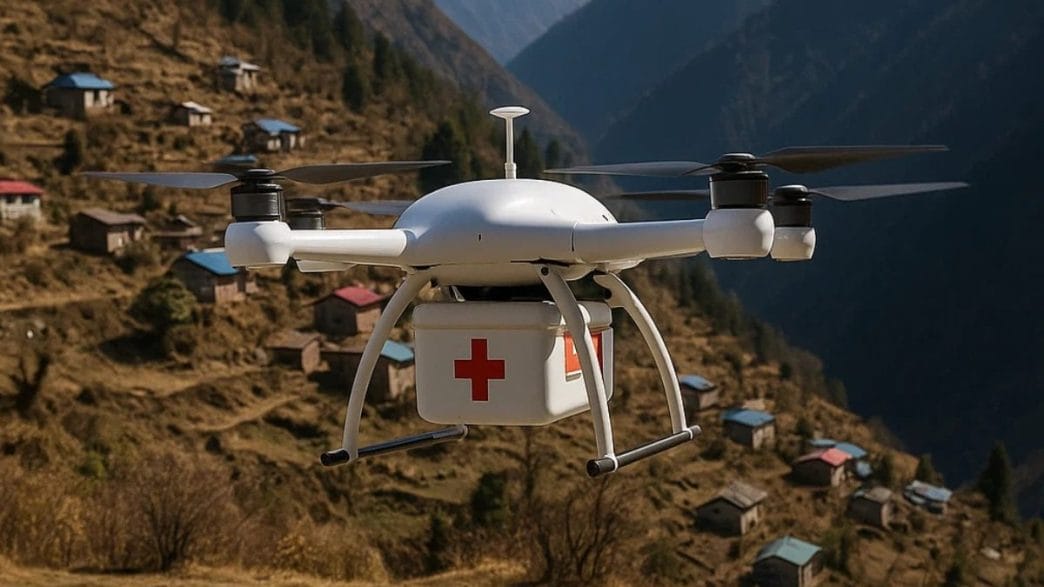
The old Silk Route took months to traverse, carrying spices and textiles across mountain passes that tested human endurance. India’s new silk route takes 22 minutes and carries blood samples, vaccines, and hope. It flies at 400 feet, navigates by GPS, and lands with precision on helipads carved into Himalayan villages. This isn’t distant future technology. It’s reshaping access and economic possibility right now across a nation where geography has always been destiny.
Jasmine Nikh became Arunachal Pradesh’s first female drone pilot, joining a revolution in how goods and medicines move across some of the world’s most challenging terrain. Her mountain routes, once eight-hour journeys, now take minutes by air.
The transformation is accelerating. India’s drone fleet is growing from roughly 10,800 in 2024 to a projected 61,000 by 2029, according to industry analysis. But raw numbers miss the deeper story about access to healthcare, precision agriculture, and economic opportunity reaching places traditional infrastructure struggles to serve.
When Mountains Become Bridges
The Medicine from the Sky initiative has completed nearly 1,000 flights across Himalayan terrain, delivering over 10,000 medical products. These flights matter. In Keylong, Himachal Pradesh, where heavy snowfall isolates communities for months, a December 2024 feasibility study by ICMR documented 15 drone sorties transporting 1,000 medicine units and 20 clinical samples during trials. For pregnant women needing emergency care or patients requiring urgent diagnostics, drones represent the gap between timely treatment and dangerous delays.
TechEagle’s collaboration with AIIMS Rishikesh demonstrated drone deliveries taking 34 minutes versus over 4 hours by road. In emergency medicine, that difference saves lives. The program creates local jobs too: 15 youths in Arunachal Pradesh now operate and service drone networks, building expertise that didn’t exist three years ago.
Precision From Above
Drones are mapping farmland across Telangana, Andhra Pradesh, Gujarat, Madhya Pradesh, and Tamil Nadu with precision that changes farming practices. Multispectral imaging reveals exactly which sections need water, which areas show early disease, and where nutrients are lacking. Instead of treating 50 acres as uniform space, farmers can target interventions down to specific patches.
The math works. According to a 2024 peer-reviewed study citing Indian Agriculture Ministry estimates, drone spraying costs roughly INR 350-450 per acre and cuts pesticide use by 25-30% through targeted application. Water consumption drops 80-90% because drones use 50-micron droplets instead of 500-micron droplets from manual spraying.
The IFFCO-Marut Drones partnership aims to cover 5 lakh acres using drone-as-a-service models that let small farmers access technology without buying equipment. Rural entrepreneurs who own drones offer services to neighboring farms, creating businesses where none existed.
Building the Infrastructure
India’s drone manufacturing has grown from INR 60 crore in 2021 to a projected INR 900 crore by 2025, according to industry projections. The government’s Production-Linked Incentive scheme expanded to INR 2,000 crore for FY 2025-28, signaling that policymakers see drones as core infrastructure. A uniform 5% GST rate implemented in September 2025 removes pricing uncertainty that complicated adoption.
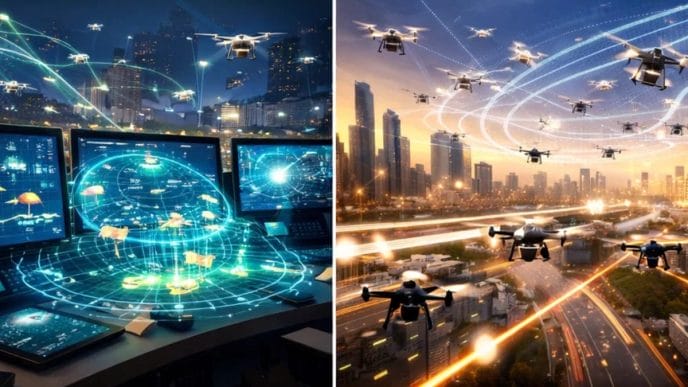
India’s regulatory approach stands out for pragmatism. Drone Rules 2021 simplified permissions through trust-based frameworks. Designating 90% of airspace as green zones allowing flights up to 400 feet without special permissions enabled experimentation. Companies like TechEagle have logged over 500,000 kilometers of beyond-visual-line-of-sight flights, according to company data, building operational protocols.
What Remains Unfinished
Drone delivery isn’t mainstream yet. Uncertainty around beyond-visual-line-of-sight operations, slow approval timelines, and unclear liability frameworks create friction. Most operations remain pilots rather than scaled deployments.
Infrastructure gaps persist. Limited charging stations, absent drone ports, and challenges coordinating with existing air traffic constrain growth. India imports 39% of flight controllers from China, with dependency reaching 90% for small drones. Manufacturing independence requires sustained investment in components, particularly rare earth materials for motors.
The Routes Being Mapped
India built highways over decades, spending billions to connect cities already served by rail and air. The drone corridors taking shape connect places highways never reached and may never will. They’re creating economic geography that doesn’t follow roads or railways but charts three-dimensional paths above them.
Market projections, $23 billion by 2030 according to industry analysis, matter less than what they represent: fundamental shifts in thinking about distance and delivery. Every drone landing medicine at a snowbound clinic, every field mapped from above, every sample rushed to a lab proves the sky isn’t empty space. It’s becoming India’s next logistics frontier.
The ancient Silk Route transformed civilizations by making impossible journeys possible. India’s drone silk route does something more profound: it makes distance irrelevant. In a country where geography has always divided opportunity, that changes everything.