



Forty light-years away, seven planets circle a dim red star. Telescopes point at them constantly, searching for water, atmospheres, any sign these worlds could support life. So far, they’re not seeing clear, thick atmospheres.
That silence might tell us something important. What if these planets were born dry?
Answering that question means rewinding time 4.5 billion years and watching planets crash together. Classical computers can run these simulations, but they take weeks. Quantum systems are starting to change the speed.
Smashing Planets Together on Purpose
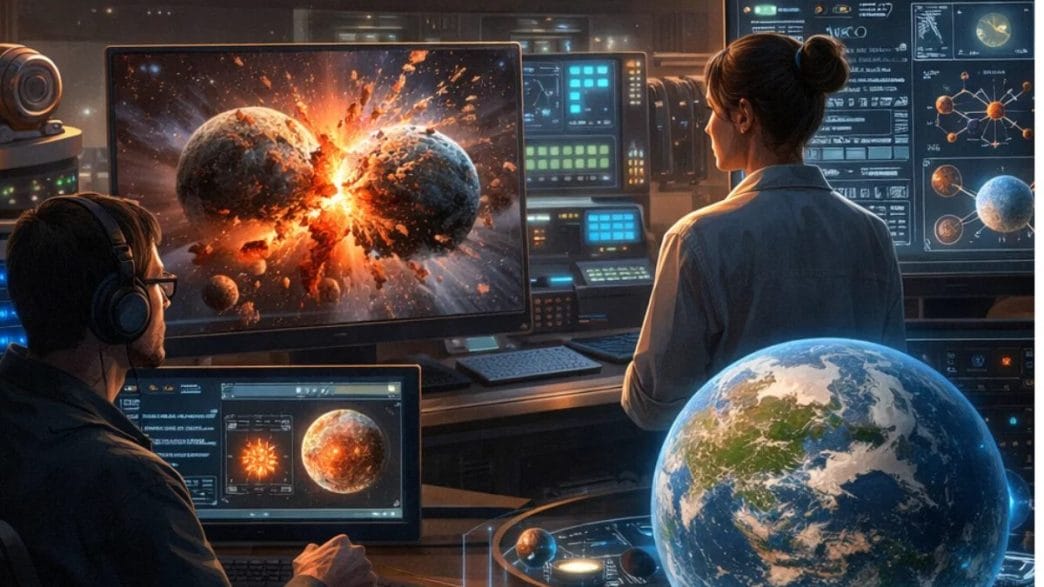
Howard Chen at Florida Institute of Technology ran virtual demolition derbies. His team simulated how TRAPPIST-1’s seven planets formed from countless smaller chunks of rock and ice.
The Dry Zone
Chen’s team ran hundreds of scenarios. The three innermost planets kept coming back dry. These worlds sit close to their star, getting hammered by more impacts and higher radiation during formation. Chen’s models suggest TRAPPIST-1 b, c, and d likely formed with very low water content. Basically nothing.
The outer planets told a different story. TRAPPIST-1 f, g, and h frequently held onto water exceeding one Earth ocean.
These results offer one possible explanation for what’s been puzzling astronomers. Other astronomers argue these planets formed wet but lost atmospheres to intense stellar radiation over billions of years. The James Webb Space Telescope looked at TRAPPIST-1 b and c, searching for atmospheres. It found no clear signals. Chen’s simulations suggest they never had thick atmospheres to begin with.
Quantum Computers Join the Hunt
Chen’s work ran on traditional supercomputers. But quantum approaches are emerging. Recent preprint research explored using Quantum Extreme Learning Machines to pull atmospheric parameters from telescope observations, showing promise for faster data analysis.
Where Quantum Actually Wins
Google Quantum AI’s October 2025 Quantum Echoes algorithm demonstrated a 13,000-times speedup over classical supercomputers for specific physics problems. This represents the first verifiable quantum advantage on hardware, running on one of the company’s mid-scale chips.
These aren’t general-purpose speedups. They work for narrowly defined problems. For planetary science, quantum computers might excel at:
- Molecular dynamics in atmospheric chemistry
- N-body gravity calculations for complex planetary systems
- Pattern recognition in spectral data from thousands of worlds
- Optimization problems in telescope scheduling
Current quantum systems still struggle with basics like loading data and maintaining stable calculations. Most practical applications today split the work between quantum and classical processors.
For now, these remain lab demonstrations rather than production tools for planetary scientists.
What Webb Keeps Finding
The James Webb Space Telescope keeps gathering TRAPPIST-1 data. Recent observations tracked stellar flares, with several significant flares per day during monitored periods. These radiation storms could strip atmospheres over geological timescales.
Webb’s infrared instruments spot absorption features when planets cross their stars. The three innermost TRAPPIST-1 planets show nothing clear. TRAPPIST-1 e continues to draw the most interest for potential habitability.
India’s Telescope Game Gets Stronger
Indian teams have made several exoplanet discoveries using PARAS-2 spectrograph mounted at Mount Abu Observatory. PARAS-2 is Asia’s highest-resolution stabilized radial velocity spectrograph.
Beyond the Moon
ISRO’s ambitions stretch past lunar missions. The Aditya-L1 solar observatory sits at the L1 point between Earth and Sun, sending back data on solar activity. In January 2025, ISRO released the first batch of scientific data from all seven instruments to researchers worldwide.
The proposed ExoWorlds mission concept represents a joint effort by ISRO, the Indian Institute of Space Science and Technology, and the University of Cambridge. The plan calls for a dedicated space telescope studying exoplanet atmospheres.
India’s space economy could reach around $44 billion by 2033. Government reforms and IN-SPACe formation opened doors for private companies. Startups are building satellites, developing launch vehicles, and providing space services.
Several factors position India for growth:
- PARAS spectrographs enabling exoplanet discoveries
- Aditya-L1 providing solar data for understanding stellar effects
- Growing private sector building satellites and launch systems
- Partnerships with international agencies like JAXA
India’s strength in software and data analysis creates natural advantages as telescopes generate more observations.
Testing Planets We’ll Never Visit
Researchers run climate models to test whether detected exoplanets could support liquid water. These simulations account for stellar radiation, atmospheric makeup, orbital characteristics, and greenhouse effects.
The simulations narrow the search space. Too much stellar radiation triggers a runaway greenhouse. Too little creates a snowball world.
Chen’s formation models add crucial context. If inner TRAPPIST-1 planets formed dry, then atmospheric simulations starting with water-rich conditions don’t reflect reality.
From Simulations to Answers
Understanding whether TRAPPIST-1’s planets formed dry or wet informs how we interpret data from thousands of exoplanets being discovered. If many rocky planets in compact systems form volatile-depleted, that changes where we look for life.
Precise observations, detailed simulations, and advancing computational tools are narrowing the possibilities. Water might exist on TRAPPIST-1 e. The outer planets could harbor subsurface oceans. Or the entire system might be dry, teaching us about planetary formation processes.
Forty light-years away, seven planets orbit a small star. We can’t visit them. But we can simulate them, model them, and analyze the light filtering through whatever atmospheres they have. Each piece of data narrows what’s possible, bringing us closer to understanding how planets form, evolve, and potentially harbor life across the galaxy.