



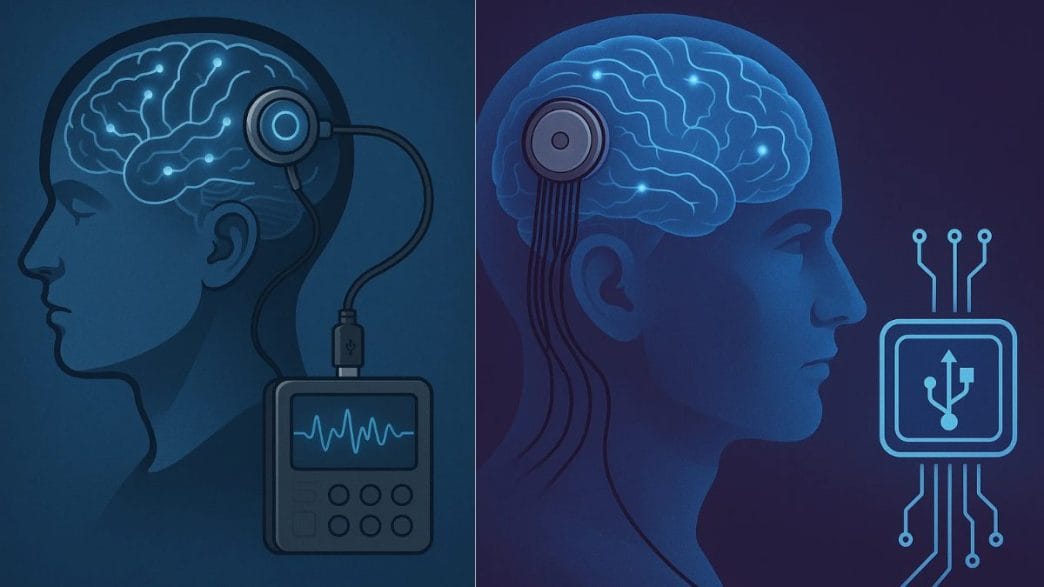
The human skull might soon need software updates. As brain-computer interfaces move from experimental labs to operating rooms, a compatibility crisis looms: what happens when your brain needs multiple devices that don’t speak the same language?
Neuralink’s 2025 Momentum
Neuralink has reached 12 trial participants as of September 2025, logging over 15,000 hours of combined usage. Their N1 implant contains 1,024 electrodes across 64 threads, thinner than red blood cells, allowing quadriplegic patients to control cursors, play games, and browse the internet through thought alone.
Noland Arbaugh, the first recipient, experienced thread retraction where an estimated 85% of electrode threads detached from brain tissue. Neuralink compensated through algorithm adjustments, but the fragility became clear. By summer 2025, the company outlined an ambitious roadmap aspiring toward 2028 targets: a whole-brain interface with over 25,000 electrodes reaching 99% of the cortex, robotic arm control, and speech restoration trials. Whether these projections materialize remains uncertain, but the venture capital backing suggests serious intent.
Synchron’s Vein-Based Alternative
Synchron threads its Stentrode device through the jugular vein rather than drilling through skulls. The procedure resembles cardiac stent placement and takes roughly 20 minutes. In September 2024, six patients completed one year in the COMMAND trial with zero serious adverse events, controlling digital devices through thought alone.
The trade-off? Synchron’s 16-electrode array captures far fewer signals than Neuralink’s system. Different insertion methods generate fundamentally different neural recordings. One reads aggregate vein activity, the other pierces tissue recording individual neurons. Patients might soon choose based on surgical risk rather than functionality, but what happens when someone needs both types? Or wants to upgrade? Or their manufacturer exits the market?
India’s Neurotech Position
India’s stroke burden represents the largest contributor to disability-adjusted life years among neurological conditions. IIT Kanpur developed a brain-computer interface powered robotic hand exoskeleton for stroke rehabilitation. Startups like BrainSightAI and NeuroLeap build mental health monitoring systems. The National Brain Research Centre in Manesar conducts foundational research with advanced imaging equipment.
China launched its first invasive brain-computer interface clinical trial in March 2025, becoming the second country after the United States to reach this milestone with reportedly more flexible electrodes. India risks watching from the sidelines as standards solidify elsewhere, despite having genomic diversity, large patient populations, and growing AI and medical device manufacturing capabilities.
Early attention to interoperability frameworks could position Indian institutions as bridge-builders rather than technology importers locked into foreign ecosystems. But only if the compatibility problem gets addressed now.
The government-backed BRAIN (Brain Research through Advanced Innovative Neurotechnologies) program is also pushing India to merge AI with neural data for preventive health insights. If aligned with early compatibility frameworks, it could make India more than a manufacturing base—it could make it a standards hub.
The 2028 Standards Gap
ISO/IEC JTC 1 has a subcommittee working on brain-computer interface standards that explicitly excludes human implants and medical applications. The FDA focuses on safety testing, not interoperability. IEEE working groups develop unified terminology, but adoption remains voluntary.
No regulatory body mandates that brain implants communicate with each other. Companies protect proprietary algorithms while arguing standardization would slow innovation. Yet proprietary systems create lock-in effects benefiting manufacturers over patients.
If Neuralink’s aspirations materialize, patients might need separate implants for motor control, vision restoration, and speech decoding by 2028. Without common protocols, each device becomes isolated. Switching providers requires explantation and reimplantation. Combining technologies from different manufacturers? Nearly impossible.
Academic researchers documented cases where bankrupt brain-computer interface companies forced patients into risky explantation surgeries because no other manufacturer could maintain their devices. Relying on a brain implant for communication only to lose that ability when the vendor’s business model collapses represents a nightmare scenario that has already happened.
Why USB Standardization Matters
Before USB in the late 1990s, computer peripherals needed device-specific drivers and incompatible connectors. Printers used parallel ports. Keyboards used PS/2 ports. External storage required SCSI adapters. Intel, Microsoft, Compaq, and others agreed to common protocols despite competitive advantages in proprietary systems because they recognized fragmentation hurt everyone.
Brain implants face identical fragmentation with higher stakes. A failing computer peripheral means buying a new mouse. A failing brain implant means surgical revision or permanent function loss. The IEEE Standards Association identified data representation and sharing as priorities in 2020, but progress focuses on non-invasive devices like EEG headsets, not implantable medical devices.
The Market Reality Check
The brain-computer interface market stood at USD 2.40 billion in 2025 and is projected to reach USD 6.16 billion by 2032, exhibiting 14.4% compound annual growth. Reports suggest Neuralink performed procedures in the UK and Canada during 2025, though independent verification remains limited.
Within three years, hundreds or thousands worldwide might be living with brain implants from multiple manufacturers. If every system stays closed, patients get locked in. The wealthy will afford multi-vendor solutions. Everyone else stays trapped in whichever ecosystem they joined first.
The Closing Window
Once hundreds of patients depend on specific devices and companies invest billions in proprietary architectures, retrofitting compatibility becomes exponentially harder. Standards become whatever the market leader implements by default.
India faces a choice: wait for Western companies to define standards and pay licensing fees, or participate early in standards development and build domestic manufacturing around open protocols. Neuralink aims for $1,000 to $2,000 implant costs once manufacturing scales. Synchron offers less invasive alternatives. Chinese developers pursue ultra-flexible electrodes. Each approach has merit, but none coordinate on compatibility.
The USB standard succeeded when competing companies recognized interoperability served everyone’s long-term interests. Brain implants need the same recognition before market forces make standardization impossible. The neural interface standards battle has already begun. Who shows up to negotiate matters, and whether access stays universal or becomes privileged will shape human-computer interaction for decades. If USB made computers universal, the next decade will decide if neural ports can do the same for our minds.