



Back in 2008, a few damaged cables near Egypt managed to knock out internet access for millions of Indians. Banks froze. Trading floors went dark. Call centers fell silent. That vulnerability is still there today, only now the stakes are exponentially higher.
Three Projects Rewriting The Map
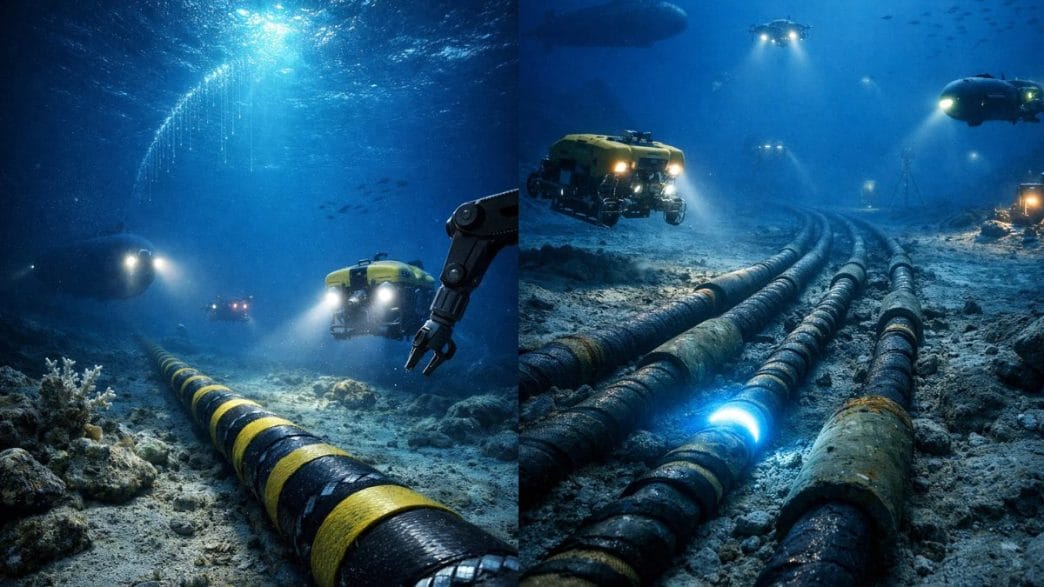
Right now, three underwater projects are landing that will fundamentally change India’s position in global data flows. The 2Africa cable, which completed its core infrastructure in November 2025, spans 45,000 kilometers and connects 33 countries. Mumbai serves as one of its key landing hubs with up to 180 Tbps design capacity on key segments
Reliance Jio is building two more massive systems. The India-Asia-Xpress (IAX) and India-Europe-Xpress (IEX) cables designed for high-capacity transmission exceeding 15 fiber pairs each, contributing to India’s bandwidth expansion, linking Chennai and Mumbai directly to Southeast Asia and Europe. Together with 2Africa, these projects should quadruple India’s international internet capacity.
But here’s the thing nobody wants to talk about. As of late 2024, India’s total submarine cable capacity stood at ~193 Tbps total provisioned capacity (with ~148 Tbps activated) across 17 active cables. Yet India holds around 1-2% of global landing stations. Every new cable adds speed, but it also adds another potential failure point someone can exploit.
The Red Sea Taught Hard Lessons
From 2023-2025, the world watched a new kind of warfare unfold. In October 2023, the Chinese vessel NewNew Polar Bear was investigated for damaging the Balticconnector gas pipeline and telecom cables between Finland and Estonia, though attribution remains contested. A separate incident in November 2024 damaged the C-Lion1 cable between Finland and Germany.
The SWIFT banking system, handling trillions in daily transactions, relies entirely on these underwater lines. Then in February 2024, four submarine cables in the Red Sea Subtel Forum cables were damaged, causing global internet outages and creating logistical challenges for regional cable projects. The shipping industry faced heightened security concerns in the region.
India’s geography makes this personal. The Malacca Strait funnels critical cables connecting Mumbai and Chennai to Singapore through a narrow chokepoint. One well-placed disruption could sever the digital link between India and Southeast Asia. The numbers tell the story, 95% of India’s sea trade and 99% of international internet traffic flows through subsea cables. Industry estimates suggest a coordinated attack during peak hours could cost millions per hour in economic disruption.
Many of India’s cables land near Versova and other Mumbai sites, alongside Chennai, Kochi, and southern landings. Concentrating this much critical infrastructure in one area creates a vulnerability that’s hard to defend.
Algorithms Watching The Ocean Floor
Traditional surveillance can’t scale to India’s maritime challenge. You can’t patrol thousands of kilometers of cable routes with boats. Satellites can’t see underwater. Human observers can’t watch around the clock.
That’s where artificial intelligence changes the equation. Distributed Acoustic Sensing systems turn the cables themselves into listening devices. These AI-powered systems analyze backscattered light patterns to detect vibrations from ships, submarines, or fishing trawlers dragging anchors near cable routes. They can pinpoint disturbances accurately enough to identify specific vessels using maritime tracking databases.
The Indian Navy is trialing AI-enabled swarm drone systems that patrol autonomously, share data across platforms, and flag anomalies in real time. These represent operational prototypes actively trialed in territorial waters.
Machine learning does something even more valuable. It predicts failures before they happen. By analyzing historical data on cable performance, ocean currents, seismic activity, and ship traffic patterns, these systems forecast which cable segments are most likely to fail and when. Maintenance crews can fix problems during low-traffic windows instead of scrambling during emergencies.
The technology sounds impressive, but there’s a gap. India still lacks domestic cable repair ships. When cables break in Indian waters, foreign-flagged vessels have to sail in and handle the work. That creates both operational delays and sovereignty concerns that no AI system can solve.
A Telegraph Act From 1885
India’s telegraph law dates from 1885. The statute doesn’t comprehensively address modern subsea cables, let alone autonomous underwater vehicles or coordinated cyber-physical attacks.
The Telecommunications Act of 2023 modernizes parts of sector regulation. The Telecom Regulatory Authority has recommended bringing submarine cables under the National Critical Information Infrastructure Protection Centre, which would provide stronger legal protection and allow Indian law to apply beyond territorial waters.
Still, critical gaps remain. India needs dedicated cable protection zones within its Exclusive Economic Zone, similar to Australia’s framework. These zones would restrict fishing operations, ship anchoring, and other activities near identified cable routes, backed by clear enforcement authority.
The 2024 Quad Cable Connectivity and Resilience Partnership offers a useful template: prepositioned spare equipment, cross-trained repair crews, joint exercises across member nations. Turning summit statements into operational protocols requires sustained political commitment and actual budget allocation.
Mining The Deep While Mapping Routes
The same ocean floor carrying data cables holds another dimension of strategic value. India’s blue economy contributes approximately 4% to GDP, supporting 28 to 30 million livelihoods through fisheries, shipping, and coastal industries.
Ocean mapping becomes foundational for both connectivity and resource exploitation. The Deep Ocean Mission, approved with ₹4,077 crore in funding, aims to explore seafloor minerals, chart biodiversity hotspots, and test technologies like Ocean Thermal Energy Conversion. The data generated feeds directly into cable route planning, helping engineers avoid ecologically sensitive areas while identifying optimal paths.
In early 2025, the MATSYA-6000 submersible completed successful wet tests at the L&T Shipbuilding facility in Chennai. The indigenously developed submersible is targeting its first 500-meter manned dive by 2026, followed by a full-depth 6,000-meter mission in 2027. Once operational, India will join the US, Russia, Japan, France, and China as nations with ultra-deep-sea exploration capability.
Geospatial technology bridges marine conservation and economic development. LiDAR systems and aerial drones map coastal erosion and track sea-level rise. Remote sensing monitors pollution levels and ecosystem health. The same infrastructure protecting coral reefs also identifies prime fishing zones and suitable locations for sustainable aquaculture.
The relationship runs deeper than shared technology. Protecting cable routes often means protecting marine habitats. Restricted fishing zones around cables become unofficial marine sanctuaries. Surveillance systems watching for sabotage also detect illegal fishing, smuggling operations, and environmental violations.
China, America, Russia Play Different Games
China controls significant portions of the global subsea cable market through state-linked companies. American tech giants like Google, Meta, Microsoft, and Amazon now control major shares of the overall subsea cable market, a dramatic shift from a decade ago. Russia maintains a fleet of specialized submarines capable of tapping or cutting cables at depths beyond normal reach.
The competition for control over data flows has become zero-sum. Every cable route carries geopolitical weight. Every landing station represents a potential leverage point.
India’s geographic position at the maritime crossroads of Asia gives it natural advantages. Data traveling between Europe, the Middle East, and Southeast Asia increasingly flows through Indian waters. This centrality creates both opportunity and obligation.
The response needs multiple fronts:
- Building Indian-flagged cable repair vessels to respond to disruptions without foreign dependency
- Expanding landing stations beyond Mumbai and Chennai to cities like Kochi, Trivandrum, and Tuticorin
- Developing domestic submarine cable manufacturing under Atmanirbhar Bharat initiatives
- Leveraging repair capabilities to assist neighboring countries, building diplomatic capital while strengthening network resilience
Where Digital Sovereignty Actually Lives
The future of India’s digital economy, military communications, financial markets, and strategic autonomy will be determined by what happens on the ocean floor. Every terabit of capacity added, every AI sensor deployed, every legal framework strengthened moves the country closer to genuine digital sovereignty.
These cables and their protection systems aren’t just infrastructure. They form the nervous system of a connected economy. When they work invisibly, commerce flows smoothly and markets operate efficiently. When they fail, consequences cascade through every sector.
The 2008 blackout taught one lesson about vulnerability. The question now is whether India has learned about resilience.
Cables stretching across the Indian Ocean floor carry more than data. They carry India’s claim to be a serious power in the digital century. Protecting that claim requires treating the ocean not as empty space between continents, but as contested territory where strategic competition plays out.
The blue economy framework, AI surveillance systems, updated legal protections, and diplomatic partnerships all point toward one recognition: in the 21st century, national security begins underwater. How India responds to this reality will determine whether it shapes the future of Indo-Pacific digital infrastructure or merely connects to networks controlled by others.