



A tumor sits deep inside a patient’s brain, wrapped in blood vessels too delicate for surgery. Radiation would damage healthy tissue around it. Most chemotherapy struggles to penetrate the blood-brain barrier in effective doses. Three years ago, many patients had no viable option at all. Today, scientists are programming microscopic robots to swim through that patient’s bloodstream, navigate past billions of cells, and deliver treatment directly to the tumor. This isn’t theoretical anymore. It’s advancing in labs right now, with preclinical momentum building toward human trials.
Magnetic Swimmers Crack the Brain Barrier Problem
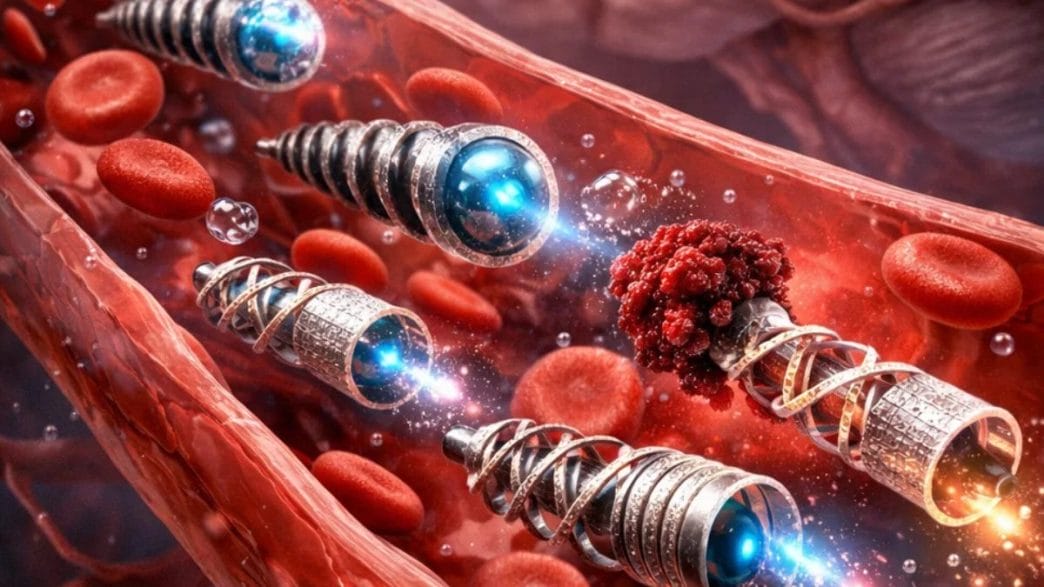
The University of Saskatchewan team spent years solving one critical question: how do you steer something far smaller than what the human eye can see through the chaotic rush of blood flow? Their answer came through advanced computational modeling. By creating detailed models of how corkscrew-shaped robots interact with blood plasma, they can now predict exactly how the bots will move when magnetic fields pull them in different directions.
Going Where Surgeons Can’t
Brain surgery requires cutting through healthy tissue to reach diseased areas. Sometimes the tumor location makes this impossible without causing paralysis, blindness, or death. That’s where these nano-swimmers redraw the options. They travel through existing blood vessels, following pathways that already lead directly to the tumor site.
Once they arrive at the tumor site, they are being designed to deliver drug payloads directly to cancer cells. This targeted approach is also being explored for stroke treatment, where clot-busting medications need to reach specific blocked vessels fast. Researchers are exploring how this could one day allow tissue repair like micro-bleeds after stroke, spots too delicate for scalpels.
DNA Folders That Starve Cancer Cells
Halfway around the world, another team took a completely different path to the same goal. Instead of delivering drugs, they built nanobots from folded DNA strands that cut off a tumor’s food supply. The concept is straightforward in design: cancer can’t grow without blood vessels bringing oxygen and nutrients. Block those vessels, and the tumor dies.
The Origami Attack Strategy
These DNA bots look like tiny tubes when they’re circulating through blood. Inside each tube sits a protein called thrombin, which triggers blood clotting when released. The tubes stay sealed until they bump into nucleolin, a molecular marker found almost exclusively on tumor blood vessel walls. Contact with nucleolin acts like a key turning a lock. The DNA tube unfolds, releases the thrombin, and a clot forms right there in the tumor’s supply line.
Mice with melanoma saw dramatic results. Three out of eight had their tumors disappear completely. The others lived twice as long as untreated mice, going from 20.5 days to 45 days on average. Follow-up testing in larger animal models suggested the bots selectively clot tumor vessels. These bots show remarkable precision, making them strong candidates for eventual human testing.
From Lab Bench to Hospital Bed
Moving any new medical technology into human patients takes time, and nanobots face unique hurdles:
- Immune response challenges: Our immune systems evolved to attack foreign objects in the bloodstream. Scientists are testing various coatings and materials to find combinations that slip past immune defenses without triggering allergic reactions.
- Manufacturing scale: Lab researchers might make a few thousand nanobots for experiments. Treating one human patient could require billions. Every single bot needs to maintain its precise shape and function, which means quality control at a scale biotechnology has never attempted before.
- Regulatory safety data: Agencies will demand extensive information on what happens to these robots after they finish their job, whether they break down safely, and how long they stay active in the body.
DNA synthesis technology has advanced rapidly in recent years though, making mass production more realistic. The pace of progress suggests we’re looking at years, not decades.
This lab progress needs factories to scale it. India is stepping up.
India’s Manufacturing Moment
This global nanobot race arrives just as India’s medtech sector builds manufacturing muscle. The country’s market is growing from $12 billion now to a projected $50 billion by 2030. That’s more than quadruple growth by 2030, fueled by smart government policy and massive corporate investment.
What’s driving this surge? Several forces are converging:
- Medtronic just committed $350 million to expand Indian manufacturing, focusing on products designed for emerging markets
- Government incentive programs are pulling global companies to build factories here instead of importing finished devices
- Research facilities like Siemens Healthineers’ Bangalore center are developing technology specifically for cost-sensitive healthcare systems
- India’s software expertise gives it a natural advantage in AI-guided medical devices, which nanobots absolutely require
The timing couldn’t be better. As nanorobot technology matures globally, India is positioned to become a major production hub. The country already has pharmaceutical manufacturing down to a science. It has biotech talent and research institutions. What it’s been missing is the infrastructure for cutting-edge medical devices. That gap is closing fast. In Bengaluru cancer centers, this could mean nanobot infusions over open surgery for deep tumors.
That manufacturing base draws capital to the whole field.
Money Follows Microscopic Machines
Healthcare investors are watching nanorobot developments closely. Every successful animal trial moves the technology closer to commercial reality, and markets respond:
- Specialized imaging equipment: New tools needed to track robots in real time through patient anatomy
- Advanced diagnostics: Systems to identify which patients would benefit most from nanobot treatments
- AI navigation platforms: Software that can plan optimal delivery routes through individual bloodstream networks
Investors are beginning to pay closer attention to companies working on magnetic navigation systems, DNA synthesis platforms, and precision medicine.
Robots in Your Veins Soon
In the coming years, someone you know might get a cancer diagnosis. Their doctor might explain that chemotherapy is an option, but there’s a newer approach. A single injection contains millions of DNA nanobots programmed to find tumor blood vessels and shut them down. The patient could potentially go home the same day. Within weeks, scans show the tumor shrinking. They avoid hair loss, nausea, and the crushing fatigue that traditional chemotherapy causes.
That scenario isn’t science fiction anymore. The research is real. The animal trials are producing results. The shift is underway, moving through the bloodstream of mice and pigs.