




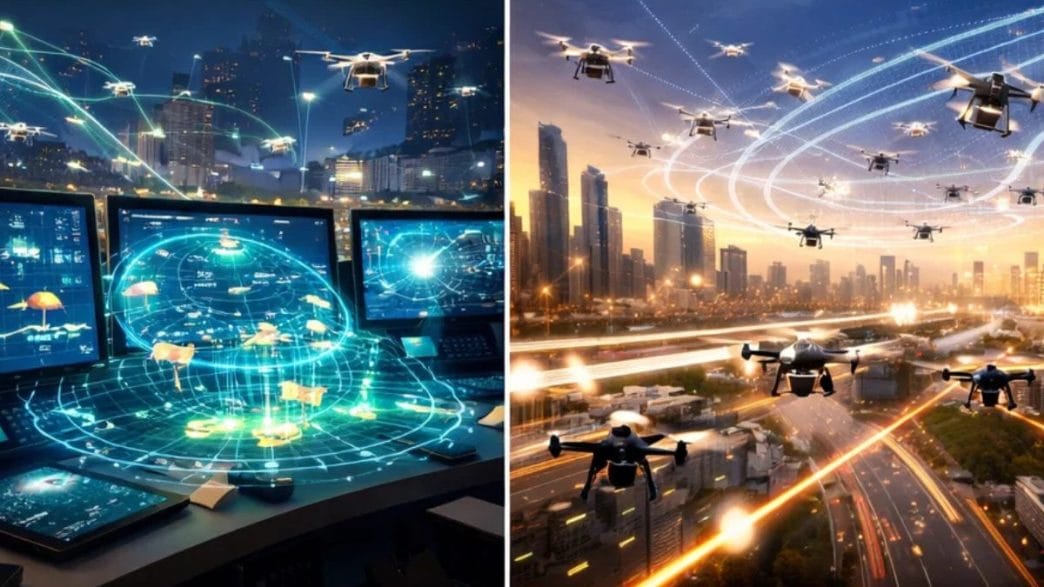
Imagine ordering your morning coffee and watching it arrive by drone in five minutes. Or looking up to see hundreds of autonomous aircraft crisscrossing above your neighborhood, all moving in perfect harmony without a single human controller managing them. This isn’t science fiction. It’s a reality taking shape right now through pilot projects and early operational deployments across logistics, inspection, and urban air mobility.
The sky above us is about to get very crowded, and humans alone can’t manage what’s coming.
When Human Controllers Hit the Breaking Point
Air traffic controllers today manage roughly 45,000 flights per day across the United States. They watch radar screens, coordinate via radio, and manually orchestrate flight paths. This system works fine for traditional aviation. But apply it to drones? The model crumbles immediately.
The commercial small drone fleet in the U.S. is forecast to reach well over 900,000 registered units later this decade, with growth continuing through the 2030s, according to the FAA’s Aerospace Forecasts. This explosion in aircraft creates unprecedented demand. Busy control towers at major airports can handle on the order of 100-120 flight movements per hour under optimal conditions, but real-world throughput varies by airport. The volume of drone operations will far exceed what traditional air traffic control infrastructure can manage.
AI systems step into this gap by analyzing datasets at speeds no human operator could match. They detect potential hazards and calculate solutions in milliseconds while simultaneously processing surveillance data, weather patterns, and flight trajectories.
Behind the Scenes of Autonomous Traffic Management
Unmanned traffic management platforms work like digital air traffic ecosystems. NASA pioneered foundational UTM research through field demonstrations testing how operators, service providers, and regulators could share information digitally. Their project concluded in 2021 after demonstrating protocols that enable a shift from purely centralized human commands toward more digital, peer-to-peer coordination between UTM services and aircraft.
The architecture relies on three technical layers. Digital communication channels connect aircraft to ground systems and each other. Three-dimensional airspace visualizations display real-time movements. Automated conflict resolution algorithms detect potential collisions and adjust flight paths without human intervention.
Machine learning models improve continuously through operational experience. These algorithms identify patterns in flight data, predict conflicts before they materialize, and optimize routing based on changing conditions.
India Leaps Ahead with Skye UTM
While many countries pilot small-scale drone programs, India launched something different. Skye UTM was launched in early 2023 as a cloud-based platform designed for large-scale drone coordination. The platform captures over 255 parameters of UAV movements, storing them in a digital blackbox that creates published descriptions of each flight in real-time.
Skye UTM has supported more than 300 successful Beyond Visual Line of Sight operations, proving the technology works for complex missions where pilots can’t physically see their drones. The system provides real-time situational awareness to operators, regulators, and controllers through continuous data sharing.
India’s broader Digital Sky platform, managed by the Directorate General of Civil Aviation under the Drone Rules, handles drone registration and permissioning. The “No Permission, No Takeoff” regime requires operators to seek automated flight clearance through the platform, while airspace is divided into green, yellow, and red zones with different permission levels. Operators must secure remote pilot licenses through DGCA-approved training centers, creating a qualified workforce for the expanding industry.
Coordinating Swarms, Not Just Individual Drones
Individual drone management represents just the starting point. The real challenge lies in coordinating entire swarms. Defense and aerospace firms are developing software platforms that allow a single operator to manage large swarms of autonomous assets and support decentralized decision-making, enabling resilient swarm behavior even when some units fail or lose connectivity.
AI dynamically assigns roles based on battery levels, sensor health, and mission priorities. High-energy drones handle longer-range duties while low-charge units switch to lighter tasks or return to base.
Research published in 2025 describes T-STAR (Time-Optimal Swarm Trajectory Planning), a system that lets drone swarms share information in real time and continuously adjust their paths. Tests show that swarms guided by T-STAR complete missions faster and with smoother, safer trajectories than earlier coordination methods.
Applications expand rapidly. Multiple drones inspect infrastructure simultaneously, accessing dangerous locations safely. Agricultural operations deploy swarms for precision spraying. Urban delivery networks coordinate package transport throughout cities.
Urban Sky Highways Become Reality
Cities worldwide are piloting and developing structured air corridor networks for drone operations. These corridors function like highways in the sky, providing predetermined flight paths between launch sites and destinations. Chinese cities have begun piloting corridor-based low-altitude routes that connect fixed hubs for logistics and early urban air mobility services, including trial operations by companies such as EHang under CAAC approvals.
Coordination complexity increases exponentially with each additional unit. Distributed AI architectures address this scaling challenge by enabling individual vehicles to make autonomous decisions within coordinated frameworks. Rather than relying on centralized control, drones negotiate paths and share position data directly with each other.
Humans Still Matter in the Loop
Despite automation advances, human oversight remains critical. Controllers excel at maintaining situational awareness, integrating information from multiple sources, and understanding broader operational context. They bring judgment, flexibility, and crisis management capabilities that automated systems can’t replicate yet.
The industry develops hybrid models where AI handles routine operations while humans manage exceptions and strategic decisions. Controllers transition from tactical management to strategic oversight. This partnership proves particularly important during edge cases where unusual weather, equipment failures, or emergencies require human judgment.
Real World Applications Solving Real Problems
The logistics sector leads cognitive traffic management adoption. Companies deploy drones for last-mile delivery, reducing ground traffic congestion while providing rapid transport. Studies show drones substantially reduce delivery times by bypassing road obstacles.
Public safety agencies integrate drone feeds into multi-agency operations. These systems provide real-time situational awareness during disasters, accidents, and security incidents. Emergency responders deploy coordinated drone teams in disaster zones, dramatically improving search and rescue efficiency.
Infrastructure inspection represents another major application. Drones examine bridges, power lines, and pipelines simultaneously, creating comprehensive assessments while reducing inspection time. Engineers can spot problems before they become catastrophic failures.
Navigating the Regulatory Maze
Certification of AI-driven aviation systems presents complex challenges. Regulators must validate that autonomous systems meet safety standards equivalent to human-operated aircraft. Questions persist about certifying AI pilots, accounting for unpredictable scenarios, and addressing cybersecurity threats.
The FAA collaborates with NASA and industry partners through operational evaluations. These consortiums develop governance approaches using industry consensus standards. Commercial drone flights beyond visual line of sight require waivers, exemptions, and specific approvals tied to regulatory requirements.
International coordination becomes critical as different countries develop varying standards. Industry stakeholders push for harmonized frameworks that balance innovation with public safety.
What Happens Next
The infrastructure to manage autonomous vehicles evolves rapidly, driven by practical needs and technological capability. Advanced swarm coordination systems continue developing, with researchers exploring increasingly sophisticated autonomous behaviors.
AI integration will enable more complex operations through machine learning algorithms that allow swarms to optimize their own performance. Systems will develop new coordination strategies through trial and experimentation, learning from each mission.
Success depends on building trust through transparent systems, rigorous testing, and gradual adoption. Urban air highways are emerging not as distant speculation but as early operational pilots in cities around the world, gradually reshaping how goods move and services reach people.