




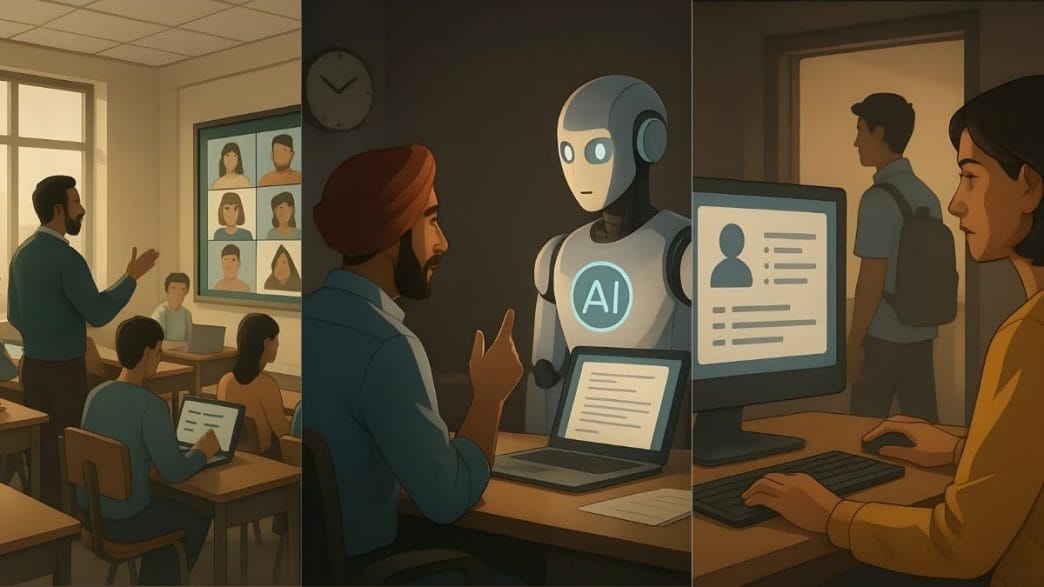
The classroom looks different now. Half the students log in remotely while an AI assistant fields questions at 2 AM. Their professor spends mornings reviewing algorithm-flagged assignments and afternoons meeting students the system predicts might drop out. Nobody planned for this to happen so fast, but here we are.
Indian universities find themselves racing to keep up with AI adoption happening faster than anyone expected.
How Fast Is This Really Happening?
The numbers tell one story. A recent EY-FICCI survey found that 60 percent of Indian higher education institutions now permit student AI use, with faculty advanced adoption around 17% per 2025 Digital Education Council reports. That does not mean every professor at every Indian university, but among those surveyed, the adoption rate sits surprisingly high.
Students have moved even faster. Multiple surveys from 2024 show that 86 percent of students worldwide now use AI in their studies, with over half using it weekly.
The institutional response has been mixed. IIT Kharagpur and IIT Madras both introduced four-year B.Tech programs in artificial intelligence starting in 2024. IIT Hyderabad actually led the way back in 2019, becoming India’s first institute to offer a dedicated B.Tech in AI. Eleven IITs now offer some form of AI-focused undergraduate program, such as B.Tech degrees in artificial intelligence or in artificial intelligence and data science.
What Changed in Course Design
Professors building courses today work differently than they did three years ago. The technology spots gaps in student understanding, suggests materials, and generates assessments. Some tools claim to cut lesson planning time from 5 to 10 hours per week down to a fraction of that.
Edtech companies in India now sell platforms where students get auto-generated quizzes during lessons that adjust based on where they struggle. Teachers see dashboards highlighting which students need help with specific concepts. The pitch sounds compelling: personalized learning at scale, something impossible before.
But Does It Actually Work?
That remains an open question. The technology exists and people use it. Whether it produces better learning outcomes stays harder to pin down. Policymakers hope these systems will prepare students for contemporary work environments. Critics wonder if we are sacrificing depth for efficiency, trading thoughtful instruction for algorithmic convenience.
The Grading Question
Automated essay grading moved from experimental to mainstream surprisingly fast. Multiple platforms now serve tens of thousands of educators. The tools promise to cut grading time dramatically, processing in seconds what once took 10 minutes per assignment.
How Accurate Is It Really?
Recent studies show LLMs like GPT-4 variants achieve Quadratic Weighted Kappa scores around 0.68 on specific tasks, with lower agreement on open-ended essays. AI-generated feedback received decent ratings from experienced markers in controlled studies.
But those results come with caveats. The studies looked at specific types of assignments under specific conditions. More recent work warns that LLM-based grading on open-ended disciplinary essays shows lower human-AI agreement in real classroom settings.
The Feedback Problem
Here is where professors get uncomfortable.
Faculty report that automated systems often deliver identical feedback to students with different problems. The nuance gets lost. One professor described watching “bots talking to bots” as both students and teachers increasingly rely on AI to produce and evaluate work.
The concern runs deeper than accuracy. If students write with AI and professors grade with AI, what exactly gets learned in that exchange?
Predicting Who Leaves
Universities have started using machine learning to identify students at risk of dropping out before it happens. The technology analyzes patterns in the data students generate:
- How often they attend class or log into the learning platform
- When they submit assignments and how complete the work is
- Whether they participate in forums or group discussions
- How their grades trend across different subjects
Recent studies using algorithms like CatBoost and LightGBM report accuracy of 80-85% on specific datasets. First-year students who eventually drop out often show warning signs early. Universities use these predictions to trigger interventions like counseling, tutoring, or financial aid adjustments.
Does It Help?
Dropout remains a major problem. Many universities see significant first-year attrition. A 2024 study examining Indian institutions found that addressing dropout requires understanding multiple factors, from socioeconomic struggles to health issues to lack of support systems.
Algorithms can flag patterns but they cannot solve the underlying problems. A student might need money, childcare, mental health support, or simply a professor who notices them. Technology identifies risk but humans have to provide solutions.
The Sameness Problem
This is where the conversation gets uncomfortable. AI promises personalization but might deliver the opposite. A 2025 study on AI ethics in education identified “student homogenized development” as a real risk.
When Customization Creates Conformity
The paradox works like this. Algorithms filter resources based on what they think each student needs. Sounds personalized. But all those personalized recommendations come from the same systems trained on the same data using the same logic. Students might receive different content but it gets curated through identical lenses.
One analysis noted that India’s education system already struggles with standardization that prizes compliance over genuine personalized learning. Adding AI risks making that worse, not better.
The Training Gap Nobody Talks About
Research shows low faculty AI training; only 6% fully agree institutions provide sufficient AI resources, with 17% advanced usage. Think about that. Universities deploy these systems while most professors have received zero preparation for using them effectively or understanding their limitations.
Analyses of Indian higher-education financing show that public universities allocate only a small share of their budgets to technology. That barely covers basic infrastructure, much less the cloud computing, software licenses, and training programs needed for responsible AI integration.
Faculty Caught in the Middle
Professors face an awkward position. AI promises to reduce their workload through automated grading and administrative help. The reality feels more complicated.
A 2025 U.S. survey found similar global patterns:
- 71 percent said administrators lead AI decisions with minimal faculty input
- 81 percent are required to use education technology systems
- Only 15 percent said their institution mandates AI use specifically
Many professors use AI tools without realizing it because the systems get embedded in learning management platforms they already use. Their roles are changing but not always in ways they chose or understand.
Who Decides How This Works?
That question matters more than it might seem. Research indicates faculty must now acquire new skills around instruction, validation, and supervision using AI. But who trains them? Who decides which tools get adopted? Who determines what counts as appropriate use?
In many cases, administrators make those decisions with limited input from the people actually teaching. The technology gets rolled out and faculty adapt as best they can.
What Comes Next
India’s National Education Policy 2020 emphasizes AI integration but the actual implementation roadmap stays vague. The government approved the IndiaAI Mission with a total outlay of about ₹10,300 crore over five years, amounting to more than USD 1 billion. Coordination between institutions remains inconsistent.
Recent research suggests that AI still appears in the strategic plans of only a minority of Indian universities, with most institutions yet to embed it into long-term planning. UGC and AICTE guidelines on AI integration remain non-mandatory, meaning institutions navigate adoption individually without unified standards.
Building Better Systems
The path forward needs more than enthusiasm.
Experts recommend:
- Creating ethical oversight committees before deployment, not after
- Developing clear data governance frameworks
- Building transparency around how algorithms make decisions
- Prioritizing faculty training instead of treating it as an afterthought
The Real Stakes
India’s higher education system serves 43.3 million students. Enrollment grew 26.5 percent between 2014-15 and 2021-22. The Gross Enrollment Ratio stands at 28.4 percent, well below the government’s 50 percent target for 2035.
Universities face impossible math. They need to expand access while maintaining quality, all with inadequate resources. AI looks like a solution. Maybe it is. Or maybe it is just a faster way to process more students through increasingly standardized systems.
The difference matters. One approach democratizes learning. The other industrializes it.
Right now, universities worldwide are integrating AI at remarkable speed. India can lead in developing responsible, context-appropriate AI education. Or it can watch existing inequalities widen as schools with resources pull ahead while others fall further behind.
The technology keeps advancing regardless. The algorithms are ready, they work, they deliver results. Whether those results actually serve students or just serve efficiency metrics depends entirely on choices humans make in the next few years.
The academic arms race started. We are in it now. The question is not whether to use AI but how to use it in ways that improve education rather than just accelerate it.