




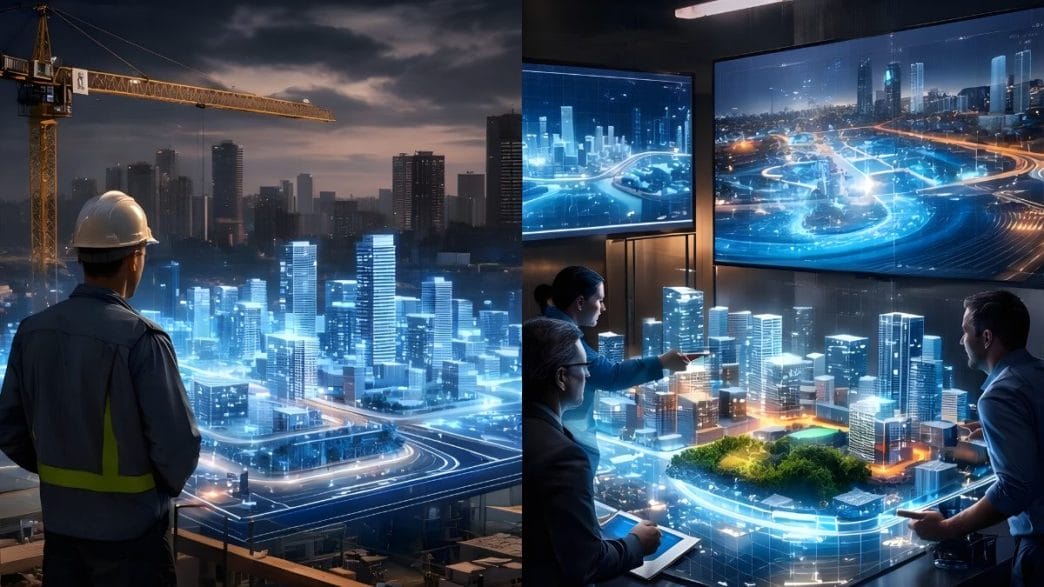
The construction crane hasn’t moved yet, but the city already exists. In a virtual realm powered by real-time data streams and sophisticated algorithms, planners walk through streets that won’t be paved for years, testing how monsoon floods might behave, where traffic chokes, and whether hospitals will need parking expansions. This isn’t science fiction. Digital twins are reshaping how India builds its future, one simulated scenario at a time.
Testing Cities Before Breaking Ground
A digital twin creates a precise virtual replica of physical infrastructure, continuously updated with sensor data from the actual city. Imagine standing at a busy intersection that exists only in code, watching how different signal timings affect rush hour flow, or observing where monsoon water accumulates before the first drain gets installed.
Amaravati took this radical approach when Andhra Pradesh decided to build a new capital from scratch. Rather than reacting to problems after construction, planners tested architectural choices and landscaping options in their virtual twin first. The simulations revealed something striking: strategic placement of green spaces and careful hardscaping choices could drop street temperatures by eight degrees Celsius during brutal summer afternoons. That’s the difference between unbearable heat and manageable warmth, discovered before a single brick got laid.
Beyond temperature control, the platform let engineers stress-test utility networks under different load scenarios, optimize placement of water pipes and power lines, and iterate through dozens of development configurations without wasting resources on physical prototypes.
India’s Urban Modernization Journey
Understanding digital twins requires looking at how India modernized its urban centers. The Smart Cities Mission launched in 2015 to transform 100 urban centers through technology and infrastructure. As of December 2025, 96 percent of 8,064 projects have been completed, worth ₹1,55,386 crore, with 323 projects still ongoing.
The mission achieved substantial milestones. All 100 cities now have operational Integrated Command and Control Centres that use AI and IoT for decision-making. Over 84,000 CCTV cameras strengthen public safety. Cities like Patna, Chandigarh, Indore, and Pune reached 100 percent project completion.
Yet implementation revealed important lessons about coordination, environmental planning, and community engagement that inform how cities approach technology today.
How European Cities Test Before Building
Digital twins flip traditional planning by making consequences visible before concrete gets poured. Helsinki has evolved its approach over two decades, initially using 3D interactive models to evaluate architectural competitions. Today, their digital twin functions as an Energy and Climate Atlas, modeling energy consumption at the building level to help achieve carbon neutrality by 2030.
The Finnish capital monitors air quality across neighborhoods, optimizes energy usage patterns to minimize waste, and allows citizens to interact with city projects through online platforms. With building heating accounting for roughly 45 percent of Helsinki’s carbon emissions, the digital twin’s ability to measure solar radiation and shadows on each surface becomes crucial for planning interventions.
Rotterdam focuses on climate resilience, building a dynamic digital twin that models climate change effects on urban infrastructure. By combining meteorological data, hydrological models, and infrastructure information, the city simulates flood scenarios and evaluates mitigation measures before physical implementation.
Dublin advances a mobility-focused digital twin that integrates data from traffic sensors, public transport systems, and pedestrian flows. The platform allows testing interventions like traffic light timing changes or dedicated bus lanes to reduce congestion and improve travel times.
Building the Policy-Tech Bridge
Hardware and software alone won’t fix India’s urban challenges. Digital twins only work when they connect to actual governance structures that can act on what the simulations reveal.
Aachen, Germany demonstrates the importance of data governance frameworks. Their transport-focused model covers 970 kilometers of road network with real-time updates, enabling planners to test traffic scenarios in virtual environments. But the city discovered that encouraging departments to share data and establishing clear legal frameworks for data processing were bigger challenges than the technical implementation itself.
Indian municipalities need similar integration between technology and decision-making. That means training staff to interpret simulation data, establishing clear protocols for which decisions get tested virtually before implementation, and creating feedback loops so lessons from the digital realm inform physical development. Cross-departmental cooperation becomes essential when mobility planning intersects with climate adaptation or public health initiatives.
Preventing Expensive Mistakes Through Simulation
Virtual testing makes urban planning tangible and accountable. Want to know if that proposed metro extension will actually reduce road traffic? Run it through the digital twin and watch what happens. Wondering whether a new park will improve air quality readings? Test different vegetation configurations and measure the simulated impact.
This matters especially for Indian cities operating under tight budget constraints. When construction costs climb into hundreds of crores and mistakes affect millions of residents for generations, catching problems during the design phase rather than after concrete gets poured saves both money and disruption.
Medical campuses, educational institutions, and transportation networks all benefit from scenario testing. Planners can explore multiple development paths side by side, comparing outcomes before committing resources. The virtual laboratory removes guesswork from decisions that lock cities into infrastructure patterns for decades.
Singapore’s Virtual Singapore demonstrates comprehensive application, integrating real-time data on roads, buildings, utilities, and environmental elements. The 3D model aids decisions on resource allocation, urban planning, and crisis management, establishing a standard for how digital twins can support entire city-state operations.
Cities Before Shovels
India doesn’t need more disconnected tech initiatives. It needs pragmatic tools that make urban planning smarter. Digital twins offer exactly that, not as a replacement for good governance but as a way to make consequences visible before they become irreversible.
The Smart Cities Mission demonstrated both the potential and challenges of urban modernization at scale. With 96 percent project completion and operational command centers across 100 cities, the mission established valuable infrastructure while revealing the importance of coordination and inclusive planning in urban development.
Digital twins point toward building on these lessons. Technology serves decision-makers rather than dazzling them. Simulations reveal what actually works instead of what sounds impressive in presentations. Virtual testing prevents expensive mistakes by catching problems during the design phase when solutions remain flexible and affordable.
European cities from Helsinki to Dublin show what becomes possible when virtual models inform real decisions. They test mobility strategies, simulate climate impacts, and engage citizens in planning processes before physical changes begin. Their experiences offer roadmaps for Indian cities ready to adopt similar approaches.
Indian cities face a straightforward choice. They can keep building based on assumptions and political pressures, discovering problems after it’s expensive to fix them. Or they can test first and build second, using holographic replicas to reveal what succeeds before shovels hit dirt. When mistakes affect millions of residents for generations, the smarter path seems clear. Cities before shovels. That’s not just a catchy phrase. It’s how urban India applies lessons learned to build what actually works.