



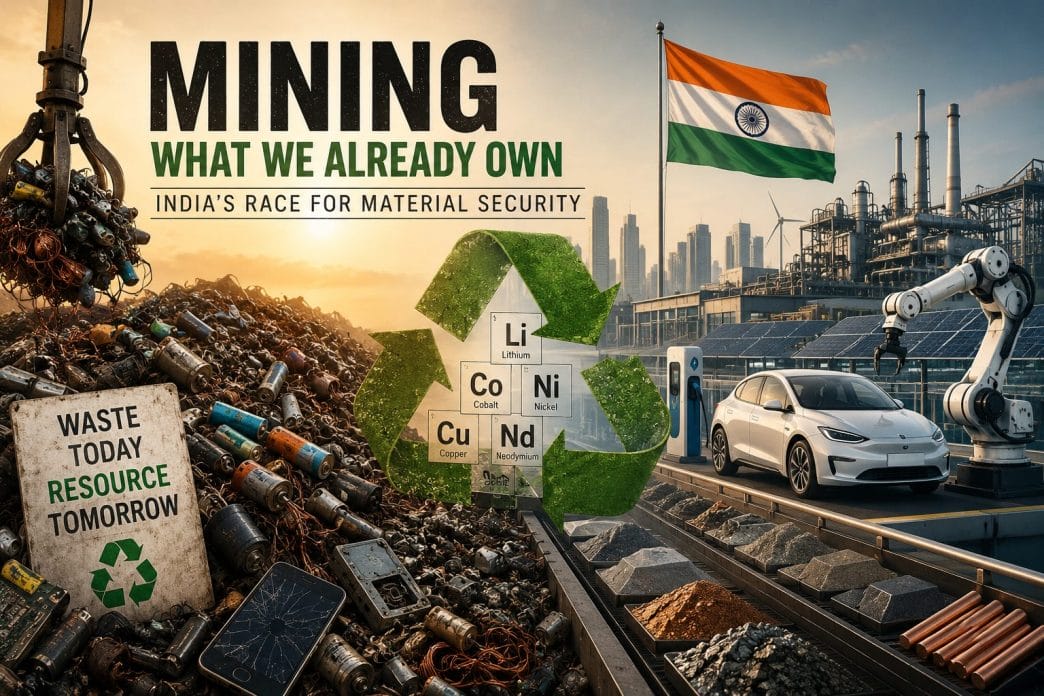
For most of modern history, national power was something you dug out of the ground. Coal built empires, oil financed them, and lithium was supposed to be the next prize buried beneath contested soil. That story is now incomplete. The materials that will decide who builds the next decade of electric vehicles, semiconductors and defence systems will not all come from mines. A growing share will come from what we already threw away.
India calls it kabaad. Dead batteries, stripped wiring, obsolete phones, the carcasses of ageing cars. For years this was treated as nuisance and afterthought, handled by an informal economy that nobody bothered to measure. It is now strategic inventory. The shift in language matters more than it sounds. When a country starts treating its scrap as a reserve rather than a problem, it has understood something important about the century ahead.
There are only two ways to secure a critical material. You can mine it, or you can recover it. Mining is slow, capital-heavy and geographically unlucky for most countries. Recovery runs on waste that already sits inside your borders. In a world where supply chains are being used as weapons, the second route is not the sustainable option. It is the faster one.
Why this stopped being an environmental story
Recycling used to be filed under sustainability, somewhere between corporate goodwill and regulatory box-ticking. That framing is now dangerously out of date. China processes more than eighty percent of the world’s rare earths and produces close to ninety percent of the high-performance magnets that sit inside electric motors, guided missiles and wind turbines. Through 2025 it showed exactly what that dominance buys. Export controls on rare-earth elements forced carmakers across the United States and Europe to cut production and idle lines, and a wider set of restrictions followed later in the year. A one-year suspension was eventually negotiated, but the licensing machinery was left fully in place. That is the part worth remembering. The tap can be turned off at will, and everyone downstream now knows it.
India’s exposure is stark. It imported roughly ninety-three percent of its rare-earth magnets from China in the last financial year, with stockpiles measured in weeks rather than months. A country cannot run an EV transition, a defence build-out and a semiconductor ambition simultaneously on a buffer that thin, held at the discretion of a strategic rival. Recovery of these materials from spent products is not an environmental nicety in that context. It is insurance against a chokehold.
Policy has quietly made recycling compulsory
The most consequential development in this sector is not a new technology. It is a set of rules. India’s Battery Waste Management Rules now require producers to recover up to ninety percent of the material from EV and portable batteries by 2026-27. More telling is the clause that follows. New batteries will have to contain a minimum share of domestically recycled material, beginning at five percent in 2027-28 and climbing to twenty percent by the end of the decade. The e-waste regime works the same way, pushing recycling targets toward seventy percent of what producers put on the market and routing the whole flow through a traceable government portal that is now linked to tax and customs data.
Read together with the National Critical Mineral Mission and a roughly seven thousand three hundred crore scheme to build domestic rare-earth magnet capacity, the direction is unambiguous. Demand for recovered material is no longer a matter of preference. It is written into law. Once that happens, recycling stops being a feel-good story and becomes a regulated input market with policy-backed demand. That is the kind of certainty industries are built on.
Unlike mining, recycling capacity can be built close to industrial demand centres. A copper smelter or battery-recovery facility near manufacturing clusters shortens supply chains, reduces import dependence and turns waste into a domestic source of raw material. In strategic terms, recycling is less about waste management than about creating an urban mine that grows alongside consumption.
The companies building the backbone
It is tempting to compare this moment to the rise of Larsen & Toubro, the firm that built so much of India’s physical infrastructure. The analogy holds, with one adjustment. The infrastructure being built this time is not roads and ports. It is resource independence. A handful of companies are laying that foundation, and they are not running side businesses.
Gravita India is the clearest example of the integrator model. Rooted in lead recycling, it has spent the past year turning itself into a multi-metal platform. It entered copper by acquiring a near-complete stake in Rashtriya Metal Industries for around five hundred and fifty-nine crore, broke ground on a greenfield copper plant at Mandvi, and commissioned a lithium-ion pilot line. With consolidated profit of close to three hundred and seventy-eight crore in FY26 and a stated plan to nearly double recycling capacity by the end of the decade, it is assembling a full-stack circular supply chain rather than expanding a single product.
Around it sits a cast of specialists, each occupying a different layer of the same emerging stack.
CMR Green Technologies is among the country’s largest aluminium recyclers, feeding die-cast alloys into the automotive industry at the volumes manufacturing actually needs. It is the unglamorous backbone, the supplier other companies depend on without naming.
Pondy Oxides and Chemicals is moving from lead into lithium-ion and e-waste, betting directly on the EV curve and the tightening regulations that come with it. Its wager is essentially that the rulebook is the business plan.
Recykal is the outlier and arguably the most interesting, because it owns no smelter at all. It is a software layer connecting waste generators to recyclers, the closest thing the sector has to a logistics and data rail for a market that has always run on informality.
Shakti Plastic Industries works the least glamorous and largest stream of all, plastic, where the recycling problem is most visible and least solved. Volume here is not a footnote. It is the whole challenge.
Collection is not the moat. Extraction is.
Here is where most analysis of this sector goes wrong. It assumes the winners will be whoever collects the most scrap. They will not. Gathering waste is the easy part and the part the informal economy already does cheaply. The real margin sits in how much value you can pull out of a tonne of mixed waste, and how purely. Hydrometallurgy for lithium and cobalt, pyrometallurgy for base metals, automated optical sorting, robotic dismantling of complex electronics. These are the capabilities that separate a scrap dealer from a material supplier. The companies investing in them are quietly changing what business they are in. They start as waste handlers and end as the upstream of someone else’s factory, which is a far more defensible place to stand.
What the next decade most likely looks like
The breathless version of this story has India dominating recycled materials overnight. The pessimistic version has policy stalling and the informal economy swallowing every gain. Neither is likely. The realistic path is slower and more durable. Mandates guarantee demand, capital is arriving, the informal sector gets gradually absorbed, and the field consolidates into three to five serious players with the scale and the technology to matter. That is not a dramatic outcome. It is a structural one, and structural outcomes tend to last.
The richest deposits of the coming decade are not buried under the Himalayas or sitting off the coast. They are in landfills, junkyards and the glove compartments of cars nobody drives anymore. India will not win this race by digging deeper. It will win, if it wins, by becoming the country that learned to mine what it already owns.