




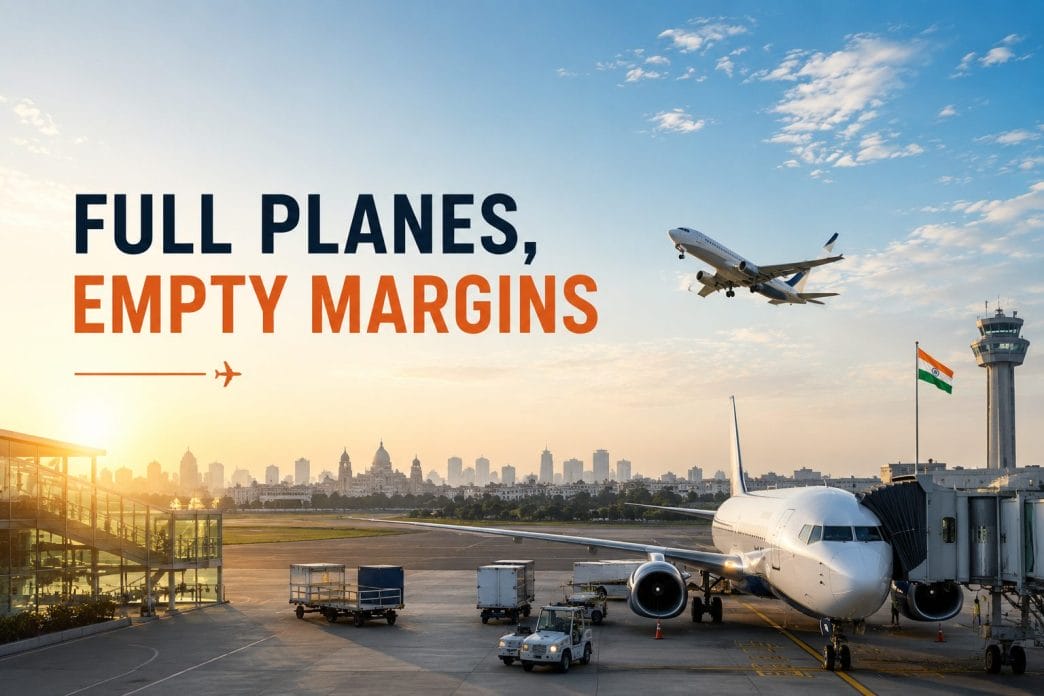
Walk through Terminal 2 at Mumbai or the new international wing at Bengaluru and the numbers look unambiguous. Load factors are running above 85%. Domestic passenger traffic hit record highs in both FY24 and FY25. IndiGo alone operates over 2,000 daily flights. By every surface metric, Indian aviation is in the middle of a structural boom.
Three of those airlines have quietly written to the government warning they may have to stop flying. Air India, IndiGo, and SpiceJet each sent letters in recent weeks flagging that they are approaching the point where continued operations cannot be guaranteed.
The Fuel Math That Doesn’t Work
Aviation turbine fuel typically accounts for 35 to 45% of an Indian carrier’s operating costs. In IndiGo’s case, the most recent annual report puts aircraft fuel expenses at Rs 26,197 crore in FY25, against total revenue from operations of Rs 80,802 crore. That makes fuel roughly 32% of revenue in a year when crude was averaging well under $90 a barrel.
Brent crude has since moved from roughly $85 to $150 a barrel following the escalation of Middle East tensions and the Strait of Hormuz blockade. Jet fuel is now priced at $179 a barrel, up from $80 just weeks ago. If fuel costs scale proportionally from their FY25 base, IndiGo’s fuel bill moves from Rs 26,197 crore toward Rs 58,000 crore or higher, against a revenue base that has not grown anywhere near commensurately. Passenger growth is running at 1.4%. The FY25 net profit margin was 9%. There is no version of that equation where margins hold.
Airlines have tried to pass some of this on through fuel surcharges, but here the government creates a second problem. The Ministry of Civil Aviation imposed domestic fare caps in December 2025 after large-scale IndiGo flight cancellations caused a spike in ticket prices. Those caps, which kept one-way economy fares within roughly Rs 18,000 depending on route, were only removed in March 2026. The government has explicitly reserved the right to reimpose them. So carriers face a world where their largest cost is spiking freely while their ability to reprice revenue is subject to regulatory discretion. The remainder of unrecovered fuel costs lands directly on the operating account.
Why This Runs Deeper Than a Spike
Two structural features of Indian aviation turn every fuel shock from a rough quarter into a potential crisis.
The first is the tax treatment of aviation turbine fuel. ATF sits outside India’s GST regime under state-level VAT: 25% in Delhi, 29% in Tamil Nadu, varying elsewhere. Airlines receive zero input tax credit to offset rising fuel costs. Every rupee of the price increase is absorbed entirely. A carrier in Europe or the Middle East gets at least partial relief through the VAT chain. Indian carriers get none. ATF has been kept outside GST since 2017, blocked each time by the political economy of state revenue.
The second is hedging, or rather the almost complete absence of it. Ryanair has approximately 80% of its near-term fuel costs locked in. EasyJet sits around 70%. Indian carriers have no scaled, board-approved hedging programme of any meaningful size. The result is full, unfiltered exposure to every move in the oil market.
| Carrier | Fuel Hedged |
|---|---|
| Ryanair | ~80% |
| EasyJet | ~70% |
| Indian carriers | ~0% |
The hedging problem extends to currency, and the numbers here are now serious. Indian carriers earn revenue in rupees but pay dollar-denominated aircraft leases and a significant portion of maintenance costs in dollars. The rupee traded at around Rs 83 to the dollar in early 2024. It crossed Rs 85 in early 2025, breached Rs 90 by January 2026, and is now hovering near Rs 95 to Rs 96, an all-time low. That is roughly a 14% depreciation in twelve months. Every dollar-denominated lease payment now costs an Indian carrier 14% more in rupee terms than it did a year ago, at the same time that jet fuel has more than doubled. These two shocks are not independent. When crude spikes, the rupee weakens, because India imports roughly 90% of its oil and the demand for dollars rises accordingly. For an unhedged Indian airline, the two risks are structurally correlated and they both move in the wrong direction at once.
What This Means for Stocks: IndiGo in Focus
InterGlobe Aviation had its two best years on record in FY24 and FY25, with operating margins running into the high teens. The market re-rated accordingly: IndiGo now trades at approximately 20x book value, pricing in continued margin strength and flawless execution. It does not price in what is happening right now.
The structural cracks, unhedged fuel, unhedged forex, dollar-denominated leases against a rupee revenue base, do not show up in good times. They show up when crude is at $150 and the rupee is near a record low simultaneously. One additional signal worth watching: promoter stake has been quietly declining over recent quarters. Insider positioning tends to be informative when the gap between market narrative and operating reality is this wide.
The Government’s Role and the Moral Hazard It Has Created
The SOS letter from Indian carriers is not a new document. It is a recurring one.
- 2008: Global financial crisis plus oil spike. Excise relief granted.
- 2012: Liquidity crunch. FDI rules relaxed to allow foreign airline equity.
- 2018: Oil at $80+. Kingfisher gone, Jet struggling. Third round of intervention.
- 2020: COVID grounds the industry. Debt moratoriums, state support, fee waivers.
- 2026: Strait of Hormuz blockade. Crude at $150. Three airlines write again. Government caps monthly ATF increases at 25%.
Every cycle ends in a concession, and that pattern has had a predictable consequence: it has eliminated any incentive to build structural resilience. Why invest in a hedging framework when the playbook is to write a letter and wait? The 25% monthly cap on ATF increases is a tourniquet, not a fix. The SOS letter is itself proof of the problem. A well-capitalised airline with a functioning hedge does not need to appeal to the state when oil moves. It has already priced the risk.
The Stand
Full planes do not equal healthy balance sheets. Passenger volumes are a leading indicator of potential revenue, not a guarantee of margin, and they say nothing about the cost structure underneath. Until ATF comes under GST, or crude falls and stays down, earnings will not follow passenger numbers.
Aviation is a watchlist sector right now. Not a buy.
This analysis is for informational purposes only and does not constitute investment advice.