



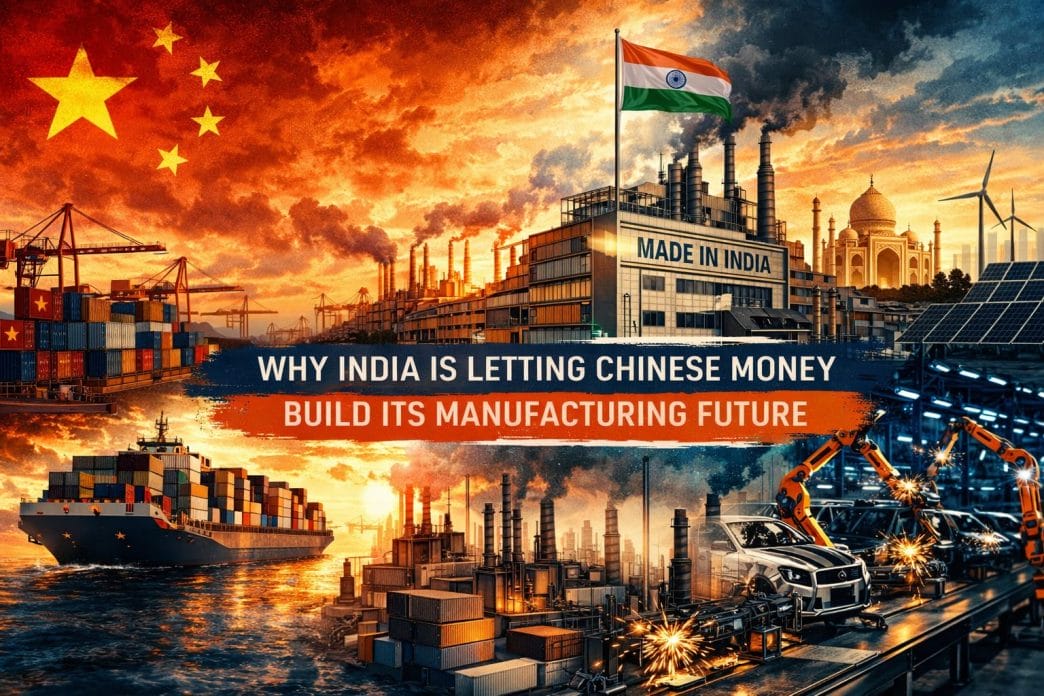
Why India Is Letting Chinese Money Build Its Manufacturing Future
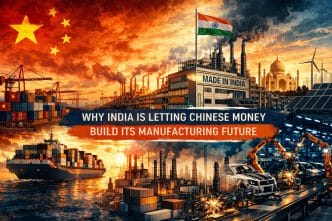
In the grand theatre of geopolitics, the most decisive battles are often fought not on borders but inside factories, ports and balance sheets. India’s latest recalibration of its foreign investment policy toward China is one such quiet but consequential move.
An Uneasy Interdependence
For years, India has lived with an uncomfortable economic paradox. China is simultaneously one of its largest trading partners and its most formidable strategic rival. The numbers are hard to ignore. India imports large volumes of electronics components, machinery, chemicals and solar equipment from China, and the bilateral trade deficit has hovered near the $100 billion mark in recent years (source). Indian factories depend heavily on Chinese intermediate goods even as political tensions simmer along the Himalayan frontier. The result is a relationship that feels economically indispensable but strategically uneasy.
The Policy Shift After 2020
The origins of India’s restrictive investment framework lie in the turbulence of 2020. The COVID-19 pandemic had shaken global markets and left many Indian firms vulnerable to opportunistic foreign acquisitions. Around the same time, the deadly clash in Galwan Valley deepened mistrust between New Delhi and Beijing. In response, the government issued Press Note 3, requiring prior approval for foreign direct investment from countries sharing a land border with India. While the rule applied broadly, its practical impact was most strongly felt by Chinese capital.
In the months that followed, much of the planned Chinese investment into India slowed or stalled. Venture funds linked to Chinese technology firms found their deals stuck in regulatory limbo. New manufacturing projects with Chinese partners were delayed or quietly shelved. Even sectors such as electric vehicles, smartphones and consumer electronics, which had benefited from Chinese funding and supply chains, suddenly faced friction. From a security standpoint, the move was understandable. Economically, it introduced new constraints into sectors already deeply intertwined with Chinese industrial ecosystems.
Why Decoupling Isn’t Simple
Over the last few years, however, a more pragmatic view has begun to take shape. A clean break from China, at least in manufacturing, is much easier to describe than to execute. China’s industrial network remains the most extensive in the world, spanning thousands of suppliers and highly specialised production clusters. Everything from smartphone cameras to lithium-ion batteries and precision machine tools flows through that system. For a country that wants to become a serious manufacturing hub, pretending that ecosystem does not exist is not a realistic option (analysis).
That recognition is now reflected in a subtle but important shift. India has begun to allow some Chinese investments into manufacturing on a case-by-case basis, even while maintaining restrictions in sensitive sectors. Instead of blanket barriers, the approach is moving toward selective approvals, minority stakes and tightly monitored partnerships. In effect, India is encouraging Chinese firms to help build factories on Indian soil that produce many of the components it currently imports.
What India Stands to Gain
By opening narrow channels for Chinese capital in manufacturing while keeping critical sectors ring-fenced, India is attempting to achieve several objectives simultaneously. The first is technological learning. Chinese manufacturers have spent decades refining large-scale industrial production, supply chain coordination and cost efficiency. Access to that expertise, even indirectly, could accelerate capability building within Indian firms.
The second is import substitution through localisation. A large share of India’s imports from China consists of intermediate goods, circuit boards, display modules, machinery parts and speciality chemicals. These are the invisible inputs behind finished products. If even a portion of this production shifts to India, it reduces import dependence and strengthens domestic industrial depth.
The third objective is integration into global supply chains. Multinational companies have increasingly adopted a “China plus one” strategy, diversifying manufacturing bases to reduce geopolitical risk (whitepaper). India wants to position itself as a credible alternative. Somewhat counterintuitively, the presence of Chinese suppliers within India could make that transition easier, since many global value chains are already built around them.
Seen from this perspective, the policy resembles a form of economic judo. Rather than confronting China’s industrial strength directly, India is attempting to redirect some of that strength into its own growth trajectory.
What China Gets in Return
There is something in it for Chinese firms as well. China’s industrial model is under pressure. Rising wages, demographic shifts and increasing trade tensions with Western economies have made overseas expansion more attractive. India offers a large domestic market, relatively competitive labour costs and a growing manufacturing push. For Chinese companies, producing in India can also provide a pathway to global markets without the same scrutiny attached to “Made in China” exports.
None of this is without risk. Even minority investments can provide access to sensitive operational data and strategic information. Over time, critical segments of supply chains could become dependent on foreign-controlled entities, creating potential leverage in times of geopolitical stress. In technology-intensive sectors, issues of data governance, standards and vendor dependence can be as important as ownership itself.
That is why the opening remains cautious. Telecom, semiconductors and other strategically sensitive sectors continue to be tightly regulated. Approval requirements remain in place, and proposals are evaluated individually. The aim is to balance economic pragmatism with strategic caution.
This balancing act is not unique to India. Governments around the world are grappling with the challenge of managing economic interdependence in an era of strategic rivalry. The United States has imposed export controls on advanced technologies. European countries are strengthening investment screening frameworks. Supply chains are increasingly shaped not just by cost, but also by resilience and political alignment.
A World Moving in the Same Direction
Within this shifting global landscape, India is attempting to chart its own path. Rather than pursuing complete economic disengagement, it is experimenting with selective engagement. Trade and investment are welcomed where they strengthen domestic capabilities, and restricted where they risk creating new dependencies.
Underlying this approach is a more mature understanding of what “self-reliance” entails. Industrial strength is not built through isolation, but through networks of capital, technology and production that evolve over time, supply chains are getting reshaped.
If managed carefully, the potential gains are significant. Localising production could reduce the trade deficit. Indian firms could move up the value chain. And the country’s position as a manufacturing destination could become more credible, both in terms of cost and capability.
The risks, however, are equally real. Move too quickly, and new dependencies may replace old ones. Move too slowly, and the opportunity to integrate into shifting global supply chains may pass.
The Balance India Is Trying to Strike
In the end, India’s evolving stance toward Chinese investment reflects a deeper reality of the modern economy. Strategic rivals are often economically intertwined. The lines between competition and cooperation are blurred by the practical demands of production and trade.
New Delhi’s approach suggests it is choosing neither outright confrontation nor passive dependence. Instead, it is attempting something more complex: using the very engine of China’s industrial strength as one of the tools to build its own.
If that experiment succeeds, the future of Asian manufacturing may not be defined by a simple contest between India and China, but by a more complicated story in which one helps shape the rise of the other.