



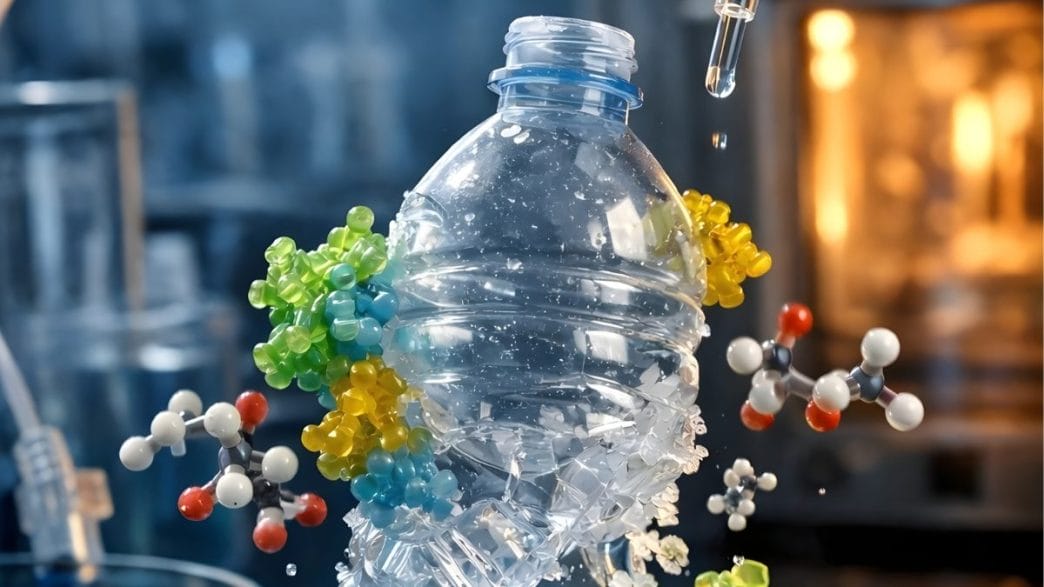
A water bottle sits in your trash bin. You toss it into recycling, feeling good. Here’s what actually happens: it gets melted down, loses quality, and after a few cycles becomes so degraded it ends up in a landfill. Now imagine lab enzymes that degrade PET in days under ideal conditions. No melting. No degradation.
This isn’t theoretical. Labs from Texas to London are running this process, and pilots are advancing toward commercial scale.
AI Shortcuts Millions of Years of Evolution
Nature has enzymes that break down organic matter, but plastic is a human invention evolution hasn’t caught up with yet. Researchers at the University of Texas at Austin trained AI on 19,000 proteins to enhance PETase, yielding FAST-PETase, which degrades low-crystallinity PET (common in textiles and some bottles) under lab-optimized conditions at 50°C. Higher-crystallinity PET degrades more slowly.
Breaking Down 51 Different Products
Lab tests on 51 post-consumer PET items showed up to 90% degradation of low-crystallinity PET over 10 days under optimized conditions, yielding terephthalic acid and ethylene glycol for potential new PET. Full-scale repolymerization remains experimental.
Commercial Players Race to Scale
- Protein Evolution uses AI for custom enzymes. Stella McCartney partnered with them in 2023 on polyester and nylon recycling, launching BioPure fibers in products thereafter.
- London startup Epoch Biodesign raised $18.3 million in March 2025 for pilot-scale enzyme recycling targeting up to 150 tonnes per year. Full factories are still in planning.
Why Temperature Matters
Traditional chemical recycling demands:
- 170°C to 300°C heating requirements
- High-pressure equipment with substantial capital costs
- Massive energy consumption for continuous operation
Enzymatic processes operate at mildly elevated temperatures of 50-70°C, far below chemical recycling’s 170-300°C range, reducing energy and costs, though controlled setups are needed.
The 91% Problem
Here’s what should bother everyone:
- Only 9% of plastic waste globally gets recycled
- 91% ends up in landfills, incinerated, or mismanaged (with only a fraction reaching oceans)
- Approximately half of all plastic enters the waste stream within about a year
- Production has roughly doubled every 15 years
Traditional recycling has real limits. You need careful sorting. Mixed plastics jam machines. Food contamination ruins batches. Even when it works, plastic degrades each cycle.
Enzymes target specific polymers amid contaminants, yielding high-purity monomers for virgin-quality recycling, though mixed waste needs preprocessing. Food residue creates fewer issues than mechanical recycling. The output quality stays consistent because you’re recovering original molecular building blocks.
India’s Circular Economy Opportunity
India’s situation presents both challenge and opportunity:
- 9.3 million tonnes of plastic waste annually
- Overall formal recycling ~8-10%, though PET bottles achieve near 90% recovery through informal collection networks
- India’s plastic recycling industry is valued at several billion dollars, growing ~6.5% annually under current and upcoming regulations
The country ranks among top global sources of mismanaged plastic. But new regulations mandate QR tracking and 30% recycled content in rigid packaging.
Perfect Timing for Adoption
Several factors position India well:
- Chemical recycling and AI-enabled sorting pilots expanding through Startup India grants in Maharashtra and Gujarat
- Strong machine learning expertise aligning with AI-designed enzyme development
- Established informal collection networks providing material flows
India’s Ministry of Environment estimates circular strategies could unlock $2 trillion and generate 10 million jobs by 2050. Enzymatic methods hold promise alongside expanding chemical/AI-sorting pilots in Maharashtra and Gujarat.
From Waste to New Products
Global synthetic fiber production consumes hundreds of millions of barrels of oil annually, with polyester accounting for roughly 70–80% of output.
Enzymatic processes handle garments with buttons, zippers, and blended fibers by targeting specific polymer molecules while leaving other materials intact. When yesterday’s inventory becomes tomorrow’s collection without quality loss, business models shift fundamentally.
When Waste Becomes Profitable
Most green technologies cost more than doing nothing. Enzymatic recycling targets profitability, though full economics await scale-up data. The pitch: buy virgin-quality plastic from yesterday’s waste instead of petroleum. If recycled costs less at scale, economics drives adoption without mandates.
Epoch’s March 2025 funding pulled in Inditex, Lowercarbon Capital, and a $1 million UK government grant. That mix signals real money betting on viability. Their pilots test whether this works economically, with full profitability awaiting production-level validation.
Three Years From Now
Picture a Pune garment factory. Polyester scraps once destined for landfills now get collected weekly and sent to a local biorecycling facility. Within days, they return as polymer chips ready for new fabric. The waste stream becomes the supply chain.
The enzymes exist. The AI models work. Pilots are advancing. The 91% of plastic we currently throw away represents both a massive problem and a massive market. Companies racing to capture it are proving that biology, accelerated by artificial intelligence, might finally make waste more valuable than virgin material.