




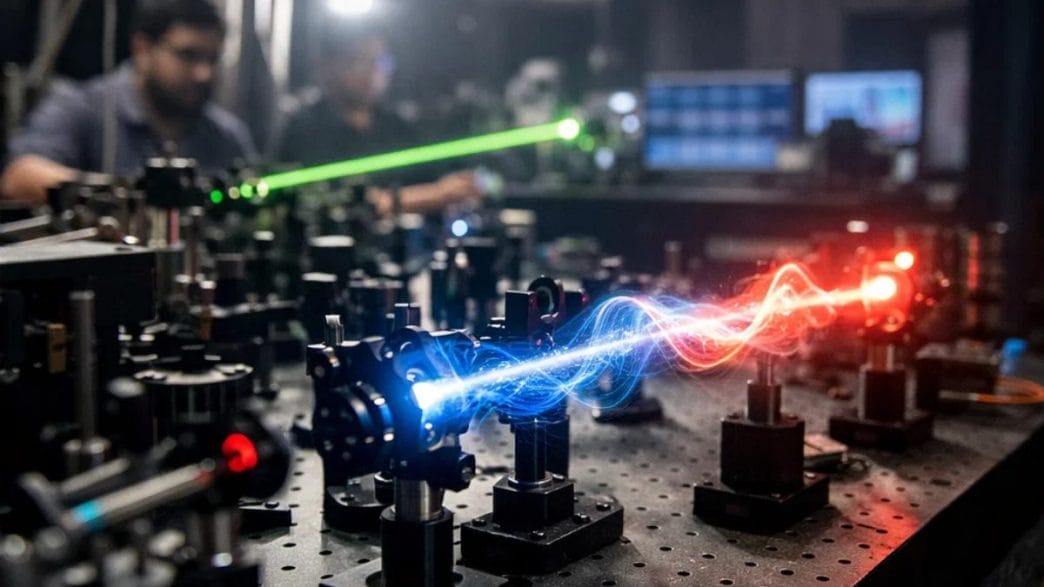
A photon splits in a Delhi lab. Touch one, and the other responds instantly across a kilometer of open air. India’s quantum internet is no longer science fiction. It’s quietly taking shape.
While headlines chase quantum computing milestones, India takes a different approach with something more immediate: unhackable communication networks. The National Quantum Mission got the green light in April 2023 with Rs. 6,003.65 crore in funding, running through March 2031. Key milestones? Targeted for 2030. The vision is ambitious: a 2,000km quantum internet linking cities through satellite connections, metropolitan networks using fiber, and quantum repeaters that can relay photons without compromising encryption.
Here’s what this means in practical terms. By 2030, Indian banks, defense networks, and smart cities could operate on communications that no hacker (even armed with a quantum computer) can breach. This isn’t some far-off theoretical protection. India is building it right now.
From Lab to Battlefield: The Free-Space Breakthrough
June 2025 was a turning point. DRDO and IIT Delhi pulled off quantum key distribution over a 1km free-space optical link right on their campus. The experiment hit a 240 bps secure key rate with less than 7% quantum bit error rate.
Those numbers might not sound impressive at first. But consider what free-space quantum communication actually means. No optical fiber needed. It works through air, which makes it perfect for battlefield scenarios, remote locations, and eventually those satellite connections. Defense Minister Rajnath Singh wasn’t exaggerating when he called it a game changer for future warfare.
Professor Bhaskar Kanseri’s team had already built credibility. Back in February 2022, they demonstrated India’s first intercity quantum link between Prayagraj and Vindhyachal, spanning 100 kilometers of commercial fiber. Then in 2024, they managed to push quantum keys through 100km of regular telecom-grade fiber using entanglement.
Free-space transmission was the piece missing from the puzzle. While China grabbed headlines with its Micius satellite back in 2016 and the US poured billions into quantum computing research, India quietly demonstrated world-class quantum links, making sure the next-generation internet gets built domestically. Now all three methods are proven: underground fiber, above-ground commercial cables, and open-air transmission.
MAQAN: Cities Go Quantum
IIT Delhi focused on distance. IIT Madras built something equally crucial. MAQAN (Metro Area Quantum Access Network) is India’s first metropolitan quantum testbed, up and running in Chennai.
Think of MAQAN as a real-world testing ground. It connects multiple spots across Chennai using quantum key distribution protocols through fiber infrastructure that already exists. The network tests protocols like Coherent One Way and Differential Phase Shift, both designed to catch eavesdropping attempts the moment they happen.
What makes it interesting is the machine learning integration. MAQAN dedicates processor cores to logging operational parameters and running ML models that tweak network performance on the fly. When atmospheric conditions shift or fiber quality drops, the system adjusts automatically.
This matters because quantum networks are incredibly finicky. Temperature changes mess with photon transmission. Vibrations in fiber cables create errors. Traditional networks handle this by copying data for error correction. Quantum mechanics says you can’t copy quantum states. So systems like MAQAN have to learn to predict and prevent problems before the photons even arrive.
C-DOT runs a similar deployment in Delhi at Sanchar Bhawan using certified QKD systems. Between these testbeds, India is figuring out the standards and protocols that will eventually scale nationwide.
Quantum Repeaters: The Invisible Backbone
The National Quantum Mission has laid out specific targets. By 2030, India plans to establish satellite-based secure quantum communication between ground stations 2,000 kilometers apart. ISRO is already collaborating with the Raman Research Institute on ground-to-satellite QKD systems equipped with adaptive optics.
At the same time, terrestrial networks will cover the same distance using inter-city quantum key distribution with trusted nodes and wavelength division multiplexing on existing optical fiber. This isn’t just theoretical planning. The infrastructure components are sitting in labs already.
The trickier challenge? Quantum repeaters. Photons lose strength over distance. Fiber absorbs them. And here’s the catch: amplifying quantum signals destroys the exact properties that make them secure.
Here’s a better way to think about quantum repeaters. They’re not like cellphone towers that boost your signal. Instead, they create fresh entangled photon pairs at each stop, letting information hop safely across huge distances without anyone being able to eavesdrop. The Mission has mandated developing multi-node quantum networks with quantum memories, entanglement swapping, and synchronized quantum repeaters at every node. Starting small with just 2-3 nodes to prove the concept scales.
How does it actually work? A repeater doesn’t amplify anything. It creates new entangled pairs at each node and swaps the entanglement through what’s called quantum teleportation. The quantum state basically jumps from node to node without physically traveling the entire distance. Imagine passing a secret message through trusted friends, except each friend creates a brand new encrypted version that only the next person can decode.
India’s Strategic Edge: Why Unhackable Networks Matter Now
The timing here isn’t random. Quantum computers represent a genuine threat to current encryption methods. RSA and elliptic curve cryptography (which protect everything from bank transfers to military communications) depend on mathematical problems that quantum computers could crack in hours instead of centuries.
India’s banking sector serves 500 million customers through institutions like SBI and PNB. Defense communications along the India-Pakistan-China borders handle classified intelligence every single day. A quantum computer in hostile hands could retroactively decrypt years of stored communications.
Quantum key distribution offers protection rooted in physics, not mathematics. Any attempt to intercept the photons changes their quantum state, immediately alerting both parties. The encryption becomes theoretically unbreakable, period.
Startups are already turning this into commercial products. QNu Labs raised $20 million and is deploying hybrid systems that combine QKD with post-quantum cryptography and quantum random number generators. They’re among eight startups getting support under the National Quantum Mission’s exclusive guidelines for quantum technology companies.
The mission runs through four Thematic Hubs established at premier institutions: IISc Bangalore tackles quantum computing, IIT Madras and C-DOT focus on quantum communication, IIT Bombay leads quantum sensing, and IIT Delhi develops quantum materials. Together they’re coordinating 152 researchers from 43 institutions spanning 17 states.
Building India First: Strategic Autonomy in Action
India became the seventh country to launch a quantum mission, joining the US, Austria, Finland, France, Canada, and China. But while others are betting heavily on quantum computing, India prioritized communication infrastructure first.
The reasoning makes sense. Quantum computers are still experimental and years away from practical deployment. Quantum communication works today. India demonstrated 500km QKD and announced it at ESTIC 2025. That’s real infrastructure protecting real data right now, not tomorrow.
This approach builds strategic autonomy. Every single component (from photon sources to detectors to quantum memories) is being developed inside India. This creates a complete ecosystem of suppliers, manufacturers, and expertise that won’t need imports during a crisis.
If projections hold, by 2030 India will be running a nationwide quantum internet backbone connecting major cities through fiber, satellite, and free-space links. Banks will be transmitting quantum-secure transactions. Military communications will operate through channels nobody can hack. Smart cities will have quantum protection baked into their digital infrastructure.
From Photons to Policy: Making It Real
Technology solves only half the equation. Quantum networks need new protocols, standards, and governance frameworks. Who keeps the quantum keys? How do you verify users without breaking quantum security? What happens when a node goes down?
There aren’t textbook answers for these questions. Chennai’s MAQAN and Delhi’s C-DOT deployment are figuring them out through trial and error. Every network outage, every atmospheric disturbance, every hardware failure teaches lessons that feed into national standards.
The National Quantum Mission isn’t just throwing money at research. It’s building human capacity through teaching laboratories, specialized training programs, and curriculum development working with AICTE. India needs quantum engineers, not just quantum physicists.
Industry partnerships play a big role too. The mission encourages collaboration between academia, government labs, and private companies through a hub-spoke-spike model. Central hubs coordinate research projects and smaller groups, sharing resources and expertise across the board.
The Unhackable Future Arrives Early
India’s quantum internet won’t just appear overnight in one dramatic launch. It’s being put together piece by piece. A free-space link in Delhi. A metropolitan network in Chennai. A satellite ground station at RRI. Quantum repeaters being refined in labs. Each component gets tested, improved, and integrated into the growing infrastructure.
By 2030, these pieces connect into a system that protects data through the actual laws of physics. No mathematical breakthrough can crack it. No supercomputer can decrypt it. The security comes from the quantum state itself.
This quiet revolution positions India in a smart strategic spot. While rivals develop quantum computers to break encryption, India is building networks that quantum computers can’t even touch. The photons splitting in IIT Delhi’s lab aren’t just physics experiments. They’re the foundation of national security architecture for the next hundred years.
China might have launched the first quantum satellite. The US might dominate quantum computing headlines. But India is building the infrastructure that actually matters: the networks that will protect a billion people’s data, secure military communications across contested borders, and prove that quantum technology works not in flashy press releases, but in the everyday operations that keep information safe.
By 2030, India’s quantum internet could set the global standard, demonstrating that secure communication isn’t just theoretical anymore, but a practical reality. The future is quantum. India is already there.